

Maddy summaryHR 7261, the Reimagining Inclusive Arts Education Act, creates a federal grant program to improve arts education access for children with disabilities in K-12 schools. The bill authorizes $15 million over five years (2025-2029) to fund competitive grants for eligible entities like school districts, state agencies, or partnerships with colleges/nonprofits. Grant recipients must use funds to adapt arts curricula, provide professional development for arts educators, and incorporate creative arts therapies (like music or dance) to increase inclusion and accessibility for students with disabilities. Priority is given to schools receiving Title I funding, and grants last up to three years with possible renewal based on program success.
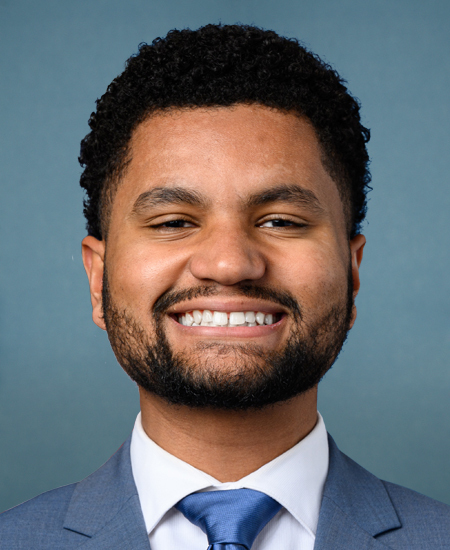
Rep. Maxwell Frost
Sponsored bills
Maddy summaryHR 7179 amends the National Voter Registration Act to allow U.S. Citizenship and Immigration Services (USCIS) field offices to serve as official voter registration agencies for new citizens. It requires USCIS offices to facilitate voter registration applications during naturalization ceremonies, and mandates that courts administering oaths of allegiance must permit this service without charging fees. The bill uses existing immigration fees and grant funds to cover costs for these new registration services. This directly affects new U.S. citizens completing naturalization, making it easier to register to vote at the same time they become citizens.
Maddy summaryHR 7127, the FAIR Act, establishes pay adjustments for federal employees in 2025. It increases base pay by 4% for most federal workers under statutory pay systems and for "prevailing rate" employees (like those in specific geographic areas), while raising locality pay rates by 3.4%. The bill directly affects all federal employees receiving pay under these systems, as it modifies their 2025 salary calculations. These changes are based on statutory formulas under Title 5 of the U.S. Code, with no new policy mechanisms beyond the specified percentage increases. The adjustments apply to pay rates in effect as of the end of fiscal year 2024.
Financial Regulators Revolving Door Enforcement Act This bill places revolving door limitations on certain individuals for two years after they have left employment with (1) specified federal financial regulators, or (2) regulated insured depository institutions or credit unions. First, the bill prohibits certain individuals from employment or consulting positions at specified federal financial regulators for two years. Specifically, this prohibition applies to individuals employed as financial executive officers at an insured depository institution or credit union that, during the last 20 years, was the subject of an official action by that regulator (e.g., was awarded a contract or was the target of an investigation). The bill also prohibits former senior agency employees at specified federal financial regulators from accepting employment from a regulated insured depository institution or credit union for two years. These former employees are also restricted with respect to contacting the regulator on behalf of a third party. These revolving door limitations are lifted two years after holding the qualifying position, however, compliance with specified disclosures is required for five years. Federal financial regulators must annually provide conflict of interest and ethics training to senior employees. The Department of Justice may impose civil penalties for violations under this bill.
Maddy summaryThe ACCESS Act of 2024 creates a federal grant program to help clinics and health care providers expand abortion and reproductive health services in states where abortion is legal (outside of life or health exceptions). It authorizes $200 million annually for fiscal years 2024-2028 to fund specific capacity-building activities, including facility expansions, hiring clinical staff, telehealth services, and culturally appropriate patient resources. Priority is given to providers in states experiencing the highest increases in out-of-state patients seeking abortion care. The bill directly supports health care entities serving patients who travel across state lines for services, aiming to reduce wait times and improve access for vulnerable communities.
Maddy summaryThe Complete Streets Act of 2024 requires states to establish programs that help local governments, transit agencies, and other eligible entities design and build transportation infrastructure accommodating all users, including pedestrians, cyclists, and public transit riders. States must provide technical assistance and grants for complete streets projects, with 5% of certain transportation funds allocated to these programs. The bill establishes design standards requiring features like protected bike lanes, accessible sidewalks, and appropriate lighting for all transportation projects, applying to new projects on Federal-aid highways within metropolitan areas. It mandates that states develop complete streets policies and prioritization plans to improve safety and accessibility, particularly in underserved communities, with compliance required by 2026 or 2029 for different project types.
Maddy summaryHR 7087, the MOMS Act, establishes a pilot program to provide evidence-based mental health support for pregnant and postpartum members of the U.S. Armed Forces and their beneficiaries (including family members). It requires the Defense Health Agency to integrate these prevention programs into existing maternal or pediatric care at military medical facilities, prioritizing diverse locations and removing barriers like childcare access. The bill mandates an advisory committee with military members, experts, and service organizations to guide implementation, along with annual reports tracking participation by demographics and a study on the program’s effectiveness. Funded at $5 million annually from 2025-2029, the pilot aims to reduce perinatal mental health conditions and improve military readiness.
Maddy summaryHR 7056, the Access to Family Building Act, establishes federal rights for individuals to access assisted reproductive technology (ART) like IVF without unreasonable restrictions, directly affecting patients seeking fertility treatments and health care providers offering ART services. The bill prohibits states from imposing limitations on ART that are more burdensome than those for comparable medical procedures, fail to advance safety, or unduly restrict access, while allowing health and safety regulations that are necessary and least restrictive. It creates federal enforcement mechanisms, including lawsuits by the Attorney General or affected individuals to challenge violating state laws, and preempts conflicting state regulations. The bill explicitly preserves state authority over health/safety regulations and does not alter existing state insurance coverage laws for ART.
Maddy summaryThe Stronger Communities through Better Transit Act establishes a new federal grant program to improve public transportation service. It provides funding to urban areas, states, and Indian tribes to cover up to 50% of public transit operating costs (up to 80% in persistent poverty areas and 100% for Indian tribes), with requirements to report on service frequency, access to jobs, and conduct community surveys. The program mandates that a majority of funds must benefit underserved communities and areas of persistent poverty, defined as census tracts with high poverty rates or minority populations. Recipients must maintain their transit funding levels and report on improvements in access to essential services. The bill authorizes $20 billion annually for fiscal years 2024-2027.
Maddy summaryThe Transit Emergency Relief Act (HR 7012) amends federal transportation law to provide more flexible funding for public transit agencies facing emergencies. It allows funds designated for emergency relief (under 49 U.S.C. § 5324) to remain available until spent, be used for prior or current fiscal years, and not reduce existing funding. The bill also increases annual funding caps for transit programs and adds $50 million per year (2024-2027) specifically for this emergency relief program. Public transportation agencies receiving federal grants are directly affected, as the changes simplify access to funds during crises while requiring compliance with labor standards (49 U.S.C. § 5333). This creates more predictable support for transit systems recovering from unexpected disruptions.