

Maddy summaryThis resolution expresses the House of Representatives' sense that the U.S. Postal Service should issue a commemorative stamp honoring Lt. Col. Charity Adams Earley. It specifically directs the Citizens' Stamp Advisory Committee (a USPS entity) to recommend such a stamp to the Postmaster General. The resolution highlights her historic role as the first Black officer in the Women’s Army Corps and her leadership of the 6888th Central Postal Directory Battalion during WWII, which cleared critical mail backlogs in Europe. This is a symbolic measure with no binding effect on USPS policy.
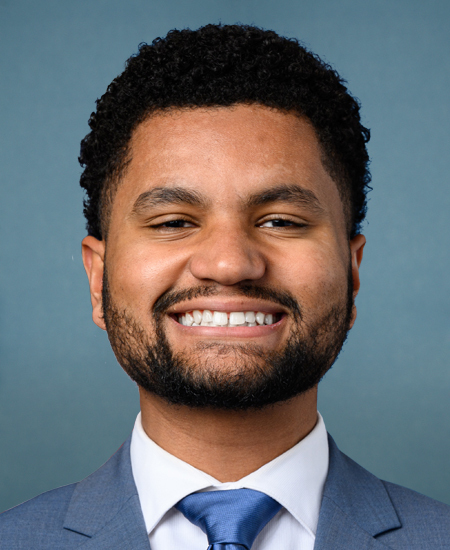
Rep. Maxwell Frost
Sponsored bills
Maddy summaryThe Stop Militarizing Our Streets Act of 2024 restricts the Department of Defense from selling military-grade assault weapons or specific high-capacity ammunition (like .223 Remington and 7.62 NATO) in the commercial marketplace, and prohibits the department from procuring weapons or ammunition from dealers that sell these items commercially. The bill establishes detailed requirements for dealers who want to sell to the government, including mandatory background checks through NICS, security measures, limits on ammunition sales to individuals (500 rounds of covered ammunition or 1,000 rounds of other types in 30 days), and employee training on recognizing straw purchases and preventing illegal sales. Government-owned plants that produce firearms or ammunition for commercial sale must report annual sales data to Congress, including customer locations and revenue. The bill also authorizes the Attorney General to establish licenses for ammunition dealers and allow them to use the NICS background check system. This legislation directly affects the Department of Defense, firearms and ammunition dealers, and government-owned manufacturing facilities.
Maddy summaryHR 9253, the National Gun Violence Research Act, repeals longstanding restrictions that blocked federal funding for gun violence research, including the 1996 Dickey Amendment. It establishes a National Gun Violence Research Program to support scientific studies on gun-related injury and death, with $200 million authorized over six years (2025-2030). The program directs agencies like the CDC, NIH, and National Institute of Justice to fund research, train researchers, develop safety standards, and share gun trace data with researchers through new protocols. This bill directly affects federal research institutions and public health agencies by enabling evidence-based study of gun violence causes and prevention strategies.
Maddy summaryThis bill establishes the Destination Reception Services Program to provide medium-term support to certain immigrants in the U.S., including those granted parole, placed in removal proceedings, or with pending asylum applications. It authorizes $3 billion annually (2025-2028) to fund services like housing assistance, healthcare, job training, legal aid for work authorization/asylum, childcare, and transportation through local government and nonprofit organizations. The program is managed by a federal Board and local community boards that identify high-need areas and allocate funds based on criteria like immigrant population density and service gaps. It explicitly states the program is not an "alternatives to detention" initiative and prioritizes services to help new arrivals achieve self-sufficiency.
Maddy summaryH.J. Res. 193 proposes a constitutional amendment to eliminate legal immunity for federal officials, including the President, from criminal prosecution for actions taken while performing official duties. It also prohibits the President from granting a pardon to themselves. The amendment would apply to all federal officers (such as the President, Vice President, and members of Congress) except for Congress members acting in their legislative role as defined in the Constitution. If ratified by 38 states, this change would become part of the U.S. Constitution, requiring no further congressional action.
Maddy summaryHRES 1375 is a non-binding resolution recognizing extreme weather as a critical threat to children's health and well-being, emphasizing that children face unique vulnerabilities due to their developing bodies, higher exposure to pollutants, and heightened risks during events like heatwaves, wildfires, and poor air quality. It expresses Congress's view that solutions must be developed and deployed rapidly and equitably, with specific attention to children's physical and mental health needs. The resolution suggests concrete measures such as improved air filtration in schools, accessible public alerts for extreme heat, expanded cooling centers, and better infrastructure for child-friendly emergency spaces, though it does not create new laws or mandates.
Maddy summaryHR 9104, the Access to Birth Control Act, requires pharmacies that normally stock contraception to provide birth control or related medications without delay if in stock, or immediately offer alternatives like referrals to other pharmacies or expedited orders if unavailable. It prohibits pharmacists from intimidating customers, misrepresenting availability, breaching confidentiality, or refusing to fill valid prescriptions for birth control. Pharmacies violating these rules face civil penalties up to $1,000 per day or private lawsuits. The law specifically applies to pharmacies that routinely carry contraception and excludes cases where a valid prescription is missing or payment cannot be made. It aims to address documented refusals to dispense birth control, particularly following the Dobbs decision.
Maddy summaryThis bill creates a new FEMA program to fund home energy storage systems (like batteries) for single-family homes affected by disasters. It directs FEMA to provide financial assistance under existing disaster relief laws for qualifying home energy storage systems installed in eligible single-residence structures. Eligible homes include single-family houses or units where less than 50% of the space is non-residential (e.g., a home in a duplex or small apartment building). FEMA must ensure projects are cost-effective for disaster resilience, and the program defines "home energy storage" as systems storing electricity for later use in residential settings. It directly affects homeowners seeking to improve power reliability after disasters.
Maddy summaryThe Environmental Health in Prisons Act requires federal, state, local, and tribal carceral facilities to monitor and publicly report on environmental conditions including air quality, water quality, noise levels, and exposure to hazards like mold, pests, and extreme temperatures. It mandates that facilities provide clear, accessible information about environmental health risks to both incarcerated people and staff, and establishes a grant program to help state and tribal facilities improve environmental conditions through infrastructure upgrades and health-focused programs. The bill also creates an advisory panel including public health experts and formerly incarcerated people, and prohibits retaliation against individuals who report environmental health concerns or participate in monitoring efforts.
Maddy summaryThis bill allows individuals to deduct auto insurance payments for household members from their income when applying for federal or state assistance programs like SNAP or Medicaid. It directly affects people seeking benefits by reducing their calculated income, potentially making them eligible for more aid. The deduction applies to payments made for passenger vehicles registered under state law, covering all household members. This change modifies how income is calculated for eligibility, without altering the benefits themselves.