

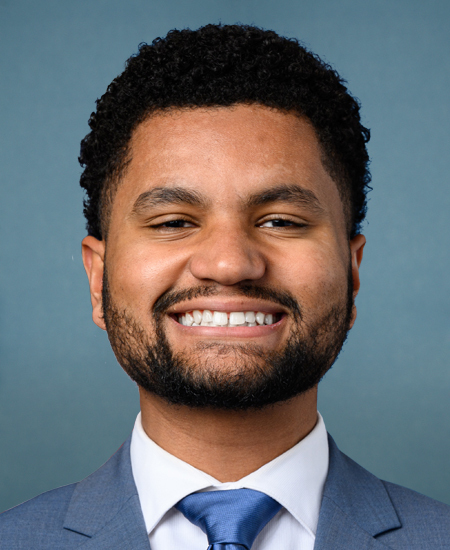
Photo of Maxwell Frost
D United States House · District 10 · Florida On the 2026 ballot

Rep. Maxwell Frost

Compare
Total votes
1,879
all sessions
Attendance
99%
15 missed
Higher than 85% of chamber peers
With party
95%
of cast votes
Near the chamber average
Bipartisan score
3%
crosses aisle rarely
Near the chamber average
Sponsored
1,065
bills & resolutions
Higher than 84% of chamber peers
Committees
7
assignments
1,065 bills and resolutions

Sponsored bills

Total
1,065
Primary
47
Co-sponsor
1,018
This page
1,065
matching current filters
Co-sponsor HR 2059
In committee · United States House · Co-sponsor
To prohibit the issuance of licenses for the exportation of certain defense articles to the United Arab Emirates, and for other purposes.

Maddy summaryThis bill blocks new U.S. defense export licenses to the United Arab Emirates (UAE) or its government agencies. It prohibits the export of specific military equipment (listed in U.S. regulations) until the President certifies the UAE is not supplying military aid to Sudan's Rapid Support Forces. The restriction applies to defense articles covered under U.S. export rules, including weapons and related technology. The bill directly affects U.S. defense exporters and the UAE government's ability to obtain new military equipment from the U.S.

In committee Mar 11, 2025 1 co-sponsor
Co-sponsor HR 2086
In committee · United States House · Co-sponsor
Rights for the TSA Workforce Act

Maddy summaryThis bill requires the Transportation Security Administration (TSA) to transition its workforce from a special personnel management system to the standard federal personnel system under Title 5 of the U.S. Code by December 31, 2025. It protects TSA employees by ensuring no reduction in pay, benefits, or retirement rights during the transition, while preserving collective bargaining rights for screening agents. The legislation also mandates consultation with labor unions during the process and requires several reports on workforce issues including recruitment, harassment policies, and workplace safety.

In committee Mar 11, 2025 1 co-sponsor
Co-sponsor HR 2045
In committee · United States House · Co-sponsor
Medicare Dental, Vision, and Hearing Benefit Act of 2025

Maddy summaryThis bill would expand Medicare to cover dental, vision, and hearing services for beneficiaries 65 and older (and some younger people with disabilities), effective January 1, 2026. It would provide 100% coverage for preventative dental services in 2026, with basic and major dental services gradually increasing to 80% coverage by 2029. Vision benefits would include 80% coverage for annual eye exams and specific limits on eyeglasses, frames, and contact lenses ($100 per year for lenses, $100 every two years for frames, $200 every two years for contacts). Hearing services would include 80% coverage for hearing exams and hearing aids, with a limit of one hearing aid per ear every 48 months. The bill also adds oral health professionals to the United States Preventive Services Task Force to help guide coverage decisions.

In committee Mar 11, 2025 1 co-sponsor
Co-sponsor HR 2021
In committee · United States House · Co-sponsor
American Teacher Act

American Teacher Act This bill establishes grants to increase the minimum salary of public elementary and secondary school teachers. It also authorizes a national campaign regarding the value of the teaching profession. First, the bill directs the Department of Education (ED) to award four-year grants to state educational agencies (SEAs) and, through them, subgrants to local educational agencies to establish a minimum annual salary of $60,000 (to be adjusted annually for inflation) for these teachers. Second, the bill directs ED to award grants to eligible SEAs to provide cost-of-living adjustments to the annual base salary of teachers. Finally, the bill authorizes ED to carry out a national campaign to (1) increase awareness about the importance of teachers and the value of the teaching profession, (2) encourage secondary school and college students to consider teaching as a professional career, and (3) diversify the pool of individuals who enter the teaching profession.

In committee Mar 10, 2025 1 co-sponsor
Co-sponsor HR 1950
In committee · United States House · Co-sponsor
Protect Social Security and Medicare Act

Maddy summaryHR 1950, the Protect Social Security and Medicare Act, requires a two-thirds vote in both the House and Senate to consider any bill or amendment that would reduce Social Security or Medicare benefits administered by the Social Security Administration (SSA) or Centers for Medicare & Medicaid Services (CMS). This rule applies directly to lawmakers who would need supermajority support to advance proposals affecting these programs. An exception allows changes to Medicare Advantage plan payments if offset by increased payments elsewhere in Medicare. Determinations about whether a provision reduces benefits are made solely by the SSA's Office of the Chief Actuary during legislative consideration.

In committee Mar 6, 2025 1 co-sponsor
Co-sponsor HR 1918
In committee · United States House · Co-sponsor
Farewell to Foam Act of 2025

Maddy summaryHR 1918, the Farewell to Foam Act of 2025, prohibits the sale of most foam food containers, packaging peanuts, and foam coolers starting January 1, 2028. It directly affects restaurants, grocery stores, food vendors, manufacturers, and retailers who sell these items, excluding medical coolers used for drugs or medical products. The bill imposes escalating civil penalties for violations: $250 for the second offense, $500 for the third, and $1,000 for fourth or subsequent violations, with reduced penalties for small businesses under specific revenue thresholds. Enforcement is led by the EPA Administrator, with states allowed to enforce under federal guidelines.

In committee Mar 6, 2025 1 co-sponsor
Co-sponsor HR 1954
In committee · United States House · Co-sponsor
Do No Harm Act

Maddy summaryHR 1954, the "Do No Harm Act," amends the Religious Freedom Restoration Act (RFRA) to clarify that RFRA does not override specific federal laws protecting against harm. It explicitly exempts provisions related to anti-discrimination (like the Civil Rights Act), workplace protections (wages, leave, collective activity), child safety, and healthcare access from RFRA's requirements. The bill ensures RFRA cannot be used to challenge government programs or contracts that provide these essential protections. It also clarifies that RFRA applies only to disputes involving government as a party, not private disputes between individuals. This change preserves existing legal safeguards while modifying RFRA's scope.

In committee Mar 6, 2025 1 co-sponsor
Co-sponsor HR 1877
In committee · United States House · Co-sponsor
Protecting Americans’ Social Security Data Act

Protecting Americans’ Social Security Data Act This bill prohibits political appointees and special government employees from accessing Social Security data systems that contain personally identifiable information about Social Security beneficiaries. Specifically, political appointees and special government employees may not access systems maintained by the Social Security Administration (SSA) that issue or record Social Security account numbers, that are used to determine eligibility for or to pay Social Security benefits, or that otherwise contain personally identifiable information about individuals receiving or applying for benefits.  The bill also establishes a civil right of action for an individual whose information was negligently accessed or disclosed in violation of these provisions. The individual may bring suit against the United States if the violator was a U.S. employee or officer, or against the violator if they were not a U.S. employee or officer. Such a claim must be brought within two years of the affected individual’s discovery of the violation. Upon a finding of liability, defendants are liable for specified monetary damages.  If an individual is criminally charged or subject to proposed disciplinary or adverse action by a federal or state agency for having accessed or disclosed information in violation of these provisions, SSA must notify the individual whose information was accessed or disclosed of the violation as soon as practicable.  Finally, the bill requires the SSA Office of the Inspector General to investigate and report to Congress on any unauthorized access to or disclosure of information in a beneficiary data system.

In committee Mar 5, 2025 1 co-sponsor
Co-sponsor HR 14
In committee · United States House · Co-sponsor
John R. Lewis Voting Rights Advancement Act of 2025

Maddy summaryThis bill strengthens the Voting Rights Act of 1965 by clarifying how to prove voting discrimination and expanding requirements for preclearance of voting changes. It establishes new standards for determining when voting practices dilute minority voting strength or deny/abridge voting rights, requiring plaintiffs to show specific conditions for vote dilution claims and including factors like historical discrimination and racial polarization in court analyses. The bill modifies the criteria for determining which states and political subdivisions must seek preclearance for voting changes, and adds new transparency requirements for jurisdictions to publicly disclose changes to voting qualifications, polling locations, and election districts. It directly affects states and local governments that implement voting policies, particularly those with a history of voting rights violations or that make changes to voting qualifications, procedures, or district boundaries. The bill aims to prevent discriminatory voting practices by providing clearer standards for courts and requiring greater transparency in voting rule changes.

In committee Mar 5, 2025 1 co-sponsor
Co-sponsor HR 20
In committee · United States House · Co-sponsor
Richard L. Trumka Protecting the Right to Organize Act of 2025

Maddy summaryThe Richard L. Trumka Protecting the Right to Organize Act of 2025 strengthens workers' organizing rights by making it an unfair labor practice for employers to threaten permanent replacement of striking workers, discriminate against workers who support unions, or require employees to attend employer campaigns unrelated to their job duties. It expands the definition of "employee" to make it harder for companies to classify workers as independent contractors and requires employers to post notices about workers' rights in conspicuous locations. The bill establishes a new electronic voting system for union elections, creates a 90-day bargaining period before mediation can be requested, and increases penalties for violations of labor laws. These changes are intended to make it easier for workers to form unions and negotiate better wages and working conditions.

In committee Mar 5, 2025 1 co-sponsor
Showing 441 to 450 of 1,065 bills
Previous 1 … 44 45 46 … 107 Next