

Maddy summaryHR 3532, the Striking and Locked Out Workers Healthcare Protection Act, prohibits employers from terminating or altering an employee’s employer-sponsored health coverage during a lawful strike or a lockout (when an employer withholds work to influence bargaining). It directly affects workers participating in strikes or facing lockouts, ensuring continued healthcare access during these labor disputes. The bill adds penalties: $75,000 per violation for lockout-related coverage termination (up to $150,000 for repeat offenses), and $50,000 per violation for strike-related termination (up to $100,000 for repeat offenses), with penalties applied alongside other remedies. These provisions amend the National Labor Relations Act to protect workers’ healthcare rights during collective bargaining actions.
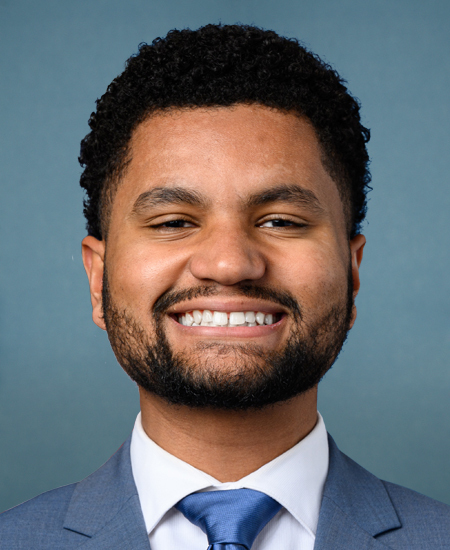
Rep. Maxwell Frost
Sponsored bills
Maddy summaryThis bill establishes a code of conduct for Supreme Court justices, requiring them to disclose gifts, income, and potential conflicts of interest. It creates a formal process for handling complaints about justices, including a judicial investigation panel to review allegations. The bill adds specific circumstances requiring recusal, such as when a justice or family member has financial ties to a party in a case. Additionally, it mandates that parties and amicus briefs disclose any gifts given to justices and lobbying activities related to their nomination. These provisions aim to increase transparency and accountability in the Supreme Court's operations.
Stronger Communities through Better Transit Act This bill requires the Department of Transportation (DOT) to establish a grant program to support operating projects for public transportation and related service improvements, particularly in underserved communities and areas of persistent poverty. Specifically, the bill requires DOT to allocate funding under the program for urbanized areas, states, and Indian tribes that are recipients of funds under either the Federal Transit Administration's (FTA's) Urbanized Area Formula Funding program or Formula Grants for Rural Areas program. Eligible recipients may use funding for operating costs associated with projects that improve public transportation service for transit-dependent populations and support increased transit ridership (e.g., service expansion, information technology enhancements, and workforce development). DOT must apportion the funding so that recipients receive funds that are proportional to their share of operating costs. The bill also provides for an increased federal cost share for operating assistance for projects or programs carried out in areas of persistent poverty or underserved communities. DOT must set up a multimodal access measurement interface for public agencies to aid transit agencies in determining and reporting on access to jobs and essential services. A grant recipient must (1) report specific information to the FTA for inclusion in the National Transit Database, and (2) survey transit riders and non-riding residents regarding transit service improvements. Further, the bill expands the purposes of the public transportation programs to include supporting public transportation's role in combating climate change through growing/retaining transit ridership.
SNAP Administrator Retention Act of 2025 This bill directs the Food and Nutrition Service (FNS) to pay Supplemental Nutrition Assistance Program (SNAP) state agencies for 100% of SNAP administrative personnel costs. The bill also requires that state SNAP agency administrators be paid at least the same amount as federal employees. (Under current law, FNS generally pays 50% of a state's administrative costs for SNAP.) Specifically, FNS must pay a state agency for 100% of all SNAP administrative personnel costs that are part of an FNS-approved state agency personnel wage plan. This must include all costs associated with hiring and training new employees, maintaining those personnel costs, and complying with wage standards. The state agency must use these funds (1) to supplement, not supplant, nonfederal funds used for existing administrative personnel costs; and (2) for existing or additional full-time positions that are above the number of positions that were held in FY2024. The bill also requires that the wage standards for SNAP state agency administrators be (1) at least the same amount as the General Schedule (GS) pay rate for federal employees; and (2) updated annually based on any increase in the GS pay rate, including locality adjustments.
Maddy summaryHRES 410 is a non-binding House resolution requiring President Trump to comply with the Constitution’s Foreign Emoluments Clause regarding a $400 million Boeing 747-8 jet gift from Qatar’s royal family. It directs the President to immediately submit all plans for the aircraft to Congress and obtain explicit congressional consent before accepting it, as required by the Constitution. The resolution cites historical precedent where all prior presidents sought Congress’s approval for foreign gifts, including items like medals, horses, and the Statue of Liberty. It emphasizes that accepting the jet without consent would violate the Constitution and pose national security risks. The bill focuses solely on procedural compliance, not the merits of the gift itself.
Maddy summaryThis bill establishes minimum nurse-to-patient ratios for hospital units across the country, requiring hospitals to maintain specific staffing levels (such as 1:1 in trauma units, 2:1 in critical care units, and 3:1 in emergency rooms) to improve patient safety and quality of care. Hospitals must develop transparent staffing plans that account for patient acuity, involve direct care nurses in planning, and document actual staffing levels for each shift. The bill includes strong whistleblower protections for nurses who object to unsafe staffing levels and prohibits hospitals from retaliating against nurses who report violations. It requires hospitals to comply with these standards as a condition for receiving Medicare and Medicaid payments, with enforcement through audits and civil penalties of up to $50,000 for repeated violations. The bill also includes provisions to support nurse recruitment and retention through workforce initiatives and training programs.
Maddy summaryHR 3368, the "Born in the USA Act of 2025," prohibits federal funding for Executive Order 14160 (which aimed to restrict birthright citizenship for children born in the U.S.). The bill directly affects federal agencies that might implement the executive order by blocking their use of funds for that purpose. Its key provision is a funding ban targeting the executive order and any similar future policies, without changing citizenship law. The bill does not alter birthright citizenship rights but prevents federal resources from being used to enforce the controversial executive order. It is a procedural measure focused on funding, not a substantive policy change to citizenship rules.
Maddy summaryHR 3376 creates the Water Affordability, Transparency, Equity, and Reliability Trust Fund, funded by increasing the corporate tax rate from 21% to 24.5% starting in 2025, with annual funding capped at $35 billion or 1/20th of 20-year infrastructure needs. The bill allocates funds to clean water programs (42%), safe drinking water programs (42.5%), household water well systems (1%), colonias assistance (0.5%), and Indian health services (3%), requiring specific prioritization of low-income and minority communities for many programs. It mandates an EPA study on water affordability, discriminatory practices, and civil rights violations in water service, including data collection on service disconnections affecting vulnerable populations. The bill also includes provisions for lead service line replacement, PFAS contamination response, and job training grants for water system operators with specific requirements to prioritize low-income communities.
Maddy summaryHRES 403 is a non-binding resolution expressing the House of Representatives' support for public servants. It commends federal, state, local, and uniformed service employees for their contributions during Public Service Recognition Week (May 4-10, 2025) and throughout the year. The resolution highlights their roles in areas like national defense, emergency response, Social Security, public health, and infrastructure. It urges the House to salute their dedication, honor those who lost their lives in service, and encourage promoting public service careers. This resolution does not create new policies or funding - it is a symbolic gesture of recognition.
Maddy summaryHR 3277, the Ensuring Lasting Smiles Act, requires group health plans and health insurance issuers to cover medically necessary outpatient and inpatient treatments for congenital anomalies or birth defects primarily affecting the eyes, ears, teeth, mouth, or jaw. This includes reconstructive procedures, dental/orthodontic support during treatment, and follow-up care, but excludes purely cosmetic surgery not tied to a medical diagnosis. Cost-sharing (like copays) for these services must not be stricter than for other medical benefits. The law takes effect for plan years beginning January 1, 2026, and mandates insurers to provide notice about this coverage to beneficiaries.