

Maddy summaryThis bill requires Medicare Advantage plans to have average monthly payments from the government that don't exceed the average cost of original Medicare (Parts A and B) for the same year. If a plan's payments exceed this cost, the government cannot allow new enrollments or re-enrollments in that plan for the following year. It directly affects Medicare Advantage plans and their enrollees, creating a financial check on plan pricing. An exception applies to specialized Medicare Advantage plans designed for individuals with specific health needs. The provision takes effect one year after the bill's enactment.
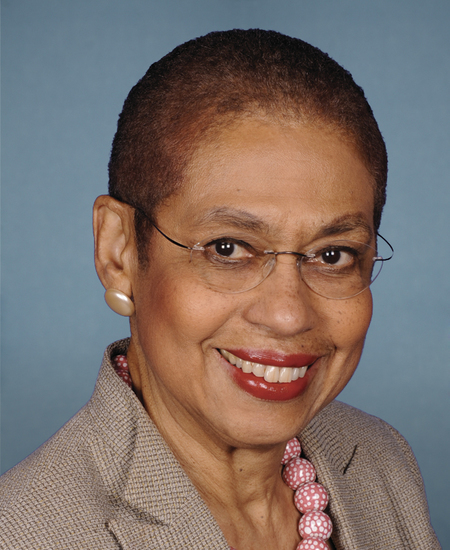
Rep. Eleanor Holmes Norton
Sponsored bills
Maddy summaryThis bill (HR 6115) requires the U.S. Department of Health and Human Services to create and maintain a website for Medicare beneficiaries. The website would allow current and prospective Medicare users to search for healthcare providers participating in either Medicare Advantage (MA) plans or traditional Medicare (Parts A and B). Key features include searching for providers by name or location and identifying which providers are in each plan's network. The website must be operational within one year of the bill's enactment. This directly affects millions of Medicare beneficiaries seeking clear information about provider availability.
Closing Loopholes for Oil and other Sources of Emissions Act or the CLOSE Act This bill amends the Clean Air Act to revise requirements for hazardous air pollutants. Specifically, the bill allows (1) emissions from oil or gas exploration or production wells and emissions from pipeline compressors or pump stations to be aggregated with emissions from other similar sources and regulated as a major source of toxic air pollutants, (2) emissions from those wells to be aggregated for purposes of emissions standards for hazardous air pollutants, and (3) emissions from oil or gas production wells to be regulated as an area source of toxic air pollutants. The Environmental Protection Agency must (1) issue a final rule adding hydrogen sulfide to the list of hazardous air pollutants; and (2) revise the list of air pollution sources within 365 days after issuing the rule to include categories and subcategories of major sources and area sources of hydrogen sulfide, including oil and gas wells.
Maddy summaryThe NEST Act (HR 6096) requires the federal government to provide newborn supply kits to new mothers, focusing on low-income families and communities with high maternal health risks. These kits include essential items like diapers, postpartum pads, breastfeeding supplies, blood pressure monitors, and health information resources. Funds for the kits come from a $5 million annual set-aside in Social Security Act funding, distributed through grants to community health centers, tribal organizations, and hospitals. Priority is given to rural areas, maternity care deserts, and mothers earning below 185% of the poverty line. The program mandates annual reporting on distribution demographics and health outcomes to Congress.
Maddy summaryThis bill creates a federal grant program to help communities near rail lines address train-related impacts on homes. It authorizes $100 million annually (2026-2030) for grants to states, local governments, rail carriers, or other eligible entities to design or build physical barriers between rail lines and residential areas. These barriers aim to reduce damage from derailments, noise, and vibrations affecting homeowners. The program directly supports residents living adjacent to rail corridors who face these specific disruptions.
Maddy summaryHRES 877 is a non-binding resolution expressing the U.S. House of Representatives' support for designating November as "Prematurity Awareness Month." It does not create new laws or allocate funds but calls on the public, interest groups, and communities to observe the month through events, promote awareness, and support preterm birth prevention programs. The resolution references statistics on preterm birth rates (over 370,000 babies born preterm in 2022) and health disparities, but its core action is symbolic advocacy. It directly affects the public by encouraging community engagement in awareness efforts during November. This resolution is procedural, focusing solely on recognition, not policy change.
Maddy summaryHR 6049, the No Payola Act, repeals a requirement that Senate staff notify the Senate when legal process seeks to disclose Senate data. It also requires Senators who received funds from private lawsuits under the repealed provision to repay those funds to the Treasury. The bill directly affects Senators who might have been involved in legal cases related to the repealed notification rules. This is a procedural change eliminating specific reporting obligations and financial penalties for certain Senate-related legal actions.
Maddy summaryHR 6056, the International Human Rights Defense Act of 2025, establishes a permanent Special Envoy at the State Department to lead U.S. foreign policy efforts addressing discrimination and violence against LGBTQI+ people globally. The bill requires the U.S. government to develop and update a biannual global strategy to prevent criminalization and violence against LGBTQI+ individuals, mandate detailed reporting on such abuses in annual country reports, and ensure all U.S. foreign assistance programs include inclusive nondiscrimination policies. This legislation directly affects U.S. foreign policy implementation, federal agencies receiving funding, and LGBTQI+ communities facing persecution worldwide. The bill aims to coordinate U.S. government efforts across departments and with international partners to advance LGBTQI+ rights globally through concrete policy mechanisms.
Maddy summaryHR 6066, the CARE Act of 2025, strengthens child labor protections for children working in agriculture. It raises the minimum age for non-family farm work from 14 to 16 years, eliminates existing exemptions for hand-harvest labor, and prohibits children under 18 from handling pesticides. The bill increases civil penalties for violations (up to $60,115 for serious harm/death) and imposes new employer reporting requirements for child injuries, illnesses, or deaths in farm work. It also mandates annual reports to Congress on child farmworker injuries, using data from labor and health agencies.
Maddy summaryHR 6011, the VA Work-Study Improvement Act, expands opportunities for veterans and military members participating in the VA's work-study program. It allows them to work on activities with state/local governments or nonprofits that benefit veterans (e.g., community service or job training), and sets a new wage standard requiring payments to be the highest of federal employee rates, state minimum wage, or local minimum wage. The bill also requires electronic tracking of work hours and annual public reporting on program participation, including demographics, wages, hours worked, and participating schools. These changes apply to work-study payments made on or after January 1, 2028.