

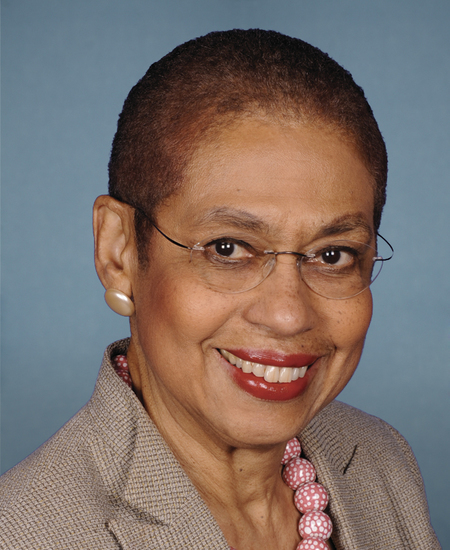
Photo of Eleanor Holmes Norton
D United States House · District At-Large · District of Columbia

Rep. Eleanor Holmes Norton

Compare
Total votes
637
all sessions
Attendance
99%
8 missed
Lower than 91% of chamber peers
With party
98%
of cast votes
Near the chamber average
Bipartisan score
2%
crosses aisle rarely
Near the chamber average
Sponsored
6,183
bills & resolutions
Higher than 99% of chamber peers
Committees
7
assignments
6,183 bills and resolutions

Sponsored bills

Total
6,183
Primary
374
Co-sponsor
5,809
This page
6,183
matching current filters
Co-sponsor HR 7341
In committee · United States House · Co-sponsor
GRAD Act

Maddy summaryThis bill creates new funding eligibility for Historically Black Colleges and Universities (HBCUs) and Predominantly Black Institutions (PBIs) that offer approved master's degree programs. It amends existing law to add specific categories (subsections S for HBCUs and F for PBIs) allowing these institutions to access federal funds previously restricted to certain program types. The key mechanism expands funding access by adjusting how remaining funds are allocated after initial disbursements. Directly affects qualifying HBCUs and PBIs meeting both the institution type and master's program criteria.

In committee Feb 4, 2026 1 co-sponsor
Co-sponsor HR 7375
In committee · United States House · Co-sponsor
End Prison Gerrymandering Act

Maddy summaryHR 7375, the End Prison Gerrymandering Act, changes how incarcerated individuals are counted in the U.S. Census starting with the 2030 census. It requires the Census Bureau to count people in prison at their last known residence before incarceration, rather than at the prison location. This directly affects incarcerated individuals and their home communities, ensuring these communities are accurately represented in congressional redistricting. States must then use this home address data when drawing congressional districts, preventing prison populations from artificially inflating representation in rural areas where prisons are often located.

In committee Feb 4, 2026 1 co-sponsor
Co-sponsor HR 7340
In committee · United States House · Co-sponsor
Rebuild America’s Schools Act of 2026

Maddy summaryThe Rebuild America's Schools Act of 2026 authorizes $20 billion annually from 2027 to 2031 to improve public school facilities nationwide. The bill provides grants to states to fund school construction, renovation, and modernization projects that focus on safety, energy efficiency, and accessibility, with priority given to schools serving high percentages of students eligible for free or reduced-price lunch. Funds cannot be used for routine maintenance, athletic facilities, or vehicles, and must meet specific environmental, safety, and energy efficiency standards. The bill also includes specific provisions for repairing school foundations affected by pyrrhotite, a mineral that causes concrete deterioration, and requires use of American-made materials for construction projects.

In committee Feb 4, 2026 1 co-sponsor
Co-sponsor HR 7384
In committee · United States House · Co-sponsor
Preventing Mass Casualties from Release of Hydrofluoric Acid at Refineries Act of 2026

Maddy summaryThis bill prohibits petroleum refineries from using hydrofluoric acid (HF) for gasoline production. New refineries cannot use HF after the law takes effect, and existing refineries must switch to safer alternatives within 5 years. Refineries that fail to comply face a $37,500 civil penalty per violation, and the law blocks waivers for this requirement. The measure targets 40 refineries using HF - potentially exposing 14 million nearby residents to severe health risks - and mandates adoption of commercially available, safer refining methods already used in most U.S. refineries.

In committee Feb 4, 2026 1 co-sponsor
Co-sponsor HR 7346
In committee · United States House · Co-sponsor
Drain ICE Act of 2026

Maddy summaryHR 7346, the Drain ICE Act of 2026, repeals specific funding provisions (sections 90003 and 100052) from the "One Big Beautiful Bill Act" and cancels all unspent funds allocated under those sections. This bill directly affects ICE’s detention budget by removing existing financial authority for detention operations. It does not change immigration enforcement practices or directly impact individuals; it solely modifies budgetary allocations. The bill focuses on eliminating funding mechanisms, not on policy changes for migrants or enforcement. (Procedural bill; summary limited to 2 sentences as specified.)

In committee Feb 4, 2026 1 co-sponsor
Co-sponsor HR 7335
In committee · United States House · Co-sponsor
Humanitarian Standards for Individuals in ICE and CBP Custody Act

Maddy summaryHR 7335 establishes comprehensive humanitarian standards for individuals held in U.S. Immigration and Customs Enforcement (ICE) and U.S. Customs and Border Protection (CBP) custody. The bill requires facilities to provide immediate health screenings within 12 hours (6 hours for high-risk individuals like children, pregnant people, or those with medical conditions), ensure access to adequate water, sanitation, food (with 2,000+ calories daily for adults), and age-appropriate shelter. It mandates specific facility standards including separate housing for males and females, accessible accommodations for people with disabilities, daily outdoor access for those detained over 48 hours, and proper medical equipment and personnel on-site. The bill also requires regular inspections, staff training on humanitarian protocols, and public reporting of sexual abuse complaints. These standards directly affect all individuals detained by ICE or CBP, with special protections for vulnerable groups like children, pregnant people, and those with medical needs.

In committee Feb 4, 2026 1 co-sponsor
Co-sponsor HR 7265
In committee · United States House · Co-sponsor
Vote by Mail Tracking Act

Maddy summaryHR 7265, the Vote by Mail Tracking Act, requires all government entities sending mail-in ballots for federal elections to use a standardized Postal Service barcode on ballot envelopes. This barcode enables tracking of each individual ballot, while also mandating specific envelope designs and machineability standards set by the Postal Service. The bill applies to all mail-in ballots for federal office elections starting in 2026, but excludes Federal write-in absentee ballots under the Uniformed and Overseas Citizens Absentee Voting Act. The Postmaster General must provide compliance guidance to government entities by June each year to implement the tracking system.

In committee Feb 4, 2026 1 co-sponsor
Co-sponsor HR 5658
In committee · United States House · Co-sponsor
Child Care for Every Community Act

Maddy summaryHR 5658, the Child Care for Every Community Act, establishes a federal framework to create universal, high-quality child care and early learning programs available to all young children not yet required to attend school. The bill requires that covered children (children below compulsory school age) be entitled to participate in these programs, with no fees for low-income families and sliding-scale fees for others based on family income. Key provisions include requiring full-working-day, full-calendar-year care; setting national quality standards for staff qualifications and facilities; mandating comprehensive services including health, nutrition, and family support; and requiring coordination with schools to support children's transitions to kindergarten. The bill directly affects families seeking child care, child care providers, and local communities that would administer these programs through designated "prime sponsors."

In committee Feb 4, 2026 1 co-sponsor
Co-sponsor HR 7324
In committee · United States House · Co-sponsor
More Behavioral Health Providers Act of 2026

Maddy summaryThis bill expands Medicare incentives to increase mental health and substance use disorder care in underserved areas. It adds a 15% bonus payment to Medicare for specific mental health and substance use services provided by qualified non-physician providers (like clinical social workers, psychologists, and counselors) in designated "mental health professional shortage areas." The bonus applies to services furnished on or after January 1, 2027, directly benefiting Medicare beneficiaries in these areas and encouraging more providers to work there. The change modifies existing Medicare payment rules to include these new provider types and service categories.

In committee Feb 3, 2026 1 co-sponsor
Co-sponsor HR 7333
In committee · United States House · Co-sponsor
Family Violence Prevention and Services Improvement Act of 2026

Maddy summaryThe Family Violence Prevention and Services Improvement Act of 2026 amends federal law to enhance support for victims of family violence, domestic violence, and dating violence. The bill authorizes $270 million annually for fiscal years 2027-2031 to fund state, tribal, and community programs, with specific funding reserved for tribal programs (12.5%), national hotlines ($20.5 million for general hotline, $4 million for Indian hotline), and services for underserved populations. It requires grantees to provide trauma-informed, culturally appropriate services while prohibiting discrimination and protecting victim confidentiality, and mandates accessibility for people with disabilities and limited English proficiency. The bill also establishes new technical assistance centers, Tribal resource centers, and community-based prevention programs to address the needs of underserved populations including Native Hawaiians, Alaska Natives, and racial and ethnic minorities.

In committee Feb 3, 2026 1 co-sponsor
Showing 681 to 690 of 6,183 bills
Previous 1 … 68 69 70 … 619 Next