Brandon Act This bill modifies the regulatory requirement for referrals by commanding officers and supervisors of members of the Armed Forces for mental health evaluations. Specifically, the regulations must (1) establish a phrase that enables the member to trigger a referral for a mental health evaluation, (2) require a commanding officer or supervisor to make such referrals as soon as practicable following disclosure by the member of the established phrase, and (3) ensure that the process protects the confidentiality of the member.
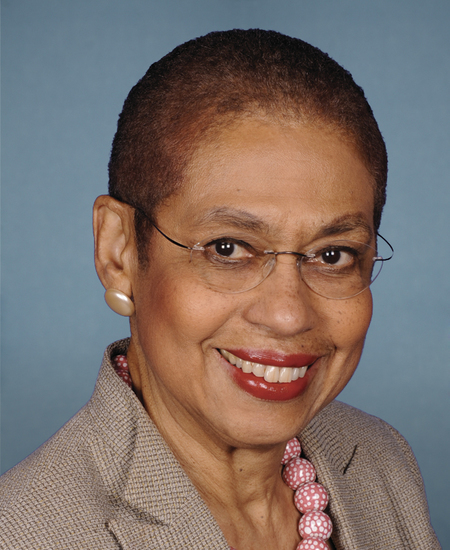
Rep. Eleanor Holmes Norton
Sponsored bills
Pell Grant Preservation and Expansion Act of 2021 This bill makes various changes to the Federal Pell Grant program, including by expanding student eligibility for Pell Grants. The bill also revises student eligibility for federal student-aid programs. Specifically, the bill provides funding to increase the maximum Pell Grant award for each eligible student. Further, the bill requires the award amount to be adjusted for inflation. Next, the bill allows students who receive means-tested federal benefits (e.g., Medicaid) to automatically qualify for the maximum Pell Grant award plus an additional award amount. In addition, the bill moves the Iraq and Afghanistan Service Grant program into the Pell Grant program. Next, the bill raises from 12 to 18 the total number of semesters during which a student may receive a Pell Grant. The bill makes Dreamer students (i.e., students who have been granted Deferred Action for Childhood Arrivals status) who entered the United States before the age of 18 and who meet certain educational criteria eligible for federal financial aid. The bill also revises satisfactory academic progress requirements for federal student-aid programs, including by allowing a student who has not been enrolled in an institution of higher education for two years to regain eligibility for federal student aid.
Coordination, Accountability, Research, and Equity for All Kidneys Act of 2021 or the CARE for All Kidneys Act of 2021 This bill requires multiple agencies to address kidney disease, with a focus on minority, rural, and other underserved populations that are disproportionately affected by the disease. First, the Department of Health and Human Services (HHS) must study patterns of care for kidney disease provided through certain health insurance providers. Second, HHS's Office of the Assistant Secretary for Health must (1) create a plan to address kidney disease, (2) develop a pilot program for best practices to diagnose and manage the disease, and (3) report annually on the impact of a Medicare model that encourages greater use of home dialysis and kidney transplants. Third, the National Institutes of Health must expand research on kidney disease. This includes research on the causes of lower rates of, and interventions to increase, kidney transplants among underserved populations. Fourth, the National Institute of Diabetes and Digestive and Kidney Diseases must conduct an awareness campaign and work with the Centers for Disease Control and Prevention (CDC) to evaluate data collection concerning kidney disease. Fifth, the CDC must award grants for public health interventions to reduce the burden of kidney disease and undertake activities to identify and address environmental and occupational causes of kidney disease. Last, the bill makes kidney disease specialists eligible for the National Health Service Corps (NHSC). The NHSC provides scholarships and student loan repayment awards to health care providers who agree to work in areas with shortages of primary care, mental health, and dental providers.

Shark Fin Sales Elimination Act of 20 21 This bill addresses the sale of shark fins and the inclusion of rays and skates in the Seafood Traceability Program. The Seafood Traceability Program has data reporting and recordkeeping requirements at the time of entry for imported fish or fish products entered into U.S. commerce. The bill makes it illegal to possess, buy, or sell shark fins or any product containing shark fins, except for certain dogfish fins. A person may possess a shark fin that was lawfully taken consistent with a license or permit under certain circumstances. Penalties are imposed for violations under the Magnuson-Stevens Fishery Conservation and Management Act. The Department of Commerce must revise its regulations to include rays and skates as species that are subject to the Seafood Traceability Program.
Pittman-Robertson Wildlife Restoration Act and Dingell-Johnson Sport Fish Restoration Act District of Columbia Equality Act of 2021 This bill treats the District of Columbia as a state with respect to receiving federal funds for management and restoration of approved wildlife projects and for fish restoration and management projects.
Helping Homeless Veterans Act of 2021 This bill permanently extends the following Department of Veterans Affairs programs and services: homeless veterans reintegration programs, financial assistance for supportive services for very low-income veteran families in permanent housing, a grant program for homeless veterans with special needs, treatment and rehabilitation for seriously mentally ill and homeless veterans, housing assistance for homeless veterans, and the Advisory Committee on Homeless Veterans.
Michael Lecik Military Firefighters Protection Act This bill establishes a presumption of service-connection for specified diseases becoming manifest in certain veterans to a degree of disability of 10% or more within 15 years of the veteran's separation from active military, naval, or air service. Under a presumption of service-connection, specific diseases or disabilities diagnosed in certain veterans are presumed to have been caused by the circumstances of their military service. Health care benefits and disability compensation may then be awarded. Veterans addressed by this bill are those who (1) are trained in fire suppression, and (2) served on active duty in a military occupational specialty or career field with a primary responsibility of firefighting or damage control for at least five years in the aggregate.
Federal Building Clean Jobs Act of 2021 This bill establishes additional energy-efficiency requirements and programs for federal buildings, with a particular focus on reducing energy and water consumption and greenhouse gas emissions by FY2030 through partnerships with the private sector. Specifically, the bill requires federal agencies to reduce the following for their facilities by FY2030: average building energy intensity (by at least 25%, relative to FY2018); average potable water consumption intensity (by 54%, relative to FY2007); industrial, landscaping, and agricultural water consumption (by 20%, relative to FY2018); and specified categories of greenhouse gas emissions (by at least 40%, relative to FY2018). Federal agencies must also implement retrofit projects that reduce the energy consumption of their facilities by at least 35%. Additionally, the General Services Administration, the Department of Defense, the Department of Homeland Security, and the Department of Veterans Affairs must develop plans that ensure that at least 50% of certain facilities offer zero-emission vehicle charging or fueling by December 31, 2030. The bill directs agencies to work with the private sector through partnerships and financing opportunities in order to implement the bill's requirements. The bill also makes several other changes relating to federal building standards and related authorities, including (1) requiring lessors (i.e., property owners) to disclose data on the utility consumption of leased spaces; (2) requiring federal agencies to assess and mitigate area flood risks, based on climate science; and (3) authorizing long-term contracts for federal purchases of renewable energy.
CHAMPVA Children's Care Protection Act of 2021 This bill provides that a child shall be eligible for medical care under the Civilian Health and Medical Program of the Department of Veterans Affairs (CHAMPVA) until the child's 26th birthday, regardless of the child's marital status.
National Children's Museum Act This bill requires the General Services Administration (GSA) to cover the rent of the National Children's Museum for the duration of the museum's current building lease, including renewals. The GSA must use specified funds for such expenses.