

Preserving Home and Office Numbers in Emergencies Act of 2021 or the PHONE Act of 2021 This bill restricts the reassignment of a telephone number assigned to a subscriber for the provision of fixed wireline voice service. Specifically, for up to one year after a major disaster has been declared, a number may not be reassigned except at the request of the subscriber. At the request of a subscriber, this prohibition must be extended for an additional year. Further, a subscriber may cancel service without a cancellation fee and resubscribe with the same number and no fee if the subscriber is located in a disaster area and the residence where the number is located is inaccessible or uninhabitable.
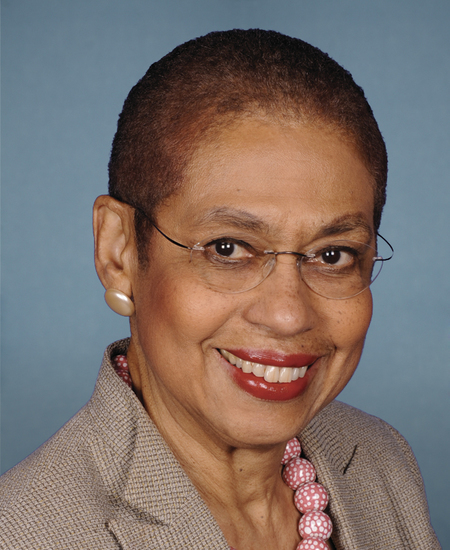
Rep. Eleanor Holmes Norton
Sponsored bills
This resolution recognizes the selfless dedication to fellow citizens displayed through heroic actions across the country and calls upon the Members of the House of Representatives and all people of the United States to observe a National Heroes Day.
This resolution supports the designation of a Muslim-American Heritage Month. The resolution also honors the contributions and integral role of Muslim Americans in the economy, culture, and identity of the United States.
This resolution reaffirms the House of Representatives' commitment to media diversity and expresses its pledge to eliminate barriers to such diversity.
Mamie Till-Mobley Memorial Stamp Act This bill directs the U.S. Postal Service to issue a commemorative postage stamp in honor of Mamie Till-Mobley, the mother of Emmett Till (who was kidnapped and lynched in 1955).
Support Through Loss Act This bill provides employees with 24 hours of paid leave time each year for an absence resulting from a pregnancy loss or other specified circumstance related to pregnancy, fertility, or an unsuccessful assisted reproductive procedure or adoption match. Employers must notify each employee about the availability of this paid leave and may not discriminate or discharge an employee for exercising or attempting to exercise the right to such paid leave. The bill provides for enforcement of this requirement by the Department of Labor and through civil action brought by an employee or individual. Further, the bill requires specified federal agencies to conduct research and publish information about pregnancy loss and related evidence-based treatment options.
Health Enterprise Zones Act of 2021 This bill provides for the designation of Health Enterprise Zones in certain geographic areas with documented and measurable health disparities. This designation, which expires 10 fiscal years after the bill's enactment, confers eligibility for certain grants, student loan repayment programs, and tax credits for those working to reduce health disparities and improve health outcomes in these zones. Specifically, community-based nonprofits or local government agencies, in coalition with health care providers, social service organizations, and others, may apply to the Department of Health and Human Services (HHS) for the designation. The application must include a plan to reduce health disparities and achieve other outcomes. In implementing the program, HHS must consult with, among others, the Department of Housing and Urban Development. When approving applications, HHS shall consider factors including geographic diversity and the commitment of supporting funds from the private sector. HHS (1) may award grants to organizations or agencies that applied for the designation to support activities aligned with their plans, and (2) must carry out a student loan repayment program for health care providers who agree to provide services in a Health Enterprise Zone. In addition, the bill establishes tax credits for employers that hire, and individuals who work as, Health Enterprise Zone workers.
Energy Efficient Public Buildings Act of 2021 This bill requires the Department of Energy to provide grants to states, local governments, or nonprofit organizations for making energy improvements in (1) public libraries, (2) public hospitals, (3) community centers, or (4) state or local government buildings.
This bill prospectively requires the Director of the Court Services and Offender Supervision Agency and the Director of the Pretrial Services Agency for the District of Columbia to reside in the District during their tenure.
Comprehensive Paid Leave for Federal Employees Act This bill provides paid family and medical leave to federal employees. Currently, federal employees are entitled to 12 weeks of administrative leave for one or more of the following reasons: (1) the birth of a child, (2) the adoption or foster care of a child, (3) the care of an immediate family member with a serious health condition, (4) inability to work due to a serious health condition, and (5) exigencies relating to an immediate family member's active duty service in the Armed Forces. However, of these reasons, employees are entitled to paid administrative leave only in connection with the birth, adoption, or foster care of a child (i.e., parental leave). The bill provides 12 weeks of paid administrative leave for any of these reasons, and specifies that this leave is in addition to any annual or sick leave to which employees are entitled.