

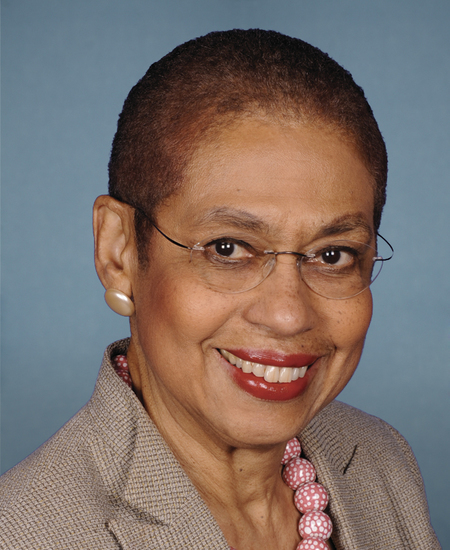
Photo of Eleanor Holmes Norton
D United States House · District At-Large · District of Columbia

Rep. Eleanor Holmes Norton

Compare
Total votes
637
all sessions
Attendance
99%
8 missed
Lower than 91% of chamber peers
With party
98%
of cast votes
Near the chamber average
Bipartisan score
2%
crosses aisle rarely
Near the chamber average
Sponsored
6,183
bills & resolutions
Higher than 99% of chamber peers
Committees
7
assignments
6,183 bills and resolutions

Sponsored bills

Total
6,183
Primary
374
Co-sponsor
5,809
This page
6,183
matching current filters
Co-sponsor HR 6373
In committee Jan 13, 2022 1 co-sponsor
Co-sponsor HR 6385
In committee · United States House · Co-sponsor
Masks for All Act of 2022

Masks for All Act of 2022 This bill directs the Federal Emergency Management Agency (FEMA) to manufacture and distribute N-95 respirator masks to every individual in the United States and to provide N-95 masks to all individuals working in health care settings in the United States that are experiencing a shortage of such masks. FEMA must provide the masks at no cost to individuals and deliver them, to the greatest extent possible, using the U.S. Postal Service. Additionally, FEMA shall designate mask pickup sites in each community and shall provide masks to each site, allocated according to population; consider new designs for masks to improve comfort, fit, and size options; and submit to Congress a strategic plan that includes monthly, measurable targets to eliminate shortages and increase domestic production of N-95 masks and to fulfill all other requirements of this bill. The President shall make use of any and all available authorities (including emergency authorities) at the disposal of the federal government to procure and domestically manufacture N-95 masks and support the domestic manufacturing of N-95 masks.

In committee Jan 13, 2022 1 co-sponsor
Co-sponsor HR 6377
In committee · United States House · Co-sponsor
Free At-Home Tests for All Act

Free At-Home Tests for All Act This bill requires the Department of Health and Human Services (HHS) to provide free antigen diagnostic tests for COVID-19 (i.e., rapid tests) to U.S. residents. The bill also automatically grants emergency use authorization for rapid tests approved by certain foreign regulators. Specifically, HHS must purchase a sufficient quantity of rapid tests to provide two tests per week at no cost to each resident for the 12 months following the bill's enactment. The President may use authorities available under the Defense Production Act of 1950 to obtain the tests. That act confers upon the President a broad set of authorities to influence domestic industry in order to provide essential materials and goods needed for the national defense. In addition, HHS must conduct outreach about the availability of free rapid tests to Medicare and Medicaid participants and make the tests available through those programs. The bill also automatically grants emergency use authorization during the public health emergency for rapid tests that are listed for emergency use by (1) the World Health Organization (WHO), or (2) a foreign regulator that is a stringent regulatory authority as defined by the WHO for purposes of medicine procurement. The Food and Drug Administration (FDA) may rescind authority for, or otherwise regulate, a rapid test that was automatically authorized. Additionally, the FDA must establish a permanent advisory committee focused on diagnostic and serological testing for public health needs.

In committee Jan 13, 2022 1 co-sponsor
Co-sponsor HJRES 68
In committee · United States House · Co-sponsor
Amending title 36, United States Code, to direct the President to issue an annual proclamation establishing Democracy Day.

Maddy summaryThis bill (H.J.Res. 68) is a symbolic, procedural measure that would require the President to issue an annual proclamation designating a day as "Democracy Day." It directs the President to call on state/local governments and citizens to observe the day through programs and activities, with January 6 referenced as a potential date. The bill does not create new government programs or change existing laws - it only establishes a recurring presidential proclamation. It directly affects federal, state, and local governments by encouraging them to participate in annual observances. The bill has no budgetary impact and remains focused on promoting civic engagement through a designated day.

In committee Jan 11, 2022 1 co-sponsor
Co-sponsor HR 6117
In committee · United States House · Co-sponsor
PrEP Access and Coverage Act

PrEP Access and Coverage Act This bill requires private health insurance plans to cover prescription drugs that prevent HIV, including related screenings, diagnostic procedures, administrative fees, and clinical follow-ups, without any cost-sharing obligation for the plan holder. Further, insurance plans must not impose any preauthorization requirement for this coverage. These coverage requirements also apply to public health insurance programs, including Medicare, Medicaid, and the Children's Health Insurance Program. Additionally, the bill prohibits denying, limiting, or qualifying coverage or increasing premiums for disability insurance, long-term care insurance, or life insurance policies based on an individual taking medication for HIV prevention. The bill further requires the Department of Health and Human Services to award grants to states, or directly to eligible local organizations, to provide uninsured individuals and underinsured individuals access to prescription drugs and related services that prevent HIV. The Centers for Disease Control and Prevention also must develop a public awareness campaign that focuses efforts in communities with a high need for HIV prevention treatment.

In committee Jan 6, 2022 1 co-sponsor
Co-sponsor HR 6250
In committee · United States House · Co-sponsor
Protecting America’s Meatpacking Workers Act of 2021

Protecting America's Meatpacking Workers Act of 2021 This bill addresses workplace conditions and safety with a particular focus on meat and poultry processing establishments and makes other changes to agricultural programs and activities. Generally, the bill provides funding through FY2027 for hiring additional Occupational Safety and Health Administration (OSHA) inspectors and related activities. It also restricts an employer's use of certain attendance policies under which a worker is assessed points for absences with progressive discipline imposed as points accumulate. Additionally, the bill expands protections for workers who exercise their rights under occupational safety and health laws and regulations. This includes specific protections and procedures for workers of meat and poultry processing establishments. The bill expands workplace safety and health requirements that apply to meat and poultry processing establishments, including by prohibiting waivers (subject to limited exceptions) related to line speeds and inspections. Additionally, OSHA must issue standards for these establishments that address, for example, ergonomic program management and preventing occupational exposure to COVID-19. OSHA must also (1) establish, within seven days, a process for establishments to report COVID-19 information; and (2) publish certain regulations regarding a workers' representative accompanying an OSHA inspector during inspections of an establishment. The bill provides funding through FY2031 for, and imposes additional conditions on recipients of, grants to improve meat and poultry processing facilities. Further, the bill increases funding for a program that supports regional and local food systems. It also requires country-of-origin labeling of beef, pork, and dairy products.

In committee Jan 4, 2022 1 co-sponsor
Co-sponsor HR 6000
In committee · United States House · Co-sponsor
Cures 2.0 Act

Cures 2.0 Act This bill addresses pandemic preparedness and public health issues, caregiver and patient engagement, drug development, insurance coverage, and biomedical research. The Department of Health and Human Services (HHS) must undertake research and other activities concerning COVID-19 and develop a strategy for future pandemics and declared emergencies. Additionally, the bill specifies actions to combat antimicrobial resistance. HHS may award grants for caregiver training. The bill also addresses diversity in clinical trials, collecting patient experience data during clinical trials, and coverage for care related to participation in specified clinical trials. The bill modifies the timeframe and requires additional guidance relating to expedited approval of certain breakthrough drugs, devices, or products. It also establishes two intercenter institutes within the Food and Drug Administration (FDA) focused on particular diseases that meet specified criteria. The bill also addresses (1) coverage in Medicare, Medicaid, and the Children's Health Insurance Program for telehealth, genetic and genomic testing, and other services; (2) electronic prescribing standards for Medicare drug benefits; and (3) access to Medicare and Medicaid claims data by certain registries. Furthermore, the bill prohibits the use of geographic tracking or biometrics in Medicaid electronic visit verification systems. The bill establishes the Advanced Research Projects Agency for Health (ARPA-H) within the National Institutes of Health to accelerate biomedical research and innovation through grants, contracts, cash prizes, and other means. The FDA may work with ARPA-H to expedite the development of medical products through specified activities.

In committee Jan 4, 2022 1 co-sponsor
Co-sponsor HR 3537
Signed into law · United States House · Co-sponsor
Accelerating Access to Critical Therapies for ALS Act

Accelerating Access to Critical Therapies for ALS Act This bill establishes grant programs to address neurodegenerative diseases, such as amyotrophic lateral sclerosis (also known as ALS or Lou Gehrig's disease), and contains other related provisions. The Department of Health and Human Services (HHS) shall award grants to eligible entities for scientific research utilizing data from expanded access to investigational ALS treatments for individuals who are not otherwise eligible for clinical trials.  The Food and Drug Administration (FDA) shall award grants to public and private entities to cover the costs of research and development of drugs that diagnose or treat ALS and other rare neurodegenerative diseases. HHS shall also establish the Public-Private Partnership for Neurodegenerative Diseases between the National Institutes of Health, the FDA, and at least one eligible entity (generally, an institution of higher education or a nonprofit organization). The partnership shall support the development and regulatory review of drugs that address ALS and other rare neurodegenerative diseases. The FDA shall publish on its website a five-year action plan for fostering the development of drugs that improve or extend the lives of people living with rare neurodegenerative diseases. The Government Accountability Office must report to Congress about the grants provided under this bill, including an analysis of the impact of such grants on research and development of treatments for ALS.

Signed into law Dec 23, 2021 1 co-sponsor
Showing 4,941 to 4,950 of 6,183 bills