

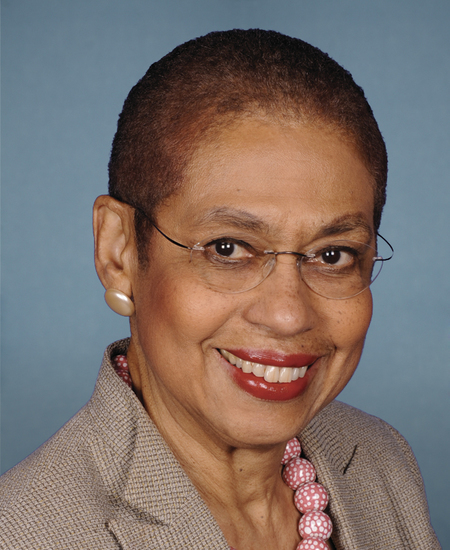
Photo of Eleanor Holmes Norton
D United States House · District At-Large · District of Columbia

Rep. Eleanor Holmes Norton

Compare
Total votes
637
all sessions
Attendance
99%
8 missed
Lower than 91% of chamber peers
With party
98%
of cast votes
Near the chamber average
Bipartisan score
2%
crosses aisle rarely
Near the chamber average
Sponsored
6,183
bills & resolutions
Higher than 99% of chamber peers
Committees
7
assignments
6,183 bills and resolutions

Sponsored bills

Total
6,183
Primary
374
Co-sponsor
5,809
Matching
6,183
matching current filters
Co-sponsor HR 4582
In committee · United States House · Co-sponsor
To amend the Family and Medical Leave Act of 1993 and title 5, United States Code, to clarify that organ donation surgery qualifies as a serious health condition.

Maddy summaryThis bill amends the Family and Medical Leave Act (FMLA) and federal employee leave rules to clarify that recovery from organ donation surgery qualifies as a "serious health condition." It directly affects private-sector workers covered by the FMLA and federal civil service employees. The key change adds "including recovery from surgery related to organ donation" to the definitions of serious health conditions in both the FMLA and federal leave statutes. This ensures eligible employees can use their existing family and medical leave benefits to recover after donating an organ, without requiring new leave entitlements.

In committee Jul 22, 2025 1 co-sponsor
Co-sponsor HR 4493
In committee · United States House · Co-sponsor
Climate Health Emergency Act of 2025

Maddy summaryHR 4493, the Climate Health Emergency Act of 2025, requires the Secretary of Health and Human Services to declare a public health emergency specifically for climate-related health risks under existing law. This bill directly affects the federal public health system by mandating this emergency declaration, based on findings that climate change drives over half of recent public health emergencies (like extreme weather and disease spread). The key mechanism is the formal declaration under the Public Health Service Act, aiming to mobilize federal resources and improve coordination for climate-driven health threats. It focuses on addressing the growing health impacts linked to climate change, as identified in congressional findings.

In committee Jul 22, 2025 1 co-sponsor
Co-sponsor HR 1522
In committee · United States House · Co-sponsor
Federal Retirement Fairness Act

Maddy summaryHR 1522, the Federal Retirement Fairness Act, changes federal retirement rules to include temporary employees' service after January 1, 1988, in retirement benefit calculations. It directly affects temporary federal employees (including U.S. Postal Service workers) and Members of Congress who served after that date. The bill removes a previous cutoff date in retirement law, allowing their temporary service to count toward retirement eligibility. This means eligible temporary workers can now have their full service period considered when calculating retirement benefits.

In committee Jul 22, 2025 1 co-sponsor
Co-sponsor HR 1144
In committee · United States House · Co-sponsor
Frederick Douglass Trafficking Victims Prevention and Protection Reauthorization Act of 2025

Frederick Douglass Trafficking Victims Prevention and Protection Reauthorization Act of 2025   This bill reauthorizes programs and activities that combat international trafficking; establishes a new program to help victims of trafficking; and updates various elements of the federal framework to combat international trafficking. Specifically, this bill reauthorizes through FY2029 programs and activities at various federal departments and agencies to combat international trafficking and reduce the prevalence of modern slavery. The bill also reauthorizes International Megan’s Law through FY2029. Among its provisions, the law requires sex offenders to provide certain information about their intended travel outside of the United States. Additionally, the bill authorizes the Department of Health and Human Services to carry out a new program to help victims of trafficking integrate or reintegrate into society. The bill requires the Department of State's Trafficking in Persons Report to include information about trafficking in persons for the purposes of organ removal.  With respect to country rankings for anti-trafficking efforts, the bill narrows the types of countries that are listed on the Tier 2 Watch List and increases the length of time a country may remain on the Tier 2 Watch List after being downgraded to the lowest ranking and then reinstated to the watch list. (The Tier 2 Watch List refers to countries that are making efforts to meet international standards for combatting human trafficking but still have a significant number of severe trafficking cases.)   Finally, the bill requires counter-trafficking strategies, activities, and efforts to be further incorporated into U.S. foreign assistance.

In committee Jul 22, 2025 1 co-sponsor
Primary HR 4574
In committee · United States House · Lead sponsor
District of Columbia Courts Home Rule Act

Maddy summaryThis bill amends the District of Columbia Home Rule Act by removing a specific provision (paragraph (4) of Section 602(a)) that previously limited the Council of the District of Columbia's authority over the District's court system. The change formally eliminates a restriction on the Council's power to enact laws governing District courts. It directly affects the Council's ability to legislate on court-related matters without federal oversight. The bill makes no new policy changes but adjusts the legal framework for local court governance.

In committee Jul 21, 2025 0 co-sponsors
Co-sponsor HR 4557
In committee · United States House · Co-sponsor
BEACON Act

Maddy summaryThe BEACON Act establishes an Inspector General (IG) for the Executive Office of the President (EOP), requiring the President to appoint one within 120 days of the bill's enactment. It grants the President authority to temporarily block the EOP IG from investigating sensitive matters involving confidential sources, intelligence, or undercover operations, but mandates written notification to the IG and congressional committees within 30 days of such a block. The bill also requires the EOP IG to submit semiannual reports to Congress detailing oversight activities, corrective actions, and any restrictions on accessing information, plus annual audits of the EOP IG office itself. Additionally, it mandates two annual evaluations of EOP classification practices to address potential misclassification of sensitive materials.

In committee Jul 21, 2025 1 co-sponsor
Co-sponsor HR 4556
In committee · United States House · Co-sponsor
Protect Our TEETH Act

Maddy summaryThis bill requires the Environmental Protection Agency (EPA) to consult the National Academies of Sciences before finalizing new safety standards for fluoride in drinking water. Specifically, the EPA must arrange for the National Academies to conduct a rapid evidence review (within 90-180 days) of proposed fluoride rules, provide them all relevant data, and consider their findings. The bill affects federal regulators (the EPA) and the process for setting drinking water standards, not directly impacting the public or water systems. It does not change fluoride levels or safety thresholds but mandates an additional review step in rulemaking. The summary focuses solely on the procedural requirement added to the Safe Drinking Water Act.

In committee Jul 21, 2025 1 co-sponsor
Co-sponsor HR 4482
In committee · United States House · Co-sponsor
Stop NOAA Closures Act

Maddy summaryHR 4482, the Stop NOAA Closures Act, imposes a temporary moratorium on closing, suspending, or limiting access to National Oceanic and Atmospheric Administration (NOAA) facilities, effective until a report is submitted to Congress by January 21, 2029. The bill requires NOAA and the General Services Administration to submit detailed reports to specific congressional committees before any future facility closure, suspension, lease termination, or consolidation - outlining cost-benefit analyses, service impacts, and justification. Exceptions apply only for emergencies posing immediate threats to personnel safety. This bill directly affects NOAA's facility management decisions and mandates congressional oversight for future closures.

In committee Jul 18, 2025 1 co-sponsor
Co-sponsor HR 4542
In committee · United States House · Co-sponsor
No Cages in the Everglades Act

Maddy summaryHR 4542, the "No Cages in the Everglades Act," bans federal funding for any immigration detention facility within or adjacent to Florida's Everglades ecosystem - including construction, operation, or maintenance. It directly affects U.S. Immigration and Customs Enforcement (ICE) and any state/local governments operating such facilities. Key provisions include requiring DHS to submit a detailed report within 90 days on facility costs, construction history, compliance with detention standards, and ecological risks, while also granting Congress unannounced access to inspect all DHS detention facilities. The bill aims to prevent new immigration detention operations in the protected Everglades area and enhance oversight of existing facilities.

In committee Jul 18, 2025 1 co-sponsor
Co-sponsor HR 4497
In committee · United States House · Co-sponsor
Extreme Heat Emergency Act of 2025

Maddy summaryHR 4497, the Extreme Heat Emergency Act of 2025, amends the Stafford Act to explicitly include "extreme heat" in the definition of a "major disaster" alongside events like floods and droughts. This change would allow communities experiencing severe, life-threatening heatwaves to qualify for federal disaster assistance under existing Stafford Act programs. The bill directly affects local governments and residents in areas hit by extreme heat events that meet the new definition, enabling them to access federal aid previously unavailable for heat emergencies. It does not create new programs or funding but adjusts eligibility criteria for current disaster relief mechanisms.

In committee Jul 18, 2025 1 co-sponsor
Showing 1,261 to 1,270 of 6,183 bills