

Maddy summaryHRES 824 is a ceremonial House resolution recognizing the religious and historical significance of Diwali, the festival of lights. It acknowledges Diwali’s meaning across Hindu, Sikh, and Jain traditions - symbolizing light over darkness, good over evil, and marking spiritual milestones like Guru Hargobind’s release and Lord Mahavira’s Nirvana. The resolution expresses respect for Indian-Americans and the global Indian diaspora, highlighting Diwali’s role in U.S. religious diversity. As a non-binding recognition, it does not create new laws, policies, or funding, but formally honors the cultural observance.
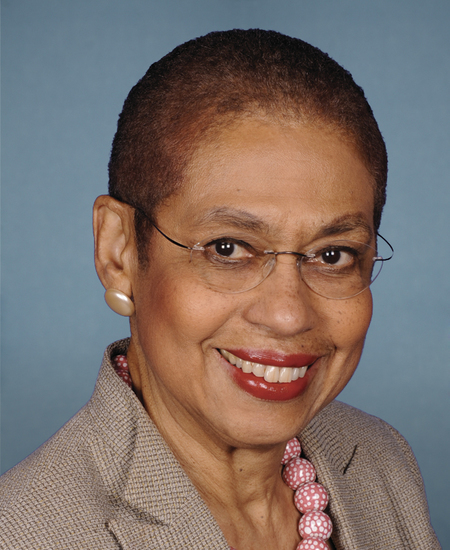
Rep. Eleanor Holmes Norton
Sponsored bills
Maddy summaryHRES 825 is a procedural resolution requesting the President to provide specific unredacted documents to the House of Representatives within 14 days. It seeks all communications related to government agencies' public messaging during the October 2025 funding lapse, including OMB directives to agencies, HUD's website statement about the shutdown, modified email messages from the Department of Education for furloughed staff, and internal reviews of whether such communications violated federal laws. This resolution focuses solely on transparency regarding government communications during the funding lapse, not on policy changes. As a procedural request for information, it does not alter laws or affect any specific group.
Maddy summaryHR 5802, titled the "MAGA Act" (officially the "Make America Govern Again Act"), requires the withholding of salaries for certain federal officials during government shutdowns. It directly affects Members of Congress, the President and Vice President, and specific executive branch employees (including those in the Executive Office of the President or under certain appointment categories) by placing their pay in escrow during shutdowns. The bill mandates that their compensation for each day of the shutdown is withheld proportionally and released only after the shutdown ends or at the conclusion of the current congressional term or presidential term, whichever comes first. This is a procedural change to existing salary payment rules, not a policy altering shutdown causes or duration.
Maddy summaryHR 5799, the FALCON Act of 2025, requires federal agencies, contractors, and grant recipients to comply with Inspector General (IG) requests for information or access within 60 days. It mandates that covered entities (including agency staff, contractors, and grantees) must respond to IG requests or face potential disciplinary actions like suspension, removal, or contract penalties. The bill also requires IGs to notify Congress and agency heads within 30 days if an entity fails to comply, detailing the non-compliant party's role and the request's subject. This applies to all covered agencies as defined in the bill, aiming to strengthen oversight by ensuring timely cooperation with IG investigations.
Maddy summaryThis bill requires federal agencies to report detailed spending data on advertising contracts starting with the 2027 budget. Specifically, agencies must disclose total advertising expenditures and break down spending for contracts with women-owned, minority-owned, and socially/economically disadvantaged small businesses (as defined by law). The reporting applies to both past fiscal year spending and estimated future spending for each agency. This is a transparency measure focused solely on data collection, not on changing how contracts are awarded or funding levels.
Maddy summaryHRES 815 is a non-binding House resolution expressing that immigration enforcement by ICE and CBP must be transparent and respect constitutional rights. It requires ICE/CBP officers to wear body cameras during public operations, ban masks/face coverings (except for safety threats), and visibly display name/badge/agency. The resolution also calls for civilian oversight boards, mandatory de-escalation training, and Justice Department oversight of ICE. It directly affects all ICE and CBP enforcement personnel and their interactions with the public, particularly in residential raids and detention. The resolution references similar pending bills but does not create new law.
Maddy summaryHR 5785 establishes a voluntary program allowing ranchers in 16 Western states (Arizona through Wyoming) to permanently retire their federal grazing permits on designated land areas. Ranchers can submit permits for retirement, but the government will accept no more than 100 nationwide and 25 per state annually. Once retired, the land permanently ends livestock grazing, and no new permits are issued for that area; ranchers also surrender rights to fences and structures (range developments) on the retired land. The bill aims to reduce land-use conflicts while providing ranchers flexibility to exit grazing operations.
Maddy summaryThis bill requires congressional and White House approval before any corporate or individual name, logo, or advertisement can be displayed on the White House grounds or in its buildings. It blocks permanent or semi-permanent displays (like plaques or signage) without consent from the House Speaker, Minority Leader, and White House Curator. The law applies to all White House grounds and structures, preventing unsanctioned commercial endorsements or sponsorships. Existing rules for commemorative monuments (under the Commemorative Works Act) would still govern approved displays.
Head Start Shutdown Protection Act of 2025 This bill requires the Department of Health and Human Services to reimburse a state, local government, or school district that uses its funds to maintain participation in the Head Start program or the Early Head Start program during a government shutdown in which there is a lapse in federal appropriations for the programs. The Head Start programs provide comprehensive early childhood education and development services to low-income children. The programs seek to promote school readiness through the provision of educational, health, nutritional, social, and other services.
Maddy summaryThis bill prohibits the Department of Veterans Affairs (VA) from discriminating against transgender veterans in healthcare, specifically requiring the VA to provide medically necessary treatments for gender dysphoria. It directly affects transgender veterans seeking VA health services by mandating that the VA cannot deny such care or misgender patients based on gender identity. The law adds a new section to VA healthcare law explicitly banning gender identity discrimination and ensuring access to gender dysphoria treatments, aligning with existing protections under the Affordable Care Act. Additionally, it requires the VA to provide quarterly reports to Congress on how transgender veterans receive healthcare services under this new standard.