

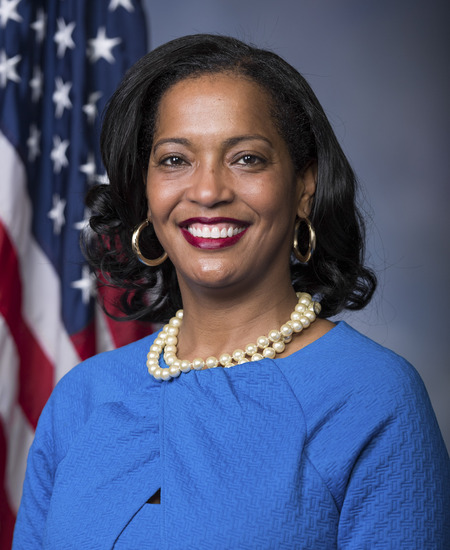
Photo of Jahana Hayes
D United States House · District 5 · Connecticut On the 2026 ballot

Rep. Jahana Hayes

Compare
Total votes
2,837
all sessions
Attendance
99%
24 missed
Near the chamber average
With party
97%
of cast votes
Near the chamber average
Bipartisan score
1%
crosses aisle rarely
Near the chamber average
Sponsored
2,286
bills & resolutions
Higher than 90% of chamber peers
Committees
6
assignments
2,286 bills and resolutions

Sponsored bills

Total
2,286
Primary
106
Co-sponsor
2,180
This page
2,286
matching current filters
Co-sponsor HR 7647
In committee · United States House · Co-sponsor
Housing ACCESS Act

Maddy summaryThe Housing ACCESS Act requires the federal government to issue guidance within one year to help states connect Medicaid beneficiaries with housing services. It directs states to align eligibility processes, streamline service coordination between health and housing agencies, and track outcomes like housing stability - disaggregated by race. The bill also mandates a national study to set fair reimbursement rates for housing services, aiming to ensure living wages for providers and a 1:15 case manager-to-client ratio. States must report on progress within two years, with the guidance intended to simplify how health and housing providers access each other's systems.

In committee Mar 15, 2024 1 co-sponsor
Co-sponsor HR 7680
In committee · United States House · Co-sponsor
Addressing Teacher Shortages Act of 2024

Maddy summaryThis bill establishes a federal grant program to address teacher shortages, particularly in rural schools and high-need subject areas like STEM, special education, and English as a second language. It authorizes funding for teacher residency programs (covering tuition, salaries, and mentor incentives), Grow Your Own programs (recruiting from local communities), and evidence-based strategies to improve teacher recruitment, retention, and diversity. The program requires grantees to track metrics like educator retention rates, teacher certification pass rates, and representation of underrepresented groups. Grants must prioritize rural districts, high-need subject areas, and efforts to diversify the teaching workforce, with specific funding allocations for these priorities.

In committee Mar 13, 2024 1 co-sponsor
Co-sponsor HR 7644
In committee · United States House · Co-sponsor
Opportunities for Success Act of 2024

Maddy summaryThe Opportunities for Success Act of 2024 increases annual federal funding for work-based learning programs at colleges and universities, with appropriations rising from $1.5 billion in 2025 to $2.5 billion by 2029. The bill defines work-based learning to include internships, apprenticeships, cooperative education, and research positions, and establishes a funding formula that prioritizes institutions with high completion rates for Pell Grant recipients. It requires institutions to use specific portions of funds to support students with exceptional need and to ensure work-based learning positions align with students' career goals. The legislation also creates a pilot grant program for developing new work-based learning opportunities and mandates regular reporting on program effectiveness to track outcomes for participating students.

In committee Mar 13, 2024 1 co-sponsor
Co-sponsor HCONRES 97
In committee · United States House · Co-sponsor
Recognizing the significance of equal pay and the disparity between wages paid to men and women.

Maddy summaryThis concurrent resolution (HCONRES 97) recognizes the gender wage gap, noting that women working full-time earn 84 cents for every dollar earned by men. It highlights racial disparities (e.g., Latinas earn 57 cents, Black women 69 cents) and the economic impact of the gap, including $965 billion in annual lost wages for women. As a symbolic resolution, it does not create new laws or policies but formally acknowledges the issue and reaffirms Congress’s commitment to addressing wage inequality.

In committee Mar 12, 2024 1 co-sponsor
Co-sponsor HRES 1074
In committee · United States House · Co-sponsor
Reaffirming the House of Representatives support of a two-state solution.

Maddy summaryHRES 1074 is a symbolic House resolution reaffirming congressional support for a two-state solution to the Israel-Palestine conflict. It explicitly states the House supports Israel's right to exist as a Jewish, democratic state and recognizes Palestinians' right to sovereignty through a separate state. The resolution identifies a two-state solution as the best path to lasting peace and condemns efforts opposing this approach. As a non-binding resolution, it does not create new law or policy but formally expresses the House's position on this issue. It was introduced by multiple House members on March 12, 2024.

In committee Mar 12, 2024 1 co-sponsor
Co-sponsor HR 7629
In committee · United States House · Co-sponsor
Protect Our Letter Carriers Act of 2024

Maddy summaryHR 7629, the Protect Our Letter Carriers Act of 2024, allocates $1.4 billion annually (2025-2029) to the U.S. Postal Service for high-security collection boxes and replacing physical universal mailbox keys with electronic versions, directly affecting USPS operations and letter carriers. It requires the Attorney General to appoint specialized prosecutors in each district to coordinate investigations and prosecutions of postal-related crimes, such as assaults on carriers or mail theft. The bill also mandates the U.S. Sentencing Commission to adjust guidelines so that assaults or robberies against postal employees are treated with the same severity as assaults against law enforcement officers. These provisions aim to enhance safety through infrastructure upgrades, improved prosecution, and stricter sentencing for crimes targeting postal workers.

In committee Mar 12, 2024 1 co-sponsor
Primary HRES 1062
In committee · United States House · Lead sponsor
Declaring racism a public health crisis.

Maddy summaryThis resolution declares racism a public health crisis in the United States, citing evidence that racial and ethnic minority groups face significant health disparities including lower life expectancies, higher maternal mortality rates, and increased risks for chronic diseases. It highlights specific examples such as Black Americans being 3 times more likely to be killed by police than White Americans and Native American women facing disproportionately high rates of violence. The resolution commits to establishing a nationwide strategy to address health disparities, dismantle systemic racism, and advance reforms to improve health outcomes for affected communities. As a formal declaration (not a law), it serves as a call to action for government agencies to address the root causes of racial health inequities.

In committee Mar 8, 2024 0 co-sponsors
Co-sponsor HR 7503
In committee · United States House · Co-sponsor
Health Equity for People with Disabilities Act

Maddy summaryHR 7503, the Health Equity for People with Disabilities Act, amends Section 330 of the Public Health Service Act to require health centers and programs serving underserved communities to explicitly include people with disabilities and provide accessible healthcare services. The bill inserts "including people with disabilities" in multiple sections and adds requirements for communication devices or services to meet accessibility needs. These changes apply to community health centers, migrant health centers, and other programs funded under Section 330, which serve medically underserved populations. The law clarifies that existing funding mechanisms remain unchanged but ensures people with disabilities are included in program eligibility and access to care.

In committee Mar 8, 2024 1 co-sponsor
Co-sponsor HR 7481
In committee · United States House · Co-sponsor
Improving Social Determinants of Health Act of 2024

Maddy summaryHR 7481 establishes a new CDC program to address social determinants of health - such as housing, food access, and transportation - that impact community health outcomes. It authorizes $100 million annually (2025-2029) to fund grants for state/local health agencies, nonprofits, and universities to design and implement community-based strategies tackling unmet health needs. Grantees must collaborate with health systems, housing organizations, and local stakeholders to collect data, develop evidence-based solutions, and monitor impacts on health equity and healthcare costs. The bill requires annual reporting and a national evaluation after five years to assess program effectiveness.

In committee Mar 8, 2024 1 co-sponsor
Co-sponsor HR 6203
In committee · United States House · Co-sponsor
Farmers Feeding America Act of 2023

Maddy summaryHR 6203 extends funding for the Emergency Food Assistance Program (EFAP) through fiscal year 2028, increasing annual commodity funding to $500 million per year for 2024-2028. It raises storage and distribution funding from $100 million to $200 million annually and creates new delivery options for geographically isolated states (Hawaii, Alaska, Puerto Rico, Northern Mariana Islands, U.S. Virgin Islands, and Guam), including allowing them to order through the Department of Defense Fresh Fruit and Vegetable Program. The bill also permits these states to use up to 20% of allocated funds to directly purchase locally grown food. Finally, it allows the Secretary to consider factors like product variety and transportation distance when awarding contracts for fresh produce packages, while maintaining nutritional goals.

In committee Mar 1, 2024 1 co-sponsor
Showing 841 to 850 of 2,286 bills
Previous 1 … 84 85 86 … 229 Next