

Maddy summaryHRES 441 is a symbolic House resolution expressing support for designating May 2025 as "Mental Health Awareness Month." It does not create new laws, allocate funding, or change existing policies - it solely aims to raise public awareness about mental health challenges. The resolution cites statistics on rising mental health issues (including youth depression, suicide rates, and disparities in care access) to underscore the need for greater attention. It encourages the public, schools, and organizations to use the month to promote mental well-being and reduce stigma, but contains no concrete policy changes or mandates.
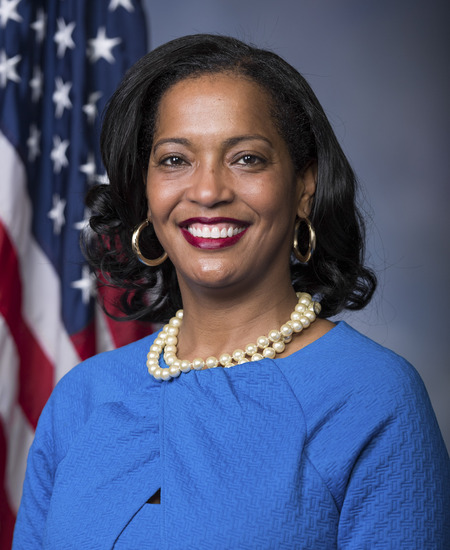
Rep. Jahana Hayes
Sponsored bills
This bill prohibits the President from selling, transferring, or exporting certain defense articles or services to Israel, except in specified circumstances. Defense articles covered by the prohibition include BLU-109 bunker busting bombs, Joint Direct Attack Munition (JDAM) assemblies, and 155mm artillery ammunition. Defense services directly related to such articles are also covered. The President may sell, transfer, or export such defense articles or services to Israel if (1) a law is enacted specifying the purposes for which such articles or services may be used, and (2) Israel provides written assurances that the defense articles or services will be used for those specific statutory purposes and in a manner consistent with certain other laws, including international human rights laws.
Maddy summaryThe College for All Act of 2025 would eliminate tuition and required fees for eligible students at public community colleges and 4-year institutions through a federal-state partnership. The federal government would cover 100% of costs in the first year (2026-2027), gradually decreasing to 80% by 2030-2031, while states would start with 0% and increase to 20% by 2030-2031. Eligible students would include those with family income below $150,000 for single parents or $300,000 for married parents, regardless of immigration status. The bill also includes requirements to maintain instruction funding, improve transfer pathways between community colleges and 4-year institutions, and provide additional support for students after tuition elimination.
Maddy summaryHR 3541, the "See the Board Act," creates a federal grant program to provide free eye care services to students in public elementary and secondary schools. The program, administered by the Secretary of Health and Human Services, awards grants to nonprofit organizations to purchase mobile eye care equipment and cover operational costs like staff, personal protective equipment, and optical services. These grants fund mobile clinics that bring vision screenings, comprehensive exams, and glasses directly to schools, targeting students attending public K-12 schools as defined under the Elementary and Secondary Education Act. The bill authorizes funding for fiscal years 2026 through 2031 to support this initiative.
Maddy summaryHR 3532, the Striking and Locked Out Workers Healthcare Protection Act, prohibits employers from terminating or altering an employee’s employer-sponsored health coverage during a lawful strike or a lockout (when an employer withholds work to influence bargaining). It directly affects workers participating in strikes or facing lockouts, ensuring continued healthcare access during these labor disputes. The bill adds penalties: $75,000 per violation for lockout-related coverage termination (up to $150,000 for repeat offenses), and $50,000 per violation for strike-related termination (up to $100,000 for repeat offenses), with penalties applied alongside other remedies. These provisions amend the National Labor Relations Act to protect workers’ healthcare rights during collective bargaining actions.
Maddy summaryThis bill would allocate $200 million annually from 2026 through 2029 to expand access to diapers and incontinence supplies for low-income families. It specifically targets infants, toddlers, medically complex children, and low-income adults with disabilities who require diapers or incontinence products. The funding would be distributed through state social services programs to support free distribution of diapers, diapering supplies, and adult incontinence materials, while requiring states to track how funds are used through detailed reporting. The bill also makes medically necessary diapers and diapering supplies eligible for reimbursement through health savings accounts and flexible spending arrangements. This legislation aims to address what is termed "diaper need" by directly providing essential supplies to vulnerable populations.
Maddy summaryThis bill establishes a code of conduct for Supreme Court justices, requiring them to disclose gifts, income, and potential conflicts of interest. It creates a formal process for handling complaints about justices, including a judicial investigation panel to review allegations. The bill adds specific circumstances requiring recusal, such as when a justice or family member has financial ties to a party in a case. Additionally, it mandates that parties and amicus briefs disclose any gifts given to justices and lobbying activities related to their nomination. These provisions aim to increase transparency and accountability in the Supreme Court's operations.
Maddy summaryHR 3526, the Uplifting First-Time Homebuyers Act of 2025, increases the maximum amount first-time homebuyers can withdraw penalty-free from retirement accounts. It amends the Internal Revenue Code to raise the limit from $10,000 to $50,000 for qualified first-time homebuyer distributions. This change directly affects individuals using retirement savings to purchase their first home, allowing them to access significantly more funds without incurring the usual 10% early withdrawal penalty. The provision applies to taxable years beginning after December 31, 2024.
Maddy summaryThis bill changes the legal standard for proving discrimination in employment cases. It amends the Age Discrimination in Employment Act (ADEA), Title VII of the Civil Rights Act, and the Americans with Disabilities Act to require that a plaintiff only show age, race, color, religion, sex, national origin, or disability was a "motivating factor" for an employment decision - not that it was the sole cause - to establish a violation. This applies to all workers filing discrimination claims under these laws, including federal employees. The bill also limits remedies: if an employer proves they would have taken the same action regardless of the protected factor, courts can only grant limited relief like attorney fees, not damages or reinstatement.
Maddy summaryHR 3498, the Henrietta Lacks Congressional Gold Medal Act, authorizes a commemorative gold medal to honor Henrietta Lacks for her contribution to science through her immortal HeLa cells. The bill directs the Treasury Secretary to strike the medal, which will be presented posthumously by Congress and displayed at the Smithsonian Institution. It also permits the sale of bronze duplicates to cover costs, with proceeds going to the U.S. Mint fund. This is a ceremonial recognition of Lacks' legacy, not a policy change affecting any group or requiring new regulations.