

No Surprise Bills for New Moms Act This bill requires health insurers to provide coverage for newborns of enrollees for the first 30-day period after the newborn's date of birth and to provide a special enrollment period for the newborn that extends at least 60 days after the initial coverage period. It also requires insurers to notify an enrollee if they receive a claim for the enrollee's newborn who is not enrolled in a health insurance plan.
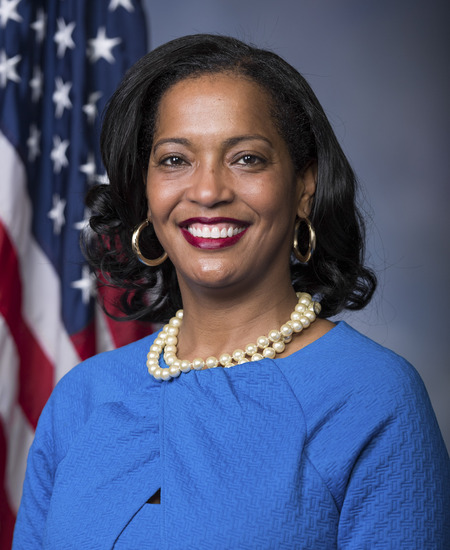
Rep. Jahana Hayes
Sponsored bills
Huntington's Disease Disability Insurance Access Act of 2021 This bill expedites payment of Social Security Disability Insurance (SSDI) benefits and eligibility for Medicare coverage for those with Huntington's disease. This is an inherited disorder that causes brain cells to die, including in areas of the brain that help to control voluntary movement. Specifically, the bill eliminates the 5-month waiting period for SSDI benefits and the subsequent 24-month waiting period for Medicare coverage for individuals with Huntington's disease. Under current law, individuals generally must wait five months after the onset of disability to begin receiving SSDI benefits and an additional 24 months to become eligible for Medicare.
Timely Mental Health for Foster Youth Act This bill requires an initial mental health screening within 30 days after a child enters foster care. In the case of a child for whom a mental health issue is identified in such initial screening, a comprehensive assessment of the child's mental health must be completed within 60 days after the child's entry into foster care. The Department of Health and Human Services must provide technical assistance for states to implement this requirement and collect data and report on the number of screenings completed.
Wise Investment in Children Act of 2021 or the WIC Act of 20 21 This bill expands eligibility for children to receive benefits under the Special Supplemental Nutrition Program for Women, Infants, and Children (WIC). The bill authorizes the Department of Agriculture to grant a waiver to a state, on request, that waives certification deadline requirements under the program if such state demonstrates there are unusual technological barriers to implementation, operational costs are not affordable within the nutrition services and administration grant of the state, or it is in the best interest of the program. If a waiver is granted, the bill extends eligibility for the program until the period that ends on the earlier of the sixth birthday of a child or when the child enters kindergarten; extends the certification period under the program for infants to up to two years, instead of the current one year; and increases the certification time under the program for postpartum women to a period of up to two years.
Jumpstart Our Businesses by Supporting Students Act of 2021 or the JOBS Act of 2021 This bill expands student eligibility for Pell Grants by establishing the Job Training Federal Pell Grant program. Specifically, the bill requires the Department of Education to award a job training Pell Grant to a student who does not have a degree; attends an institution of higher education (IHE); is enrolled in a career and technical education program at an IHE that provides 150 to 600 clock hours of instructional time over a period of 8 to 15 weeks and provides training aligned with high-skill, high-wage, or in-demand industry sectors (i.e., job training programs); and meets all other eligibility requirements for a Pell Grant. It also specifies that any period during which a student receives a job training Pell Grant counts toward that student's Pell Grant eligibility period.
Alice Cogswell and Anne Sullivan Macy Act This bill expands special education and related services for students who are deaf or hard of hearing, students with visual disabilities, and children and youth who are deaf-blind. The individualized education program for each child who is visually and/or hearing impaired must include specified components and must provide the child with instruction that meets the child's unique learning needs. In addition, a state's closure of a special school serving deaf or blind children shall count as a reduction of its financial support for special education and related services. Among other provisions, the bill authorizes support, including grants for training special education personnel, to be used in preparing individuals to become qualified teachers and early intervention specialists for children with hearing disabilities. The bill establishes within the Department of Education the Anne Sullivan Macy Center on Visual Disability and Educational Excellence to better support students with visual disabilities.
Crisis Assistance Helping Out On The Streets Act or the CAHOOTS Act This bill allows state Medicaid programs to cover certain community-based mobile crisis intervention services for individuals experiencing a mental health or substance-use disorder crisis outside of a facility setting. Among other requirements, such services must be (1) provided by multidisciplinary teams composed of behavioral health professionals who are trained in trauma care and de-escalation techniques, (2) available 24-7, and (3) voluntary for the individual experiencing the mental health or substance-use disorder crisis. The bill provides an enhanced Federal Medical Assistance Percentage (i.e., federal matching rate) for such services, as well as specified funds for state planning and evaluation grants.
Child Care is Infrastructure Act This bill establishes grants for child care facilities and higher education loan repayment and scholarship programs for child care educators, among other provisions. The Administration for Children and Families must conduct long- and short-term assessments of child care infrastructure, including the effect of the COVID-19 (i.e., coronavirus disease 2019) pandemic on such facilities. The bill provides grants to (1) states to acquire, construct, or improve child care facilities; and (2) intermediary organizations with demonstrated experience in child care facilities financing to develop or finance child care facilities. The bill further provides for education loan repayments of up to $6,000 per year for up to five years for early childhood educators who agree to work for certain child care providers. Additionally, the bill establishes a program for institutions of higher education to award grants of up to $3,000 per academic year to individuals who are enrolled in early childhood educator programs and agree to serve in a state-licensed early learning program. Finally, the bill modifies and reauthorizes through FY2027 supports for campus-based child care for low-income parents enrolled in institutions of higher education and requires the Department of Housing and Urban Development to consider early learning facilities in planning and implementation grants under the Choice Neighborhoods Initiative.
Medicare Multi-Cancer Early Detection Screening Coverage Act of 2021 This bill provides for Medicare coverage and payment for multi-cancer early detection screening tests that are approved by the Food and Drug Administration and that are used to screen for cancer across many cancer types.
This bill directs the Speaker of the House and the President pro tempore of the Senate to arrange for the award of three Congressional Gold Medals to the U.S. Capitol Police (USCP) and other law enforcement agencies that protected the U.S. Capitol on January 6, 2021. Following the award of these medals, one medal shall be given to the USCP, one medal shall be given to the Metropolitan Police Department of the District of Columbia, and one medal shall be given to the Smithsonian Institution and displayed with a plaque listing all law enforcement agencies that participated in protecting the Capitol on January 6, 2021.