

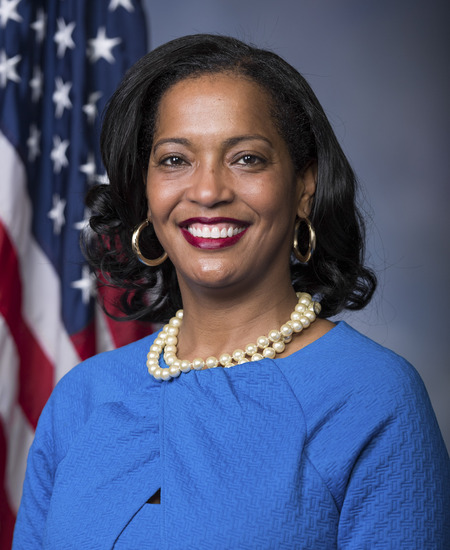
Photo of Jahana Hayes
D United States House · District 5 · Connecticut On the 2026 ballot

Rep. Jahana Hayes

Compare
Total votes
2,837
all sessions
Attendance
99%
24 missed
Near the chamber average
With party
97%
of cast votes
Near the chamber average
Bipartisan score
1%
crosses aisle rarely
Near the chamber average
Sponsored
2,277
bills & resolutions
Higher than 90% of chamber peers
Committees
6
assignments
2,277 bills and resolutions

Sponsored bills

Total
2,277
Primary
106
Co-sponsor
2,171
This page
2,277
matching current filters
Co-sponsor HR 1034
In committee · United States House · Co-sponsor
Domestic Violence Public Health Emergency Guidance Act

Domestic Violence Public Health Emergency Guidance Act This bill requires the Department of Justice to issue guidance to law enforcement agencies on model practices for addressing domestic violence and protecting the safety of law enforcement officers during the COVID-19 (i.e., coronavirus disease 2019) public health emergency.

In committee Apr 28, 2021 1 co-sponsor
Co-sponsor HR 3
In committee · United States House · Co-sponsor
Elijah E. Cummings Lower Drug Costs Now Act

Elijah E. Cummings Lower Drug Costs Now Act This bill establishes several programs and requirements relating to the prices of prescription drugs. In particular, the bill requires the Department of Health and Human Services (HHS) to negotiate prices for certain drugs (current law prohibits HHS from doing so). Specifically, HHS must negotiate maximum prices for single-source, brand-name drugs that lack certain generics and that are among either the 125 drugs that account for the greatest national spending or the 125 drugs that account for the greatest Medicare spending. HHS must negotiate the prices of at least 25 such drugs for 2024 and of at least 50 such drugs thereafter and must also negotiate prices for certain newly approved drugs and for insulin products. The negotiated prices must be offered under Medicare and may also be offered under private health insurance unless the insurer opts out. The negotiated maximum price may not exceed (1) 120% of the average price in Australia, Canada, France, Germany, Japan, and the United Kingdom; or (2) if such information is not available, 85% of the U.S. average manufacturer price. Drug manufacturers that fail to comply with the bill's negotiation requirements are subject to civil and tax penalties. The bill also makes a series of additional changes to Medicare prescription drug coverage and pricing, including by (1) requiring drug manufacturers to issue rebates to the Centers for Medicare & Medicaid Services for covered drugs that cost $100 or more and for which the average manufacturer price increases faster than inflation, and (2) capping annual out-of-pocket spending under the Medicare prescription drug benefit. The bill also requires drug manufacturers to report specified information for certain high-cost drugs, and it provides funds for opioid epidemic initiatives and biomedical research.

In committee Apr 27, 2021 1 co-sponsor
Co-sponsor HR 1476
In committee · United States House · Co-sponsor
PFC Joseph P. Dwyer Peer Support Program Act

PFC Joseph P. Dwyer Peer Support Program Act This bill requires the Department of Veterans Affairs (VA) to establish the PFC Joseph P. Dwyer Peer Support Program to make grants to eligible entities for peer-to-peer mental health programs for veterans. Eligible entities include (1) a nonprofit organization that has historically served the mental health needs of veterans; (2) a congressionally chartered veteran service organization; or (3) a state, local, or tribal veteran service agency, director, or commissioner. The VA shall establish an advisory committee to create appropriate program standards.

In committee Apr 27, 2021 1 co-sponsor
Co-sponsor HR 2851
In committee · United States House · Co-sponsor
Affordable Housing Preservation Act of 2021

Affordable Housing Preservation Act of 2021 This bill directs the Department of Housing and Urban Development (HUD) to implement a demonstration program for the establishment or preservation of limited- or zero-equity resident-controlled housing. Limited- or zero-equity resident-controlled housing (e.g., a housing cooperative) restricts the initial and resale price of shares of stock or membership interests in a residence so that the shares or interests remain affordable to families of certain incomes. Specifically, HUD may assist nonprofit organizations to establish or preserve such housing through providing (1) mortgage insurance; and (2) grants for predevelopment costs, monitoring fees, technical assistance, gap funding, and intermediary financing. Housing receiving such assistance must be governed by a board of directors elected by members of a limited- or zero-equity resident-controlled housing corporation with voting structured equitably among all members. A limited- or zero-equity resident-controlled housing corporation may sell corporate shares in such housing to an eligible household for a purchase price that ensures dwelling units in the housing will remain affordable for at least 30 years to households earning less than a certain income.

In committee Apr 26, 2021 1 co-sponsor
Co-sponsor HRES 103
In committee · United States House · Co-sponsor
Condemning the bigotry that was displayed and voiced during the January 6th siege of the United States Capitol, the prominent role played by White supremacists and domestic terrorists in planning and leading the siege, and the elected officials who encouraged them.

This resolution condemns the bigotry that fueled those who stormed the U.S. Capitol, the elected officials who stoked that bigotry, including former President Trump, and the Members of Congress who have continued to support those individuals. It reaffirms that harmful rhetoric and violent behavior against individuals based on factors including religion, race, immigration status, and sex will not be tolerated.

In committee Apr 23, 2021 1 co-sponsor
Co-sponsor HR 2763
In committee · United States House · Co-sponsor
Job Creation through Energy Efficient Manufacturing Act

Job Creation through Energy Efficient Manufacturing Act This bill requires the Department of Energy (DOE) to establish a Financing Energy Efficient Manufacturing Program that provides grants for energy efficiency improvement projects in the manufacturing sector. The following types of entities are eligible for grants: state energy offices; Native American tribes; nonprofit organizations that focus on providing energy efficiency or renewable energy services and receive funding from states, tribes, or utilities; electric cooperative groups; or entities with a public-private partnership under the Hollings Manufacturing Extension Partnership. The entities that receive grants must then distribute subgrants to certain small- or medium-sized manufacturers (employing no more than 750 employees) located in the same states as the entities. Recipients of subgrants must carry out projects that (1) improve the energy efficiency of the manufacturers, and (2) develop technologies that reduce electricity or natural gas use by the manufacturers. The bill establishes labor requirements for projects that receive grant funding under this bill. In addition, grant projects may only use iron and steel products that are produced in the United States, unless DOE grants a waiver of the requirement.

In committee Apr 23, 2021 1 co-sponsor
Co-sponsor HR 2803
In committee · United States House · Co-sponsor
Agriculture Resilience Act

Agriculture Resilience Act This bill establishes, expands, and revises multiple programs and activities of the Department of Agriculture (USDA) primarily to reduce carbon emissions from the agriculture sector. Specifically, USDA must finalize and implement a plan to achieve net-zero emissions from the sector by 2040. USDA must periodically review and revise the plan, as necessary, and annually report on its implementation. Additionally, the bill expands the scope of various USDA research, extension, and education programs; conservation programs; and livestock programs to incorporate climate change adaption and mitigation. Expanded activities include efforts to improve soil health and preserve farmland and grassland. Further, the bill changes programs that support renewable energy in rural areas to address carbon emissions in the agriculture sector. Among these changes, the bill provides statutory authority for a program for reducing methane emissions from livestock waste that is carried out by the Environmental Protection Agency and transitions the program to USDA. The bill also addresses food waste, for example, by (1) standardizing the voluntary labels used by food producers to indicate the date by which food should be used or discarded, and (2) making composting activities eligible for support through USDA conservation programs. Moreover, the bill establishes grants to reduce and prevent food waste in landfills and in schools.

In committee Apr 23, 2021 1 co-sponsor
Co-sponsor HR 2828
In committee · United States House · Co-sponsor
DAIRY PRIDE Act

Defending Against Imitations and Replacements of Yogurt, milk, and cheese to Promote Regular Intake of Dairy Everyday Act or the DAIRY PRIDE Act This bill prohibits the sale of any food that uses the market name of a dairy product (such as milk , yogurt , or cream cheese ) unless the food (1) is the milk of a hooved animal, (2) is derived from such milk, or (3) contains such milk as a primary ingredient.

In committee Apr 23, 2021 1 co-sponsor
Co-sponsor HR 2771
In committee · United States House · Co-sponsor
Strengthening America’s Families Act of 2021

Strengthening America's Families Act of 2021 This bill provides statutory authority for the Infant and Toddler Court Program and a related resource center. It also permits the Health Resources and Services Administration to expand the program through grants to states, tribal nations, and territories for establishing, stabilizing, or enhancing infant-toddler court teams. This program aims to improve the well-being of infants, toddlers, and families in the child welfare system through team-based case management services that foster coordination among courts, child welfare agencies, and other child-serving organizations. The resource center provides technical assistance, training, and other support for infant-toddler court teams.

In committee Apr 23, 2021 1 co-sponsor
Co-sponsor HR 2764
In committee · United States House · Co-sponsor
Community Solar Consumer Choice Act of 2021

Community Solar Consumer Choice Act of 2021 This bill supports the expansion of community solar energy and doubles the allowable time period for a long-term contract between the General Services Administration (GSA) and a public utility. Specifically, the bill requires the Department of Energy (DOE) to establish a program for expanding community solar energy options, including options for low-income and moderate-income individuals. In addition, DOE must expand existing grant, loan, and financing programs to include community solar projects as specified by the bill. Further, the bill revises requirements for electric utilities, including by requiring each electric utility to offer a community solar program. Finally, the bill allows the GSA to make a public utility contract for a period of up to 30 years. Currently, the GSA may make a public utility contract for up to 10 years.

In committee Apr 23, 2021 1 co-sponsor
Showing 1,981 to 1,990 of 2,277 bills