Exposing Discrimination in Higher Education Act This bill requires the Department of Education's Office for Civil Rights to publish prominently on its website the names of the institutions of higher education (IHEs) that request, and the names of the IHEs that receive, religious exemptions from the prohibition on sex discrimination in federally funded education programs and activities. It also requires an IHE that requests, receives, exercises, or intends to exercise such a religious exemption to publish prominently on its website certain information with respect to such exemption.
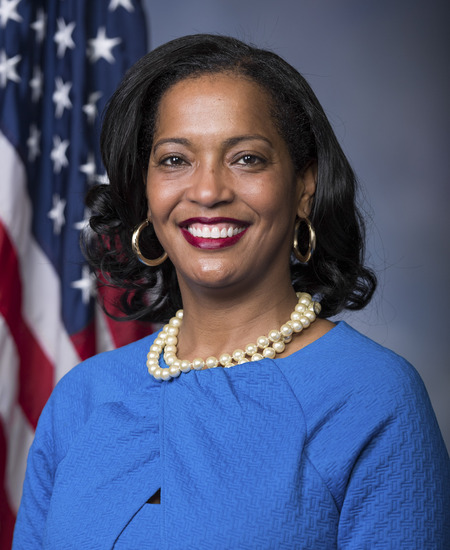
Rep. Jahana Hayes
Sponsored bills
Closing the Meal Gap Act of 202 1 This bill revises the requirements for calculating Supplemental Nutrition Assistance Program (SNAP) benefits. The bill increases the minimum SNAP benefit and requires benefits to be calculated using the value of a low-cost food plan. The Department of Agriculture (USDA) must determine the requirements for the low-cost food plan, which is the diet required to feed a family of four, consisting of a man and a woman 19-50 years of age, a child 6-8 years of age, and a child 9-11 years of age. USDA must (1) reevaluate and publish the market baskets of the plan by January 1, 2027, and every five years thereafter, based on current food prices, food composition data, consumption patterns, and dietary guidance; and (2) make adjustments to the plan to account for household size, changes in the cost of the diet, and the costs of food in specified areas. The bill modifies the requirements for calculating household income to determine SNAP eligibility by (1) authorizing a standard medical expense deduction for households containing an elderly or disabled member, and (2) eliminating the cap on the excess shelter expense deduction. The bill eliminates certain work requirements for SNAP. The requirements apply to able-bodied adults who are ages 18-49 and have no dependent children. The bill allows Puerto Rico, American Samoa, and the Northern Mariana Islands to participate in SNAP. Currently, the three territories receive block grants instead of participating in SNAP.

Strengthening Loan Forgiveness for Public Servants Act This bill revises the Public Service Loan Forgiveness (PSLF) program to provide for partial loan cancellation based on the length of public service employment. Specifically, the bill directs the Department of Education (ED) to cancel 15%, 15%, 20%, 20%, and 30% of the amount a borrower owes after 2, 4, 6, 8, and 10 years of public service employment, respectively, on Federal Direct Loans made after the bill's enactment. Under the current PSLF program, ED must cancel the balance of interest and principal due on a borrower's Federal Direct Loans after the borrower makes 120 monthly loan payments while employed in a public service job.
Veterans Service Organization Modernization Act of 2021 This bill requires the Department of Housing and Urban Development to provide competitive grants to veterans service organizations for repairs or rehabilitation of existing facilities and for modernization of technologies.
Supermarket Tax Credit for Underserved Areas Act This bill expands the tax credits that are available for the establishment of supermarkets in underserved areas. The bill includes provisions that (1) increase the rate of the rehabilitation tax credit for a supermarket building placed in service after December 31, 2021, and before January 1, 2025, in an underserved area; (2) increase by $1,000 the limit on wages eligible for the work opportunity tax credit for employees of a new underserved area supermarket; and (3) allow a business-related tax credit for 15% of the gross receipts from the retail sale of fresh fruits and vegetables in a new underserved area supermarket.
Extinction Crisis Emergency Act of 2021 This bill requires the President to declare the global wildlife extinction crisis a national emergency and to take certain actions to restore wildlife. Specifically, the President shall direct the U.S. Fish and Wildlife Service and the National Marine Fisheries Service to review all species that are identified as critically imperiled, critically endangered, endangered, or vulnerable, and to use all authorities to propose and finalize protections for all species that may warrant protection; and establish new national wildlife refuges and new marine protected areas. The Departments of Commerce and the Interior must, after accepting public comment, conduct annual reviews of every nation's compliance with any international fishery conservation program or international program for endangered or threatened species, and take specified actions. The President must enlist all federal agencies to help fight the wildlife extinction crisis by directing each federal agency to take specified actions to prioritize the recovery of endangered species and to rebuild healthy wildlife and plant populations, including by fully integrating climate change concerns into the conservation and recovery of endangered species. The President must direct the Department of Defense to prioritize the protection of endangered species and rare habitats on U.S. military installations around the world.
Close the Medigap Act of 2021 This bill (1) expands guaranteed issue rights with respect to Medigap policies (Medicare supplemental health insurance policies), (2) eliminates certain limitations on Medigap policies for newly eligible Medicare beneficiaries, and (3) modifies other provisions related to Medigap policies. (Guaranteed issue rights require that a policy be offered to any eligible applicant without regard to health status.)
Securing Universal Communications Connectivity to Ensure Students Succeed Act or the SUCCESS Act This bill provides additional funding for the Emergency Connectivity Fund, which supports remote learning during the COVID-19 emergency period by covering reasonable costs of laptop and tablet computers, Wi-Fi hotspots, modems, routers, and broadband connectivity purchases for off-campus use by students, school staff, and library patrons.
Time for Completion Act This bill expands consumer information disclosure requirements related to student completion or graduation rates at institutions of higher education (IHEs) that participate in federal student-aid programs. Currently, such IHEs must disclose the completion or graduation rate of first-time, full-time, certificate- or degree-seeking undergraduate students. This bill expands disclosure requirements to include the completion or graduation rates of non-first-time and half-time certificate- or degree-seeking undergraduate students. The bill also sets forth new time periods for calculating the completion or graduation rates for programs of study that are less than four years.
School Milk Nutrition Act of 20 21 This bill revises requirements for milk provided by the National School Lunch Program of the Department of Agriculture. The bill permits schools participating in the program to offer students low-fat flavored milk.