

Temporary Family Visitation Act This bill establishes a new nonimmigrant visa classification for an alien temporarily entering the United States to visit a relative who is a U.S. citizen or lawful permanent resident. The maximum period of stay for a family visitor visa shall be 90 days. An alien seeking such a visa must have health insurance for the duration of the stay. An alien who holds such a visa may not change to another nonimmigrant visa classification except in certain limited instances. If an alien has been approved for a family-based immigrant visa and is waiting for one to become available, the alien may obtain a family visitor visa if the alien meets the eligibility requirements.
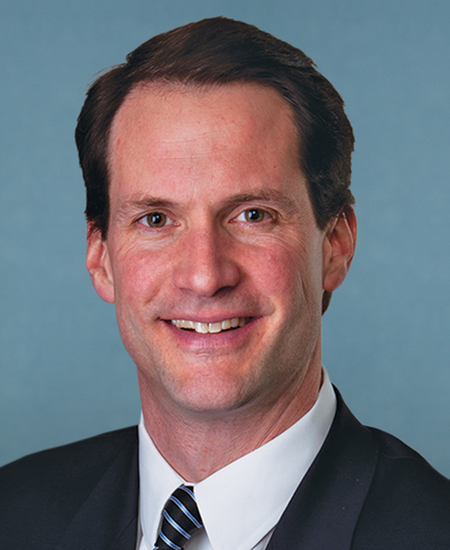
Rep. James A. Himes
Sponsored bills
Untraceable Firearms Act of 2021 This bill establishes a federal statutory framework to regulate the manufacture, sale, offer to sell, transfer, purchase, and receipt of ghost guns (i.e., guns without serial numbers). Additionally, the bill revises the federal statutory framework regulating the manufacture, possession, sale, import, shipment, delivery, receipt, and transfer of undetectable firearms. Among the revisions, the bill defines undetectable firearm as a firearm without a major component wholly made of detectable material.
Fair and Clear Campaign Transparency Act This bill directs the Federal Communications Commission to require certain online public inspection files to be made available to the public in a machine-readable format that supports automated searching, bulk downloading, aggregation, manipulation, sorting, and analysis. Online public inspection files (including political files that contain records of requests to purchase broadcast time by or on behalf of candidates for public office or to communicate a message relating to a political matter of national importance) are files that must be uploaded to the internet by certain television broadcast stations and television systems, AM or FM radio broadcast stations, cable operators, direct broadcast satellite service providers, or satellite digital audio radio service providers.
Fiscal State of the Nation Resolution This concurrent resolution requires the congressional budget committees to conduct an annual joint hearing to receive a presentation from the Comptroller General regarding (1) the Government Accountability Office's audit of the financial statement of the executive branch, and (2) the financial position and condition of the federal government.
This bill expands eligibility for Department of Veterans Affairs hospital care, medical services, and nursing home care to include veterans of World War II who are not already covered.
This resolution expresses that the House of Representatives applauds the Biden administration for reaffirming the U.S. commitment to the Paris Agreement on climate change and to our collective responsibility to globally combat climate change; encourages the Biden administration to implement measures to ensure global climate change remains a top priority for this and future administrations and to cement the United States as a global leader in the fight to mitigate its most severe consequences; voices strong commitment as legislators toward achieving the climate goals of the Paris Agreement, fulfilling the forthcoming pledges from the COP26 in Glasgow, Scotland, and advancing other international efforts to keep global warming to no more than 1.5 degrees Celsius and realize global net-zero carbon emissions by 2050 using a whole-of-government approach; and recognizes the critical responsibility of the United States and other developed nations to ensure all societies have the capabilities to transition to a clean energy economy, the resources to protect against climate-induced disasters, and the necessary assistance to endure climate-related challenges to food security, regional migration, and public health.
Social Security 2100: A Sacred Trust This bill makes changes to Social Security benefits, taxes, and other aspects of the program, including by raising the primary insurance amount, increasing the maximum taxable earnings that are subject to Social Security payroll taxes, and requiring Social Security account statements to be mailed unless the individual recipient opts for electronic delivery.
Original National Domestic Violence Awareness Month Resolution of 2021 This resolution supports the goals and ideals of National Domestic Violence Awareness Month. Further, it expresses the sense of the House of Representatives that Congress should continue to raise awareness of and support programs to end domestic violence.
Catastrophic Risk Transfer Act of 2021 or the CART Act This bill establishes a system for the taxation of catastrophic risk transfer companies and their security holders to ensure sufficient capital to cover catastrophic insurance losses. The bill defines catastrophic risk as a risk of loss that has a low likelihood of occurring but that would be large in amount. The bill defines catastrophic risk transfer company as any domestic corporation created and regulated under state law with the purpose of entering into one or more insurance or reinsurance agreements covering catastrophic risk.
Public Service Freedom to Negotiate Act of 20 21 This bill provides minimum collective bargaining rights and procedures for public employees and prohibits strikes by certain public safety workers. The Federal Labor Relations Authority (FLRA) shall determine for each state whether the laws of such state substantially provide for each of the minimum standard collective bargaining rights and procedures specified by this bill, including the right of public employees and supervisory employees to self-organize, form or join a labor organization, or collectively bargain. The FLRA must issue rules and take actions to establish and administer bargaining rights and procedures for those states that do not substantially provide for them. No employers, emergency services employees, or law enforcement officers may engage in a lockout, strike, or any other organized job action that is likely to result in a measurable disruption of the delivery of emergency or public safety services. Furthermore, no labor organization may be the cause of a violation of such prohibition.