

Stop Subsidizing Childhood Obesity Act This bill denies a tax deduction for advertising or marketing directed at children (age 14 or under) for food of poor nutritional quality or a brand primarily associated with food of poor nutritional quality. The bill also denies a deduction for related expenses, including: travel; goods or services constituting entertainment, amusement, or recreation; gifts; or other promotion expenses. The Department of the Treasury must enter into a contract with the National Academy of Medicine to develop procedures to evaluate and identify food of poor nutritional quality and brands that are primarily associated with such food. The bill authorizes additional funding to carry out the Fresh Fruit and Vegetable Program under the Richard B. Russell National School Lunch Act.
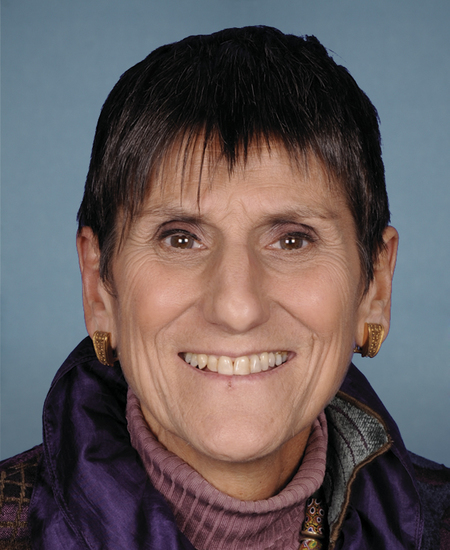
Rep. Rosa L. DeLauro
Sponsored bills
Prevent All Soring Tactics Act of 2022 or the PAST Act of 2022 This bill addresses the practice of soring horses. The soring of horses includes various actions taken on horses' limbs to produce higher gaits that may cause pain, distress, inflammation, or lameness. Specifically, the bill expands soring regulation and enforcement at horse shows, exhibitions, sales, and auctions, including by establishing a new system for inspecting horses for soring. In addition, the bill increases penalties for violations.
This concurrent resolution expresses the sense of Congress for ensuring the speediest end of the COVID-19 pandemic the United States and European governments should unite to enact a World Trade Organization Agreement on Trade-Related Aspects of Intellectual Property Rights waiver, require technology transfer, and otherwise facilitate access in low- and middle-income countries to high-quality COVID-19 mRNA vaccines; and vital U.S. partners, with shared values who also prioritize global cooperation and saving lives and livelihoods worldwide, should unite to remove all obstacles to global access to COVID-19 vaccines, diagnostics, treatments, oxygen, and other medical products to advance the common goal of quickly ending the COVID-19 pandemic. The resolution states that the U.S. government has an obligation to the American people, whose taxpayer funds helped to develop lifesaving COVID-19 vaccines, to ensure that doses are ultimately delivered to those most in need around the world so as to ensure the global COVID-19 vaccination necessary to end the pandemic.
Maddy summaryHJRES 53 proposes a constitutional amendment to ban slavery and involuntary servitude as a criminal punishment. Currently, the 13th Amendment to the U.S. Constitution permits such punishments for crimes, creating a legal loophole. If ratified by 3/4 of state legislatures, this amendment would eliminate that exception nationwide, making it unconstitutional to impose forced labor or slavery as part of criminal sentences. The change would directly affect all states' criminal justice systems, particularly prison labor practices, by prohibiting these punishments for any offense.
This joint resolution proposes a constitutional amendment providing that the rights protected by the Constitution are the rights of natural persons only. Artificial entities, such as corporations, shall have no rights under the Constitution and are subject to regulation. The amendment requires federal, state, and local government to (1) regulate, limit, or prohibit election contributions and expenditures, including a candidate's own contributions and expenditures; and (2) require that any permissible contributions and expenditures be publicly disclosed. The judiciary is prohibited from construing the spending of money to influence elections to be speech under the First Amendment, and the amendment shall not be construed to abridge the freedom of the press.
Maddy summaryThis resolution (HRES 981) commemorates the one-year anniversary of the March 16, 2021, Atlanta spa shootings that killed eight people, six of whom were Asian women, and denounces anti-Asian hate. It formally condemns the violence, honors the victims, and recognizes the ongoing impact of anti-Asian hate crimes on the Asian American and Pacific Islander community. The resolution reaffirms support for the existing COVID-19 Hate Crimes Act and commits the federal government to combating hate and violence against AAPI communities. As a symbolic measure, it does not create new laws or funding but serves as a formal statement of solidarity.
This resolution expresses the sense of the House of Representatives that the proposed constitutional amendment known as the Equal Rights Amendment has been duly proposed by Congress and ratified by the states and is therefore valid as the Twenty-Eighth Amendment to the Constitution. (The proposed amendment prohibits the United States or any state from denying or abridging equal rights under the law on account of sex.)
Providing Real Opportunities and Lifelong Investments For Everyone Act of 2022 or the PRO-LIFE Act of 2022 This bill establishes new, and modifies existing, programs related to maternal and child health, tax credits and other benefits for parents and caregivers, and support for childcare infrastructure. The bill requires multi-agency efforts to improve maternal health and reduce maternal mortality, particularly among racial and ethnic minority groups, veterans, and other vulnerable populations, by addressing both health-related factors and the social determinants of health (i.e., nonmedical factors that influence health outcomes, such as housing, food security, transportation, and environmental conditions). Additionally, the bill permanently extends the Children's Health Insurance Program (CHIP) and related measures. Further, the bill (1) sets up a family medical leave insurance benefit that entitles employees to a monthly benefit payment for a period of qualified caregiving; and (2) imposes a tax on employers, employees, and self-employed individuals to fund the benefits. The bill also increases the amount of the child tax credit and makes the credit fully refundable and payable in advance on a monthly basis. In addition, the Department of Labor must carry out a program to certify and recognize employers that implement family-friendly workplace programs (e.g., providing paid family and sick leave or subsidizing childcare). The bill also requires support for childcare infrastructure, for example by establishing grants for childcare facilities and scholarship and loan repayment programs for childcare educators.
Latonya Reeves Freedom Act of 2022 This bill prohibits government entities and insurance providers from denying community-based services to individuals with disabilities that require long-term service or support that would enable such individuals to live in the community and lead an independent life. Specifically, these entities may not discriminate against such individuals in the provision of community-based services by such actions as imposing prohibited eligibility criteria, cost caps, or waiting lists or failing to provide a specific community-based service. Additionally, community-based services must be offered to individuals with such disabilities prior to institutionalization. Institutionalized individuals must be notified regularly of community-based alternatives. The bill requires the Department of Justice to issue regulations requiring government entities and insurance providers to offer community-based long-term services to individuals with such disabilities who would otherwise qualify for institutional placement. Government entities must ensure sufficient availability of affordable, accessible, and integrated housing that is not a disability-specific residential setting or a setting where services are tied to tenancy. Regulations shall also (1) require government entities and insurance providers to perform self-evaluation on current services, policies, and practices and concerning compliance with requirements of this bill; and (2) require government entities to submit a transition plan. The bill provides funds for FY2022 for the Department of Health and Human Services to provide technical assistance with respect to transition plans. The bill allows civil actions by individuals subjected to, or about to be subjected to, a violation of its requirements.
Schedules That Work Act This bill provides employees with the right to request changes to their work schedules related to the number of hours they are required to work or be on call, the location of the work, the amount of notification about work schedule assignments, and fluctuations in work hours. Employers must negotiate in good faith with employees who make such requests and comply with certain work schedule notice and split shift pay requirements for retail, food service, cleaning, hospitality, or warehouse employees.