

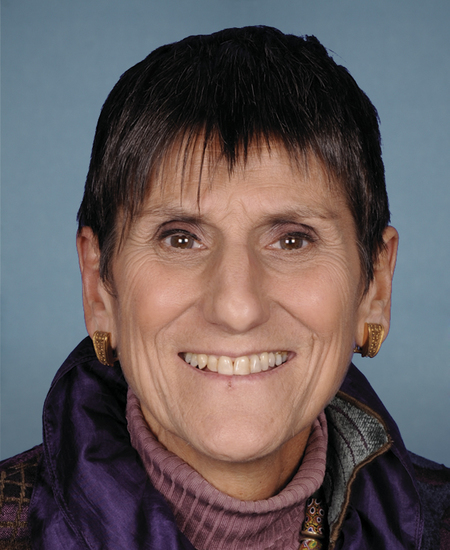
Photo of Rosa L. DeLauro
D United States House · District 3 · Connecticut On the 2026 ballot

Rep. Rosa L. DeLauro

Compare
Total votes
2,837
all sessions
Attendance
99%
32 missed
Near the chamber average
With party
98%
of cast votes
Higher than 82% of chamber peers
Bipartisan score
1%
crosses aisle rarely
Lower than 83% of chamber peers
Sponsored
814
bills & resolutions
Near the chamber average
Committees
2
assignments
814 bills and resolutions

Sponsored bills

Total
814
Primary
142
Co-sponsor
672
This page
814
matching current filters
Co-sponsor HR 5644
In committee · United States House · Co-sponsor
End Diaper Need Act of 2023

Maddy summaryThe End Diaper Need Act of 2023 creates a federal program that will provide free diapers and incontinence supplies to low-income families with infants, toddlers, medically complex children (3+ years old with chronic health conditions), and low-income adults with disabilities. It allocates $200 million annually from 2024-2027 to fund this assistance through states and community organizations, making medically necessary diapers eligible for reimbursement through health savings accounts and other health benefit programs. The legislation requires integration with existing services like Medicaid, WIC, and TANF, and includes annual reporting requirements and an evaluation of the program's effectiveness within two years.

In committee Dec 17, 2024 1 co-sponsor
Primary HR 4731
In committee · United States House · Lead sponsor
Access to Infertility Treatment and Care Act

Maddy summaryThe Access to Infertility Treatment and Care Act would require most health insurance plans to cover infertility treatment (including assisted reproductive technology like IVF) and fertility preservation services for people undergoing medical treatments that might cause infertility, such as cancer therapies. It prohibits cost-sharing (like deductibles and copays) for these services that exceeds what's charged for similar medical services and applies to private insurance, federal employee health plans, TRICARE, veterans' benefits, and Medicaid programs. The bill also requires insurers to provide clear notice to plan members about these coverage requirements. This legislation aims to ensure infertility treatment is covered similarly to other medical conditions, as recognized by medical organizations.

In committee Dec 17, 2024 0 co-sponsors
Co-sponsor HR 4583
In committee · United States House · Co-sponsor
Social Security 2100 Act

Maddy summaryThe Social Security 2100 Act would significantly enhance Social Security benefits for millions of Americans by increasing monthly payments for retirees, disabled workers, widows/widowers, and children. Key provisions include raising the minimum benefit for long-term low earners, improving cost-of-living adjustments using a more accurate index, eliminating the 5-month waiting period for disability benefits, and extending child benefits to age 26. The bill also changes how Social Security taxes are calculated by applying them to income above $400,000 and establishes a unified Social Security Trust Fund to manage program finances. Most provisions would apply to benefits payable from 2025 through 2034, affecting all current and future Social Security beneficiaries.

In committee Dec 17, 2024 1 co-sponsor
Co-sponsor HR 4260
In committee · United States House · Co-sponsor
Public Servants Protection and Fairness Act of 2023

Maddy summaryThis bill, the Public Servants Protection and Fairness Act of 2023, amends Social Security to better protect public servants who work in jobs not covered by Social Security (such as certain government positions). It creates a new formula for calculating retirement benefits that combines both covered and noncovered earnings, ensuring public servants receive the higher of two benefit calculations. The bill also provides an additional $150 monthly payment for certain public servants whose benefits were previously reduced by the windfall elimination provision. It improves Social Security account statements to clearly show noncovered earnings and requires a study of how state retirement plans handle these benefits. These changes will apply to benefits starting in 2025.

In committee Dec 17, 2024 1 co-sponsor
Co-sponsor HR 3589
In committee · United States House · Co-sponsor
Affordability is Access Act of 2023

Maddy summaryHR 3589, the Affordability is Access Act of 2023, requires health insurance plans to cover FDA-approved over-the-counter birth control without cost-sharing (like copays or deductibles). It directly affects millions of people who use contraception, particularly low-income individuals and those in areas with limited access to reproductive health services ("contraceptive deserts"). The bill clarifies that existing insurance coverage rules under the Affordable Care Act apply to over-the-counter contraceptives, and directs the FDA to expedite reviews for over-the-counter status. Retailers must not block access to these products but may refuse sales if payment isn’t provided.

In committee Dec 17, 2024 1 co-sponsor
Primary HR 3481
In committee · United States House · Lead sponsor
FAMILY Act

Maddy summaryThe FAMILY Act (HR 3481) would establish a national paid family and medical leave insurance program administered by the Social Security Administration. Eligible workers would receive wage replacement benefits (up to 85% of average earnings, with a maximum of $4,000 monthly) for up to 60 caregiving days per 12-month benefit period for qualifying reasons like caring for a sick family member, personal serious health conditions, or responding to domestic violence. The program would be funded through 0.2% payroll taxes from employees and employers (with self-employed individuals paying 0.4%), with benefits coordinated with existing state programs. The law includes protections against employer retaliation for taking leave and requires employers to maintain health coverage during leave periods.

In committee Dec 17, 2024 0 co-sponsors
Co-sponsor HR 3352
In committee · United States House · Co-sponsor
Improving Diaper Affordability Act of 2023

Maddy summaryThis bill would allow diapers to be counted as qualified medical expenses under federal tax law, enabling low-income families with infants and toddlers to use pre-tax funds from health savings accounts, dependent care benefits, and flexible spending arrangements to cover diaper costs. It also prohibits states and localities from imposing sales tax on diaper purchases. These changes directly benefit families who spend up to 14% of their income on diapers - over 5 million children in low-income households face this burden. The policy aims to reduce financial strain by expanding access to tax-advantaged spending for a basic need.

In committee Dec 17, 2024 1 co-sponsor
Primary HR 3136
In committee · United States House · Lead sponsor
National Critical Capabilities Defense Act of 2023

Maddy summaryThis bill establishes a new review process for certain foreign investments in U.S. companies operating in critical technology sectors like semiconductors, advanced batteries, artificial intelligence, and pharmaceuticals. It creates a Committee on National Critical Capabilities to review investments involving entities from designated "countries of concern" (including China, Russia, Iran, North Korea, and Venezuela). The Committee requires advance notifications for covered activities, can review these investments for national security risks, and may impose conditions or prohibit activities that threaten U.S. security. Covered activities include acquisitions, joint ventures, and other business arrangements with foreign entities from designated countries. The bill aims to protect U.S. national security by mitigating risks associated with foreign investments in strategic technology sectors.

In committee Dec 17, 2024 0 co-sponsors
Primary HR 3086
In committee · United States House · Lead sponsor
Find It Early Act

Maddy summaryHR 3086, the "Find It Early Act," requires health insurance plans to cover breast cancer screenings with no cost-sharing for certain individuals at higher risk of breast cancer. The bill affects people with increased risk (based on medical criteria or dense breast tissue) or those needing screening due to factors like age, race, ethnicity, or family history. Key provisions mandate coverage for 2D/3D mammograms, ultrasounds, MRI, and other technologies without frequency limits for these groups. This applies to group health plans, Medicare, Medicaid, TRICARE, and VA healthcare systems starting January 1, 2024. The law aims to improve early detection by removing financial barriers to necessary screenings.

In committee Dec 17, 2024 0 co-sponsors
Co-sponsor HR 2534
In committee · United States House · Co-sponsor
PROTECT 340B Act of 2023

Maddy summaryThe PROTECT 340B Act of 2023 prohibits pharmacy benefit managers (PBMs), health insurance plans, and health insurance issuers from discriminating against healthcare providers participating in the 340B drug pricing program. It specifically bans these entities from paying less for 340B drugs than they would for similar drugs dispensed by non-340B providers, imposing special requirements on 340B providers, or requiring identification of 340B drugs in billing. The bill establishes civil penalties of up to $5,000 per violation per day for PBMs that violate these protections and requires the Health Resources and Services Administration to create implementing regulations. It directly affects safety-net hospitals, clinics, and health centers that serve low-income patients, particularly those in rural areas, by protecting their ability to use 340B drug discounts to provide affordable care.

In committee Dec 17, 2024 1 co-sponsor
Showing 281 to 290 of 814 bills
Previous 1 … 28 29 30 … 82 Next