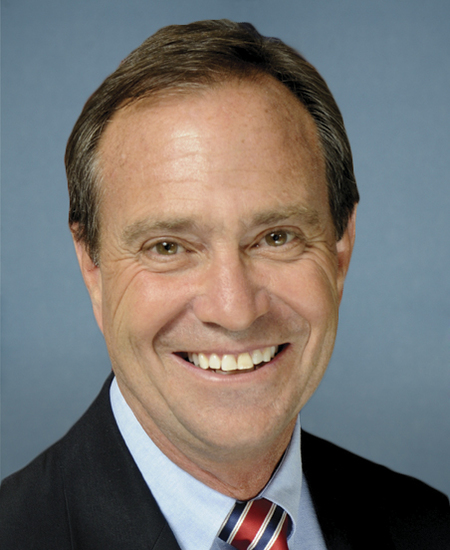
Photo of Ed Perlmutter
D United States House · District 7 · Colorado

Rep. Ed Perlmutter

Compare
Total votes
958
all sessions
Attendance
99%
5 missed
Near the chamber average
With party
98%
of cast votes
Higher than 78% of chamber peers
Bipartisan score
1%
crosses aisle rarely
Lower than 80% of chamber peers
Sponsored
366
bills & resolutions
Near the chamber average
Committees
0
assignments
366 bills and resolutions

Sponsored bills

Total
366
Primary
18
Co-sponsor
348
This page
366
matching current filters
Co-sponsor HR 7079
In committee · United States House · Co-sponsor
Cut Red Tape For Online Sales Act

Cut Red Tape For Online Sales Act This bill modifies requirements for third party settlement organizations to eliminate their reporting requirement with respect to the transactions of their participating payees unless they have earned $5,000 or more. A third party settlement organization is the central organization that has the contractual obligation to make payments to participating payees (generally, a merchant or business) in a third party payment network. The bill also requires entities that report income to to issue a plain-language description of the taxability of income reported on Form 1099-K.

In committee Mar 15, 2022 1 co-sponsor
Co-sponsor HRES 881
Passed · United States House · Co-sponsor
Condemning the heinous terrorist attack on Congregation Beth Israel in Colleyville, Texas, on January 15, 2022.

This resolution condemns the terrorist attack on Congregation Beth Israel in Colleyville, Texas, on January 15, 2022. It also expresses support for the affected community, commends the actions of law enforcement and emergency responders, and reaffirms a commitment to combat hate, bigotry, anti-Semitism, and violence against Jewish Americans.

Passed Mar 8, 2022 1 co-sponsor
Co-sponsor HR 3755
Passed · United States House · Co-sponsor
Women's Health Protection Act of 2021

Women's Health Protection Act of 2021 This bill prohibits governmental restrictions on the provision of, and access to, abortion services. Specifically, governments may not limit a provider's ability to prescribe certain drugs, offer abortion services via telemedicine, or immediately provide abortion services when the provider determines a delay risks the patient's health. Furthermore, governments may not require a provider to perform unnecessary medical procedures, provide medically inaccurate information, comply with credentialing or other conditions that do not apply to providers whose services are medically comparable to abortions, or carry out all services connected to an abortion. In addition, governments may not (1) require patients to make medically unnecessary in-person visits before receiving abortion services or disclose their reasons for obtaining such services, or (2) prohibit abortion services before fetal viability or after fetal viability when a provider determines the pregnancy risks the patient's life or health. The bill also prohibits other governmental measures that are similar to the bill's specified restrictions or that otherwise single out and impede access to abortion services, unless a government demonstrates that the measure significantly advances the safety of abortion services or health of patients and cannot be achieved through less restrictive means. The Department of Justice, individuals, or providers may bring a lawsuit to enforce this bill, and states are not immune from suits for violations. The bill applies to restrictions imposed both prior and subsequent to the bill's enactment.


Passed Feb 28, 2022 1 co-sponsor
Co-sponsor HRES 942
In committee · United States House · Co-sponsor
Original Black History Month Resolution of 2022

Original Black History Month Resolution of 2022 This resolution recognizes the importance of commemorating Black History Month to acknowledge the achievements of Black Americans throughout history.

In committee Feb 25, 2022 1 co-sponsor
Co-sponsor HRES 915
In committee Feb 9, 2022 1 co-sponsor
Co-sponsor HR 6583
In committee · United States House · Co-sponsor
Stop the Wait Act of 2022

Stop the Wait Act of 2022 This bill allows individuals with disabilities to begin receiving Social Security Disability Insurance (SSDI) benefits in the month they become eligible for the benefits. It also allows these individuals to immediately enroll in Medicare if they cannot afford minimum essential coverage. (Under current law, an individual must generally wait 5 months after the onset of disability to begin receiving SSDI benefits and an additional 24 months to become eligible for Medicare.)

In committee Feb 4, 2022 1 co-sponsor
Primary HRES 860
Passed · United States House · Lead sponsor
Providing for consideration of the bill (H.R. 1836) to amend title 38, United States Code, to ensure that the time during which members of the Armed Forces serve on active duty for training qualifies for educational assistance under the Post-9/11 Educational Assistance Program of the Department of Veterans Affairs, and for other purposes; providing for consideration of the bill (H.R. 4673) to amend title 38, United States Code, to provide for the automatic enrollment of eligible veterans in patient enrollment system of Department of Veterans Affairs, and for other purposes; and for other purposes.

This resolution sets forth rules for consideration of H.R. 1836 (expanding eligibility for Post-9/11 GI Bill educational assistance) and rules for consideration of H.R. 4673 (providing for the automatic enrollment of eligible veterans in the Department of Veterans Affairs health care system). The resolution also amends H.Res. 188 (regarding certain procedural requirements in the House of Representatives).

Passed Jan 11, 2022 0 co-sponsors
Co-sponsor HR 6000
In committee · United States House · Co-sponsor
Cures 2.0 Act

Cures 2.0 Act This bill addresses pandemic preparedness and public health issues, caregiver and patient engagement, drug development, insurance coverage, and biomedical research. The Department of Health and Human Services (HHS) must undertake research and other activities concerning COVID-19 and develop a strategy for future pandemics and declared emergencies. Additionally, the bill specifies actions to combat antimicrobial resistance. HHS may award grants for caregiver training. The bill also addresses diversity in clinical trials, collecting patient experience data during clinical trials, and coverage for care related to participation in specified clinical trials. The bill modifies the timeframe and requires additional guidance relating to expedited approval of certain breakthrough drugs, devices, or products. It also establishes two intercenter institutes within the Food and Drug Administration (FDA) focused on particular diseases that meet specified criteria. The bill also addresses (1) coverage in Medicare, Medicaid, and the Children's Health Insurance Program for telehealth, genetic and genomic testing, and other services; (2) electronic prescribing standards for Medicare drug benefits; and (3) access to Medicare and Medicaid claims data by certain registries. Furthermore, the bill prohibits the use of geographic tracking or biometrics in Medicaid electronic visit verification systems. The bill establishes the Advanced Research Projects Agency for Health (ARPA-H) within the National Institutes of Health to accelerate biomedical research and innovation through grants, contracts, cash prizes, and other means. The FDA may work with ARPA-H to expedite the development of medical products through specified activities.

In committee Jan 4, 2022 1 co-sponsor
Showing 121 to 130 of 366 bills
Previous 1 … 12 13 14 … 37 Next