

This bill limits eligibility for the Public Service Loan Forgiveness (PSLF) program to borrowers with adjusted gross incomes below a certain maximum threshold. Under the current PSLF program, the Department of Education must cancel the balance of interest and principal due on a borrower's Federal Direct Loans after the borrower makes 120 monthly loan payments while employed in a public service job and, at the time of loan forgiveness, the borrower is employed in a public service job. This bill specifies that, in order to count as a qualifying monthly loan payment under the PSLF program, the borrower must have an adjusted gross income that does not exceed $173,000.
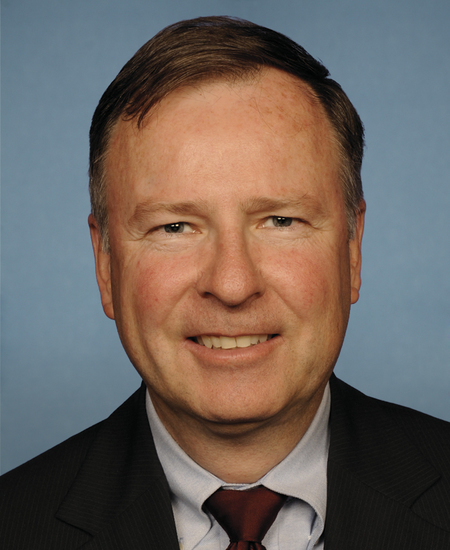
Rep. Doug Lamborn
Sponsored bills
Promoting Cross-b order Energy Infrastructure Act This bill establishes a new process for approving the construction and operation of energy infrastructure across an international border of the United States and replaces the existing process established under specified executive orders. Specifically, this bill requires a person to obtain a certificate of crossing before constructing, connecting, operating, or maintaining a border-crossing facility for the import or export of oil, natural gas, or electricity across an international border. A certificate must be obtained from the Federal Energy Regulatory Commission (FERC) for a facility consisting of oil or natural gas pipelines or the Department of Energy (DOE) for an electric transmission facility. As a condition of issuing a certificate, DOE must require that an electric transmission facility be constructed, connected, operated, or maintained consistent with specified policies and standards. FERC and DOE must meet a deadline for issuing a certificate as set forth by this bill. The bill also requires FERC to meet a deadline for approving applications to import or export natural gas to or from Canada or Mexico.
This concurrent resolution recognizes the historic significance of the 70th anniversary of the founding of the U.S. Army Special Forces and honors Colonel Aaron Bank for his role in establishing the U.S. Army Special Forces. The concurrent resolution also recognizes the sacrifices and accomplishments of U.S. Army Special Forces soldiers and other special operations soldiers in the Armed Forces.
No Transferring GITMO Terrorists to America Act of 2022 This bill prohibits the use of Department of Defense (DOD) funds to transfer, release, or assist in the transfer or release of any individual detained at Guantanamo to or within the United States or its territories or possessions. Individuals detained at Guantanamo means those detained as of October 1, 2009, who are not citizens of the United States or members of the U.S. Armed Forces and are in the custody or under the control of DOD or otherwise under detention. The bill also prohibits DOD funds from being used to construct or modify any facility in the United States or its territories or possessions to house any individual detained at Guantanamo for the purpose of detention or imprisonment in the custody or under the control of DOD. This prohibition does not apply to any modification of facilities at United States Naval Station, Guantanamo Bay, Cuba.
WHO Withdrawal Act This bill requires the President to immediately withdraw the United States from the World Health Organization (WHO) and prohibits using any federal funds to provide for U.S. participation in the WHO. The bill also repeals the 1948 act authorizing the United States to join the WHO.
Defending Freedom of Conscience for Cadets and Midshipmen Act of 2022 This bill provides that a cadet or midshipman at a federal service academy (e.g., the U.S. Naval Academy) may not be required to be vaccinated for COVID-19 as a condition for graduation and may not be dismissed from the academy as a result of refusing to be vaccinated. Cadets and midshipmen who are prohibited from fulfilling their service agreement due to their refusal to receive a COVID-19 vaccination may not be subjected to repayment provisions (e.g., bonus repayment) or specified debt repayment collections.
Halting Academic Liaisons To Our Adversaries Act or the HALT Our Adversaries Act This bill requires the Department of Defense (DOD) to identify academic institutions of China, Russia, and other countries that are known to provide support to China's People's Liberation Army or Russia's armed forces. Further, the bill prohibits an institution of higher education from receiving federal funds if it maintains a contract or other agreement with such an academic institution identified by DOD.
Taylor Force Martyr Payment Prevention Act of 2022 This bill expands the institutional factors the Department of the Treasury must consider when making a finding that a foreign financial institution is of primary money laundering concern and is therefore subject to special measures, including the prohibition of opening or maintaining correspondent accounts in U.S financial institutions. Specifically, Treasury must consider (1) the extent to which an institution knowingly provides financial services to Hamas, or to an agent of Hamas; and (2) the extent to which an institution, transaction, or type of account is used to facilitate or promote payments for certain acts of terrorism against U.S. and Israeli citizens.
Trust the Science Act This bill directs the Department of the Interior to remove protections for the gray wolf under the Endangered Species Act of 1973 (ESA). Specifically, the bill requires Interior to reissue the final rule titled Endangered and Threatened Wildlife and Plants; Removing the Gray Wolf (Canis lupus) From the List of Endangered and Threatened Wildlife and published on November 3, 2020. The rule removed the gray wolf in the lower 48 United States, except for the Mexican wolf ( C. l. baileyi ) subspecies, from the endangered and threatened species list. However, the U.S. District Court for the Northern District of California vacated the rule on February 10, 2022. As a result, the gray wolf reattained the protection status it had prior to the rule's promulgation. The bill also prohibits the reissuance of the rule from being subject to judicial review.
Geospatial Support for Atrocity Accountability Act This bill requires the Department of State to ensure that information and intelligence related to war crimes and atrocities are shared within the State Department and with certain other entities. For example, the State Department's Atrocity Warning Task Force must provide unclassified commercial geospatial imagery to domestic and international courts prosecuting persons responsible for crimes against humanity, if such imagery may provide evidence of such crimes.