

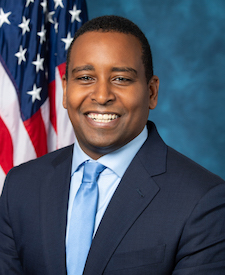
Photo of Joe Neguse
D United States House · District 2 · Colorado On the 2026 ballot

Rep. Joe Neguse

Compare
Total votes
2,837
all sessions
Attendance
100%
4 missed
Higher than 92% of chamber peers
With party
99%
of cast votes
Near the chamber average
Bipartisan score
1%
crosses aisle rarely
Near the chamber average
Sponsored
2,383
bills & resolutions
Higher than 95% of chamber peers
Committees
8
assignments
2,383 bills and resolutions

Sponsored bills

Total
2,383
Primary
300
Co-sponsor
2,083
This page
2,383
matching current filters
Co-sponsor HR 802
In committee · United States House · Co-sponsor
STAR Act of 2025

Maddy summaryThe STAR Act of 2025 adds a 25% tax credit for qualified semiconductor design expenses incurred by U.S. companies. It directly affects businesses conducting semiconductor design in the United States, covering both in-house costs (like wages and supplies for U.S. design work) and contracted design services. The credit excludes duplicating existing products, cosmetic design, or activities unrelated to performance or reliability improvements. This incentive expires for design expenses paid after December 31, 2036.

In committee Jan 28, 2025 1 co-sponsor
Co-sponsor HR 764
In committee · United States House · Co-sponsor
Global Health, Empowerment and Rights Act

Maddy summaryHR 764, the Global Health, Empowerment and Rights Act, removes two barriers for foreign nongovernmental organizations (NGOs) seeking U.S. foreign assistance. It ensures these organizations cannot be denied funding solely because they provide health services (like counseling and referrals) using non-U.S. government funds, as long as those services comply with local laws. The bill also requires that foreign NGOs face the same rules on using non-U.S. funds for advocacy and lobbying as U.S. NGOs receiving similar aid. This directly affects international health-focused NGOs working in countries where U.S. aid is provided.

In committee Jan 28, 2025 1 co-sponsor
Co-sponsor HR 753
In committee · United States House · Co-sponsor
FIRE Act of 2025

Maddy summaryHR 753, the FIRE Act of 2025, directs the NOAA Administrator to establish a program improving wildfire forecasting and detection to reduce loss of life and property. The bill requires developing advanced satellite detection, fuel moisture assessments, and coupled fire-atmosphere modeling systems to better predict wildfire spread, smoke dispersion, and enable early detection. It authorizes $15 million for fiscal year 2026 to fund research testbeds for these capabilities, created through NOAA partnerships with industry and academia. This program directly affects communities at wildfire risk, firefighters, and emergency responders by enhancing early warning systems and risk communication.

In committee Jan 28, 2025 1 co-sponsor
Co-sponsor HR 801
In committee · United States House · Co-sponsor
Charitable Act

Maddy summaryHR 801, the Charitable Act, creates a new tax deduction for individuals who do not itemize deductions on their federal tax returns. It allows these taxpayers to deduct up to one-third of their standard deduction amount for charitable contributions in 2026 and 2027. The bill directly affects non-itemizing individual taxpayers by providing a limited, direct deduction for charitable giving without requiring them to itemize. The deduction is capped at 1/3 of the standard deduction amount for those tax years, effective for returns filed in 2027 and 2028.

In committee Jan 28, 2025 1 co-sponsor
Co-sponsor HRES 68
In committee · United States House · Co-sponsor
Expressing strong disapproval of the President's announcement to withdraw the United States from the Paris Agreement.

Maddy summaryHRES 68 is a non-binding House resolution expressing strong disapproval of the President’s announcement to withdraw the U.S. from the Paris Agreement. It commends states, businesses, and citizens supporting the Agreement, urges the President to reverse the withdrawal decision, and calls for Congress to prioritize U.S. climate leadership. The resolution does not create new laws or affect specific groups but formally states the House’s position against withdrawing from the international climate accord. It was introduced by 115 co-sponsors and reflects broad congressional concern about reversing U.S. climate commitments.

In committee Jan 24, 2025 1 co-sponsor
Co-sponsor HR 712
In committee · United States House · Co-sponsor
Child and Animal Abuse Detection and Reporting Act

Maddy summaryHR 712, the Child and Animal Abuse Detection and Reporting Act, amends federal law to require the national clearinghouse tracking child abuse and neglect data to also collect information on animal abuse incidents connected to child abuse cases. Specifically, it expands the existing data collection framework to include "the incidence of any such cases related to animal abuse," such as when a family's pets are harmed during a child abuse situation. This means state child welfare agencies reporting to the federal clearinghouse must now include animal abuse data tied to child abuse incidents, without requiring separate animal cruelty reports. The bill directly affects the federal agency managing the clearinghouse (within the Department of Health and Human Services) and state child welfare systems that provide this data.

In committee Jan 23, 2025 1 co-sponsor
Co-sponsor HR 715
In committee · United States House · Co-sponsor
BNA Fairness Act

Maddy summaryHR 715, the BNA Fairness Act, amends the tax code to exclude the basic needs allowance provided to members of the Armed Forces from taxable income. This allowance, paid for daily living expenses like food and housing, directly affects active-duty service members who receive it. The bill adds a specific provision clarifying that this allowance qualifies as a non-taxable "qualified military benefit" under existing tax law. The change takes effect for tax years after the bill becomes law, ensuring service members no longer pay income tax on this specific benefit.

In committee Jan 23, 2025 1 co-sponsor
Co-sponsor HR 705
In committee · United States House · Co-sponsor
To direct the Secretary of Defense to establish a compensation fund for military firefighters exposed to PFAS.

Maddy summaryHR 705 establishes a Military Firefighters Compensation Fund within two years of enactment to provide compensation for current and former military firefighters (including some contractors) who develop illnesses due to PFAS exposure during their duties. It presumes exposure occurred if they worked at military installations or National Guard facilities during periods when PFAS was present. Compensation covers disabilities or death from such illnesses, with payments prioritized to surviving spouses, then children, parents, and other relatives as specified. The fund also covers related medical benefits, transportation, and supplies for qualifying individuals.

In committee Jan 23, 2025 1 co-sponsor
Co-sponsor HR 621
In committee · United States House · Co-sponsor
Protecting First Responders from Secondary Exposure Act of 2025

Maddy summaryThe Protecting First Responders from Secondary Exposure Act of 2025 requires federal funding to provide training and containment devices for first responders, specifically to prevent exposure to fentanyl and other dangerous substances during emergencies. This bill directly affects police, firefighters, and emergency medical personnel who face accidental exposure risks while responding to drug-related incidents. The key provision amends existing federal law to mandate both training resources and the purchase of specialized containment equipment for first responder use. The policy change aims to reduce health risks from secondary exposure without altering drug enforcement or criminal law.

In committee Jan 22, 2025 1 co-sponsor
Co-sponsor HR 637
In committee · United States House · Co-sponsor
911 SAVES Act

Supporting Accurate Views of Emergency Services Act of 2025 or the 911 SAVES Act This bill requires the Office of Management and Budget to categorize public safety telecommunicators as a protective service occupation under the Standard Occupational Classification system no later than 30 days after the enactment of this bill. (The Standard Occupational Classification system is a federal statistical standard used by federal agencies to classify workers into occupational categories for the purpose of collecting, calculating, or disseminating data.)

In committee Jan 22, 2025 1 co-sponsor
Showing 681 to 690 of 2,383 bills
Previous 1 … 68 69 70 … 239 Next