

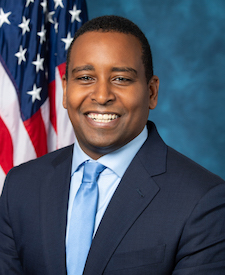
Photo of Joe Neguse
D United States House · District 2 · Colorado On the 2026 ballot

Rep. Joe Neguse

Compare
Total votes
2,837
all sessions
Attendance
100%
4 missed
Higher than 92% of chamber peers
With party
99%
of cast votes
Near the chamber average
Bipartisan score
1%
crosses aisle rarely
Near the chamber average
Sponsored
2,383
bills & resolutions
Higher than 95% of chamber peers
Committees
8
assignments
2,383 bills and resolutions

Sponsored bills

Total
2,383
Primary
300
Co-sponsor
2,083
This page
2,383
matching current filters
Co-sponsor HR 3305
In committee · United States House · Co-sponsor
LEO Fair Retirement Act of 2025

Maddy summaryThe LEO Fair Retirement Act of 2025 allows federal law enforcement officers to include unpaid overtime hours in their retirement benefit calculations. Currently, pay caps prevent officers from being compensated for all overtime worked, meaning they miss out on retirement credit for those hours. To qualify, officers must make a lump-sum payment (or choose a reduced monthly annuity) to cover the retirement contributions they would have made if paid, based on their actual overtime hours. This applies to officers covered by the Civil Service Retirement System (CSRS) or Federal Employees Retirement System (FERS), and the bill also provides a tax credit for the lump-sum payment.

In committee May 8, 2025 1 co-sponsor
Co-sponsor HR 3277
In committee · United States House · Co-sponsor
Ensuring Lasting Smiles Act

Maddy summaryHR 3277, the Ensuring Lasting Smiles Act, requires group health plans and health insurance issuers to cover medically necessary outpatient and inpatient treatments for congenital anomalies or birth defects primarily affecting the eyes, ears, teeth, mouth, or jaw. This includes reconstructive procedures, dental/orthodontic support during treatment, and follow-up care, but excludes purely cosmetic surgery not tied to a medical diagnosis. Cost-sharing (like copays) for these services must not be stricter than for other medical benefits. The law takes effect for plan years beginning January 1, 2026, and mandates insurers to provide notice about this coverage to beneficiaries.

In committee May 8, 2025 1 co-sponsor
Co-sponsor HR 3312
In committee · United States House · Co-sponsor
SERVICE Act of 2025

Maddy summaryThe SERVICE Act of 2025 creates a federal grant program to fund local veteran response teams within law enforcement agencies. These teams, composed of veteran officers and community partners, will provide 24/7 crisis response for at-risk veterans, coordinate with the Department of Veterans Affairs, and offer mental health training focused on military-related issues like PTSD. The program directly affects veterans in crisis and law enforcement agencies that receive grants to establish these teams. It requires teams to track outcomes and share best practices, with funding tied to existing crime control grants for fiscal years 2026-2030.

In committee May 8, 2025 1 co-sponsor
Co-sponsor HR 3296
In committee · United States House · Co-sponsor
MIL FMLA Act

Maddy summaryThe MIL FMLA Act expands the Family and Medical Leave Act to provide military families with additional leave options. It allows eligible employees to take up to 26 workweeks of leave during a 12-month period to care for a covered servicemember (active duty member or veteran), regardless of the employee's family relationship to the servicemember. The bill adds new definitions to include domestic partners, grandparents, siblings, and other extended family members as eligible caregivers, and creates a new "veteran leave" provision for employees who are covered servicemembers needing leave due to service-related serious injury or illness. These changes aim to better support military families by providing more comprehensive leave options for caregiving needs related to military service.

In committee May 8, 2025 1 co-sponsor
Co-sponsor HR 3304
In committee · United States House · Co-sponsor
Providing Child Care for Police Officers Act of 2025

Maddy summaryHR 3304, the Providing Child Care for Police Officers Act of 2025, establishes a federal grant program to help law enforcement agencies provide child care for officers' minor children during nonstandard shifts. The program awards competitive 3-year grants to state or local "lead agencies" (like state child care offices) to fund child care services through eligible law enforcement agencies or consortia, with 20% of funds reserved for small agencies (under 200 officers). Grants cover startup costs, provider training, sick child care, facility construction, and other needs, requiring local matching funds (10% to 33% over three years). The program is authorized for $24 million annually from 2026-2030 and includes studies to evaluate its impact on child care access for officers and other first responders.

In committee May 8, 2025 1 co-sponsor
Co-sponsor HR 3243
In committee · United States House · Co-sponsor
Therapeutic Fraud Prevention Act of 2025

Maddy summaryHR 3243, the Therapeutic Fraud Prevention Act of 2025, bans the provision of paid conversion therapy aimed at changing a person's sexual orientation or gender identity, and prohibits advertising such therapy as effective, safe, or without risk. It directly affects LGBTQ+ individuals and their families who might be targeted by these practices, as professionals have determined conversion therapy is ineffective and harmful. The law treats violations as deceptive acts under consumer protection laws, empowering the Federal Trade Commission and state attorneys general to enforce it through civil actions. It explicitly excludes legitimate gender transition support and non-discriminatory counseling from the ban.

In committee May 7, 2025 1 co-sponsor
Co-sponsor HR 3226
In committee · United States House · Co-sponsor
Law Enforcement Officers Equity Act

Maddy summaryThe Law Enforcement Officers Equity Act expands federal retirement benefits to include specific non-traditional law enforcement roles, such as IRS tax collection officers, U.S. Postal Inspection Service employees, Department of Veterans Affairs police, and certain U.S. Customs and Border Protection seized property specialists. It directly affects current and future federal workers in these positions who were previously excluded from law enforcement retirement benefits under the Federal Employees Retirement System and Civil Service Retirement System. The bill allows current employees (incumbents) to elect to count prior service toward retirement by paying a deposit covering the difference in retirement contributions, with government contributions made over 10 years. It also temporarily exempts law enforcement officers from mandatory separation for three years after enactment.

In committee May 7, 2025 1 co-sponsor
Co-sponsor HR 3241
In committee · United States House · Co-sponsor
Defense Workforce Integration Act of 2025

Maddy summaryHR 3241, the Defense Workforce Integration Act of 2025, creates pathways for military personnel medically disqualified from service to transition into civilian defense jobs. It requires the Defense Department to establish a process within one year for entry-level service members (like those in basic training or ROTC) who can't serve due to medical reasons to qualify for civilian roles in the Department of Defense. The bill also mandates a new program to connect medically disqualified individuals with employment opportunities in the defense industrial base, cybersecurity, research, and other national security support roles. Additionally, it directs the Navy to provide career information about Military Sealift Command and shipbuilder training to personnel during transition assistance. The Secretary of Defense must report on implementation to Congress within one year.

In committee May 7, 2025 1 co-sponsor
Co-sponsor HR 3246
In committee · United States House · Co-sponsor
Violet’s Law

Maddy summaryHR 3246, "Violet’s Law," amends the Animal Welfare Act to require federal research facilities to create plans for placing eligible animals (dogs, cats, nonhuman primates, guinea pigs, hamsters, or rabbits) no longer needed for research. It directs federal departments and agencies operating such facilities to develop standards within one year of enactment to facilitate adoption or placement with qualified organizations like animal rescue groups, sanctuaries, or shelters. Animals must be certified by a licensed veterinarian as free of infectious disease or physical issues endangering health before release. This applies directly to all U.S. federal agencies conducting animal research, mandating concrete steps to transition animals out of research settings into permanent care.

In committee May 7, 2025 1 co-sponsor
Co-sponsor HR 3184
In committee · United States House · Co-sponsor
PFAS Alternatives Act

Maddy summaryHR 3184, the PFAS Alternatives Act, funds research to develop turnout gear (firefighter safety clothing) without harmful PFAS chemicals, directly affecting firefighters who wear this gear. It authorizes $25 million annually (2025-2029) for grants to eligible organizations to research and test PFAS-free gear, requiring partnerships with firefighting groups to translate findings into practice. The bill also allocates $2 million yearly (2027-2031) for training programs on safe gear use and decontamination. Its goal is to reduce firefighters' exposure to chemicals linked to occupational illnesses during operations.

In committee May 6, 2025 1 co-sponsor
Showing 441 to 450 of 2,383 bills
Previous 1 … 44 45 46 … 239 Next