

Averting Loss of Life and Injury by Expediting SIVs Act of 2021 or the Allies Act of 2021 This bill increases the number of special immigrant visas available to qualified Afghan nationals who worked for the U.S. government or the North Atlantic Treaty Organization (NATO) missions in Afghanistan. The bill also relaxes certain qualifications for such visas. Specifically, this bill makes available an additional 8,000 visas for principal aliens under this special visa program, to be available until all such visas have been issued. (The numerical limitations in this program apply only to the principal alien who applies for the visa, not to any accompanying spouse or child.) Under this bill, an alien may qualify based on a credible basis for concern about the possibility of an ongoing serious threat in Afghanistan due to their work with the U.S. government or a NATO mission, where currently the alien must have experienced such a threat. The bill also eliminates a requirement for each applicant to submit a credible sworn statement describing that threat. Furthermore, for an applicant qualifying for a visa by performing duties for U.S. military personnel stationed with a NATO mission, this bill eliminates a requirement that the duties performed qualify as sensitive and trusted duties. If an alien submits a visa application that included an accompanying spouse or child but the alien passes away before the application is granted, the surviving spouse or child shall remain eligible to receive a visa under that application. Currently, a surviving spouse or child retains eligibility only if the application was approved before the alien passed away.
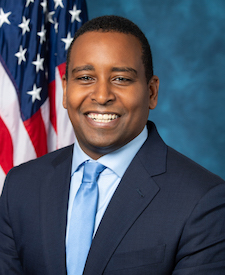
Rep. Joe Neguse
Sponsored bills
Universal School Meals Program Act of 2021 This bill revises requirements under the food and nutrition programs of the Department of Agriculture, such as the school lunch and breakfast programs. For example, the bill permanently provides free meals to all school children regardless of income. The bill increases the reimbursement rate for school food authorities participating in the food and nutrition programs. The bill also prohibits school food authorities from (1) physically segregating or otherwise discriminating against any child participating in the free breakfast program, or (2) overtly identifying a child participating in the program with a special token or announcement. Additionally, the bill expands the summer food service program by making all children eligible for participation in the program. Further, the bill revises eligibility determinations for measuring poverty to include runaway or homeless youth, foster children, migratory children, and children participating in specified programs (e.g., Head Start).
VOCA Fix to Sustain the Crime Victims Fund Act of 2021 This bill adds a new source of revenue for the Crime Victims Fund and makes changes to formula grants supported by the fund. Specifically, the bill directs revenues collected from deferred prosecution and non-prosecution agreements to be deposited into the Crime Victims Fund. Currently, such revenues are deposited into the general fund of the Treasury. Additionally, the bill increases the percentage—from 60% to 75%—of state compensation payments to crime victims in the prior fiscal year used to calculate formula grants for state victim compensation programs. Finally, the bill directs states to waive the matching requirement for recipients of state victim assistance formula grants during and for one year after a pandemic-related national emergency. It also allows states to waive the matching requirement pursuant to a policy established by the state.
This resolution recognizes the selfless dedication to fellow citizens displayed through heroic actions across the country and calls upon the Members of the House of Representatives and all people of the United States to observe a National Heroes Day.
This resolution reaffirms the House of Representatives' commitment to media diversity and expresses its pledge to eliminate barriers to such diversity.
Water and Agriculture Tax Reform Act of 2021 This bill permits tax-exempt mutual ditch or irrigation companies to earn income from dispositions of certain property and stock interests without affecting their tax-exempt status, but requires that such income be used to pay the costs of operations, maintenance, and capital improvements of such a company. The bill also establishes a rule regarding the organizational governance of mutual ditch or irrigation companies. Where state law provides that such a company may be organized in a manner that permits voting on a basis that is pro rata to share ownership on corporate governance matters, the tax-exempt status of the mutual ditch or irrigation company must be determined without taking into account whether its member shareholders have one vote on corporate governance matters per share held in the corporation.
Reverse Transfer Efficiency Act of 2021 This bill allows the release of a transfer student's educational records from an institution of postsecondary education where a student earned credit for coursework to an institution of postsecondary education where the student was previously enrolled in order to apply the student's coursework and credits toward completion of a recognized postsecondary credential, such as an associate's degree. Specifically, the bill allows the Department of Education to provide funding to an institution of postsecondary education that releases a student's records of postsecondary coursework and credits without the consent of the student or the student's parents if the student provides written consent prior to receiving the credential.
Medium- and Heavy-Duty Electric Vehicle Infrastructure Act of 2021 This bill directs the Environmental Protection Agency to establish a rebate program that encourages the purchase and installation of electric vehicle charging equipment for medium-duty electric vehicles and heavy-duty electric vehicles.
Helping Ensure Access to Local TeleHealth Act of 2021 or the HEALTH Act of 2021 This bill modifies requirements relating to Medicare coverage of telehealth services, including services that are furnished by federally qualified health centers (FQHCs) and rural health clinics (RHCs). Specifically, the bill expands coverage to include audio-only telehealth services. It also permanently allows FQHCs and RHCs to serve as the distant site (i.e., the location of the health care practitioner) for telehealth services and excludes such services from certain geographic restrictions. Payment must be made in the same manner as for non-telehealth services, rather than in accordance with a separate methodology determined by the Centers for Medicare & Medicaid Services.
End Double Taxation of Successful Consumer Claims Act This bill allows a deduction from gross income (above-the-line deduction) for attorney fees and court costs in connection with a claim of a consumer protection violation.