

Wildlife Conservation and Anti-Trafficking Act of 2021 This bill sets forth provisions relating to wildlife conservation, anti-trafficking and poaching, and illegal fishing. Specifically, the bill directs the Departments of Justice, the Interior, Commerce, State, and the Treasury to develop a plan of action for awards to whistleblowers of violations of laws applicable to wildlife trafficking; directs Interior to carry out the International Wildlife Conservation Program to, among other things, address global conservation threats and combat wildlife trafficking and poaching; provides funding for the conservation of certain endangered species; authorizes Interior, in consultation with the State Department, to station not less than one U.S. Fish and Wildlife Service officer in the primary diplomatic or consular post of the United States in a focus country or country of concern (i.e., countries engaging in wildlife trafficking); and directs Commerce to make amounts available for illegal, unreported, and unregulated fishing enforcement. The bill also modifies the federal criminal code to make wildlife trafficking and illegal fishing predicates with respect to the enforcement of certain criminal offenses, including racketeering and money laundering.
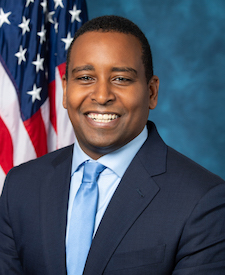
Rep. Joe Neguse
Sponsored bills
Downwinders Parity Act of 2021 This bill expands a program that compensates individuals who were exposed to radiation from atmospheric nuclear testing and subsequently developed specified cancers. Under current law, the program compensates, among others, individuals who were present in a designated geographic area during a period of nuclear testing. The bill expands that area to include all parts of Clark County, Nevada, and Mohave County, Arizona. Current law restricts eligibility to certain parts of those counties. The Department of Justice must report on efforts to inform individuals newly eligible for compensation about the program.
Safe Routes to All Schools Act This bill expands the safe route to school program of the Department of Transportation to high schools. Currently, the program is carried out for the benefit of children in primary and middle schools (schools providing education from kindergarten through eighth grade).
Clean Cooking Support Act This bill provides for a way of increasing the number of clean cookstoves and fuels for household, institutional, or commercial use throughout the world. The Department of State and the U.S. Agency for International Development (USAID) shall jointly establish the Clean Cooking Interagency Working Group to assist with overseeing the planning, management, and coordination of initiatives to increase the number of clean cookstoves and fuels worldwide. The State Department, USAID, the Department of Energy, the National Institutes of Health, the Centers for Disease Control and Prevention, and the Environmental Protection Agency shall work with the Clean Cooking Alliance to carry out clean cooking activities that relate to the missions of such departments or agencies.
Reforming Broadband Connectivity Act of 2021 This bill requires the Federal Communications Commission (FCC) to make changes to the financing of the Universal Service Fund. This fund, which is financed by fees contributed by telecommunications carriers, supports programs to expand the availability of and access to telecommunications services. Specifically, the bill directs the FCC to (1) study the need for expanding the fund's contribution base to ensure fairness and equity in applicable contribution requirements, and (2) reform the fund's contribution system through rulemaking. In carrying out the rulemaking, the FCC must consider the findings and recommendations of its study and the impact of changes on consumers, businesses, and seniors.
This bill posthumously provides for the award of a Congressional Gold Medal in commemoration of the 13 service members who died on August 26, 2021, while stationed at Hamid Karzai International Airport in Afghanistan.
Combating International Islamophobia Act This bill establishes within the Department of State the Office to Monitor and Combat Islamophobia and addresses related issues. The office shall monitor and combat acts of Islamophobia and Islamophobic incitement in foreign countries. The bill establishes the position of Special Envoy for Monitoring and Combating Islamophobia, who shall head the office. The bill also requires certain existing annual reports to Congress about human rights and religious freedom in foreign countries to include information about Islamophobia, such as information about (1) acts of physical violence or harassment of Muslim people, (2) instances of propaganda in government and nongovernment media that attempt to justify or promote hatred or incite violence against Muslim people, and (3) actions taken by a country's government to respond to such acts. The office shall coordinate and assist in preparing these portions of the reports. No funds made available pursuant to the bill may be used to promote or endorse a boycott, divestment, and sanctions movement ideology (i.e., economic measures against Israel or Israel-related individuals or organizations) or used to promote or endorse a Muslim ban.
Protecting Our Democracy Act This bill addresses issues involving (1) abuses of presidential power; (2) checks and balances, accountability, and transparency; and (3) election integrity and security. Specifically, regarding abuses of presidential power, the bill requires the Department of Justice (DOJ) and the President to submit to Congress specified materials relating to certain pardons, prohibits presidential self-pardons, suspends the statute of limitations for federal offenses committed by a sitting President or Vice President, prohibits the acceptance of foreign or domestic emoluments, and sets forth provisions regarding Office of Government Ethics and Office of Special Counsel jurisdiction and enforcement authority. To address checks and balances, accountability, and transparency, the bill authorizes specified actions to enforce congressional subpoenas, imposes limits on presidential declarations of emergencies, requires DOJ to maintain a log of specified communications between it and the White House, requires cause for removal of inspectors general, increases whistleblower protections, and requires a candidate for President or Vice President to provide copies of tax returns for the 10 most recent taxable years to the Federal Election Commission. To address election integrity and security, the bill requires federal campaign reporting of foreign contacts, makes various changes to requirements concerning foreign donations to political campaigns and candidates and foreign contributions to online electioneering communications, prohibits distribution of materially deceptive audio or visual media prior to an election (i.e., deepfakes), and establishes a program to support states and localities transition to ranked choice voting systems.
Humane Cosmetics Act of 2021 This bill generally prohibits animal testing in the evaluation of cosmetic products, and it prohibits the sale or transport of cosmetics developed using animal testing, subject to civil penalties. These prohibitions begin one year after enactment. The bill specifies exceptions to these prohibitions, including if such animal testing (1) is conducted outside the United States to comply with a foreign regulatory authority; (2) is pursuant to a specified finding that there are no nonanimal alternatives to test the safety of a potentially dangerous cosmetic product or ingredient; (3) is of a product or ingredient for a drug or device subject to regulation by the Food and Drug Administration (FDA); or (4) is required for a noncosmetic purpose pursuant to a state, federal, or foreign regulatory authority. Further, no animal-testing evidence may be used to establish the safety of a cosmetic product or ingredient that is regulated by the FDA after the effective date of this bill, subject to limited exceptions.
Elementary and Secondary School Counseling Act This bill directs the Department of Education to award formula grants to state educational agencies and, through them, subgrants to local educational agencies to increase access to school-based, mental-health-services providers at high-need public elementary and secondary schools.