

Clean Energy Minerals Reform Act of 2022 This bill addresses mineral leasing, exploration, and development on federal land. For example, the bill prohibits the issuance of a patent for certain mining or millsite claims; establishes a permitting and leasing system for hardrock mining; establishes a 12.5% royalty on new mining operations and an 8% royalty on existing operations, with an exemption for small miners; protects special places, such as wilderness study areas, roadless areas, and wild and scenic rivers, from hardrock mining activity; requires consultation prior to undertaking any mineral activities that may have a substantial direct impact on the lands or interests of Indian tribes; establishes an environmental standard for mining activities to ensure that mining activities prevent undue degradation of public lands and resources; prescribes requirements for the exploration permit process and for operations permits, including financial assurances; and authorizes the Hardrock Minerals Reclamation Fund to be used for responding to hazardous substance releases on abandoned hardrock mine land, including efforts to reclaim the land.
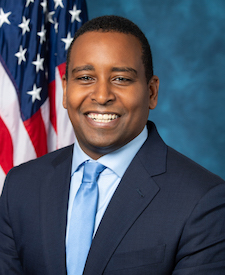
Rep. Joe Neguse
Sponsored bills
Armenian Genocide Education Act This bill requires the Library of Congress to maintain a public website and otherwise support educational initiatives to promote understanding about the Armenian Genocide.
Help for Healing Communities Act This bill establishes a program through which the Substance Abuse and Mental Health Services Administration may award grants to support mental and behavioral health services for survivors of active shooter events and incidents of targeted violence. Eligible grant recipients include state, tribal, territorial, and local governments and nonprofits located in or serving a community that experienced an active shooter event or incident of targeted violence in the preceding fiscal year.
Safe Workplaces Act This bill requires the Occupational Safety and Health Administration (OSHA) to promulgate an occupational safety and health standard on reducing the threat of workplace violence, including firearm violence. Additionally, the National Institute for Occupational Safety and Health must study and make recommendations about ways to reduce workplace violence. OSHA must consider those recommendations when promulgating the workplace safety and health standard.
Helicopter Passenger Protection Act This bill requires that certain rotorcraft manufactured before April 5, 2020, comply with Federal Aviation Administration requirements relating to fuel system crash resistance. The requirement does not apply to an unmanned aircraft that does not carry occupants. The bill also allows a tax credit equal to 10% of the costs of making changes to a fuel system in an emergency medical rotorcraft to comply with certain requirements for fuel system crash resistance.
Targeting Resources for Equitable Access to Treatment for Long COVID Act or the TREAT Long COVID Act This bill requires the Department of Health and Human Services to award competitive grants to create or expand the capacity of clinics that treat patients with persistent, long-term symptoms following recovery from acute COVID-19 (i.e., Long COVID). Eligible recipients include federally qualified health centers, rural health clinics, urban Indian health centers, and state and local health departments.
Replacing Essential Passports and Licenses After Certain Emergencies Act or the REPLACE Act This bill requires the President to automatically waive fees to replace critical documents for individuals and households affected by major disasters for which assistance is provided under the Individuals and Households Program.
Energy Security and Independence Act of 2022 This bill addresses domestic industrial base and manufacturing capabilities for specified energy-efficiency and renewable energy systems and technologies (e.g., electric transportation systems), including by establishing a program to provide financial assistance for the construction of new facilities that manufacture components of specified energy-efficiency and renewable energy systems and technologies (or to retool, retrofit, or expand such facilities).
Public Service Loan Forgiveness Payment Completion Fairness Act or the PSLF Payment Completion Fairness Act This bill removes the requirement that a borrower must be employed in a public service job at the time of loan forgiveness under the Public Service Loan Forgiveness (PSLF) program. Under the current PSLF program, the Department of Education must cancel the balance of interest and principal due on a borrower's Federal Direct Loans after the borrower makes 120 monthly loan payments while employed in a public service job and, at the time of loan forgiveness, the borrower is employed in a public service job. This bill removes the requirement that the borrower must be working in a public service job at the time of loan forgiveness.
Postal Service Reform Act of 202 2 This bill addresses the finances and operations of the U.S. Postal Service (USPS). The bill requires the Office of Personnel Management (OPM) to establish the Postal Service Health Benefits Program within the Federal Employees Health Benefits Program under which OPM may contract with carriers to offer health benefits plans for USPS employees and retirees. The bill provides for coordinated enrollment of retirees under this program and Medicare. The bill repeals the requirement that the USPS annually prepay future retirement health benefits. Additionally, the USPS may establish a program to enter into agreements with an agency of any state government, local government, or tribal government, and with other government agencies, to provide certain nonpostal products and services that reasonably contribute to the costs of the USPS and meet other specified criteria. The USPS must develop and maintain a publicly available dashboard to track service performance and must report regularly on its operations and financial condition. The Postal Regulatory Commission must annually submit to the USPS a budget of its expenses. It must also conduct a study to identify the causes and effects of postal inefficiencies relating to flats (e.g., large envelopes). The USPS Office of Inspector General shall perform oversight of the Postal Regulatory Commission.