National Liberty Memorial Preservation Act This bill extends through FY2027 the authority of the National Mall Liberty Fund D.C. to establish a memorial on eligible federal land to honor the slaves and free Black persons who served as soldiers and sailors or provided civilian assistance during the American Revolution.
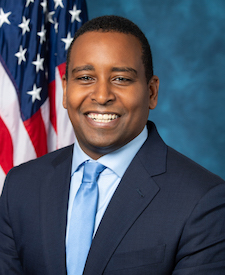
Rep. Joe Neguse
Sponsored bills
Violent Incident Clearance and Technological Investigative Methods Act of 2022 or VICTIM Act of 2022 This bill directs the Department of Justice to establish a grant program for state, tribal, or local law enforcement agencies or prosecuting offices (or groups of tribal agencies or offices) to establish, implement, and administer violent incident clearance and technological investigative methods.
Break the Cycle of Violence Act This bill establishes federal grant programs and related entities to support violence intervention initiatives. Specifically, the bill directs the Department of Health and Human Services (HHS) to award grants for coordinated community violence intervention initiatives in communities disproportionately impacted by homicides and community violence. HHS must also establish several related entities, including an Office of Community Violence Intervention to administer programs and activities related to violence intervention; the Community Violence Intervention Advisory Committee to advise and assist the office and HHS; and the National Community Violence Response Center to provide training and technical assistance, coordinate research, and develop data collection policies. Additionally, the bill directs the Department of Labor to award grants for job training and workforce programs in communities disproportionately affected by gun violence to connect youth ages 16 to 24 to in-demand occupations.
State Antitrust Enforcement Venue Act of 2022 This bill limits the transfer and consolidation of antitrust cases that are brought by states in federal court. Current law generally permits federal civil cases that are related to be transferred to a single district court and consolidated for pretrial proceedings. However, under current law, antitrust cases brought by the federal government are exempt from transfer and consolidation. This bill adds to that exemption antitrust cases brought by states.
Protecting Kids from Fentanyl Act This bill allows states and local educational agencies to use unexpended COVID-19 elementary and secondary school emergency relief funds for additional purposes. In particular, these funds may be used for (1) purchasing naloxone or other opioid antagonists; (2) providing training to school nurses, teachers, school administrators, and school resource officers on how to administer naloxone or other opioid antagonists; and (3) providing fentanyl awareness classes or materials to students.
Social Security Fairness Act of 2021 This bill repeals provisions that reduce Social Security benefits for individuals who receive other benefits, such as a pension from a state or local government. The bill eliminates the government pension offset , which in various instances reduces Social Security benefits for spouses, widows, and widowers who also receive government pensions of their own. The bill also eliminates the windfall elimination provision , which in some instances reduces Social Security benefits for individuals who also receive a pension or disability benefit from an employer that did not withhold Social Security taxes. These changes are effective for benefits payable after December 2021.
Access to Reproductive Care for Servicemembers Act This bill establishes leave policies for the military departments regarding abortion care for members of the Armed Forces, including policy elements related to privacy. Additionally, the bill requires the military departments to reimburse members for travel costs incurred if a member must travel to a different jurisdiction for an abortion. Under the bill, no member may be subject to any adverse action for requesting or taking leave in relation to abortion care.
Peace Corps Reauthorization Act of 2022 This bill reauthorizes through FY2024 and modifies operations of the Peace Corps. Changes include increasing the readjustment allowance paid to volunteers when their service terminates and providing statutory authority for an executive order that grants returned volunteers noncompetitive eligibility for federal civil-service positions. Additionally, the bill entitles returned volunteers to sixty days of health care benefits. The Peace Corps must also provide volunteers with information about enrolling in U.S. health plans before service termination and mental health care during and after service. The bill also includes provisions to address involuntary termination of Peace Corps service in emergencies, including by expediting re-enrollment of involuntarily terminated volunteers. The Peace Corps must also adequately insure volunteers' safety and must coordinate with the Department of State to periodically update agreements concerning the security of Peace Corps volunteers and staff abroad. The bill also authorizes Peace Corps to recruit domestically based volunteers to serve in the United States at the request of another agency or to provide services in a host country virtually, modifies the Peace Corps National Advisory Council's membership and functions, expands whistleblower protections for volunteers, increases the rate of pay that applies to a volunteer's workers compensation claim, requires Peace Corps to implement a zero tolerance drug use policy regarding volunteer involvement with illegal drugs, and emphasizes the use of the internet in Peace Corps programs. Furthermore, the bill requires reporting, including on the provision of mental health services to volunteers.

Access to Critical Non-Emergency Transportation Services Act This bill requires the Centers for Medicare & Medicaid Services to work with state Medicaid programs to assist individuals who are dually eligible for Medicare and Medicaid with accessing non-emergency transportation benefits under Medicaid. The bill applies to dually eligible individuals who are participating in the Repetitive, Scheduled Non-Emergent Ambulance Transport Prior Authorization Model under Medicare.
Secure Rural and Tribal Lands Act This bill specifies the factors to be considered when allocating funding from the Local Assistance and Tribal Consistency Fund (a general revenue enhancement program that provides additional assistance to eligible counties and tribal governments for any governmental purpose except lobbying).