

Renewing Immigration Provisions of the Immigration Act of 1929 This bill expands eligibility for a program that authorizes the Department of Homeland Security to, at its discretion, provide lawful permanent resident status to certain long-term residents of the United States, including individuals who are unlawfully present. Currently, this program, sometimes referred to as the Registry program, is only available to eligible non-U.S. nationals ( aliens under federal law) who entered the United States before January 1, 1972. The bill removes this entry cutoff date and opens up the program to eligible individuals who have resided in the United States for at least seven years. Existing requirements (e.g., the individual must not be inadmissible or deportable due to certain grounds related to crime or terrorism) continue to apply.
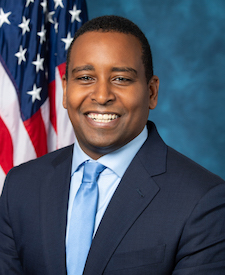
Rep. Joe Neguse
Sponsored bills
Hermit's Peak Fire Assistance Act This bill provides for monetary compensation to the victims of the prescribed fire burn in the Santa Fe National Forest in New Mexico that became a wildfire known as the Hermit's Peak Fire or the Hermit's Peak Fire/Calf Canyon Fire. Each victim of the Hermit's Peak Fire shall be entitled to receive monetary compensation from the United States, including for personal injury, loss of property, business loss, or financial loss. An Office of Hermit's Peak Fire Claims is established within the Federal Emergency Management Agency (FEMA) to receive, process, and pay claims to victims of the fire. FEMA or the independent claims manager (which FEMA may appoint) shall, on behalf of the United States, investigate, consider, ascertain, adjust, determine, grant, deny, or settle any claim for money damages asserted by a victim of the Hermit's Peak Fire. Any claimant aggrieved by a final decision of FEMA concerning compensation may, not later than 60 days after the date on which the decision is issued, bring a civil action in the U.S. District Court for the District of New Mexico, to modify or set aside the decision.
Judicial Ethics and Anti-Corruption Act of 2022 This bill makes various changes to the federal framework governing judicial ethics. Among the changes, the bill prohibits federal judges and Supreme Court Justices from owning individual stocks and securities; requires the Judicial Conference of the United States to issue regulations restricting the solicitation or acceptance of gifts in connection with a private judicial seminar; expresses the sense of Congress that the Code of Conduct for U.S. Judges shall apply to Supreme Court Justices; requires federal judges and Supreme Court Justices to report on each association or interest that would require recusal, including any financial interest of a spouse or minor child who resides in the household; and establishes a committee to review complaints against the Supreme Court.
This bill requires states to prioritize additional groups (i.e., victims of firearm violence or the family members of victims of homicide) for state victim assistance formula grants.
Strengthen and Tackle Opportunities to Prevent Violence Act of 2022 or the STOP Violence Act of 2022 This bill allows funds under the Antiterrorism and Emergency Assistance Program to be used for efforts to prepare against mass violence and protect public assembly facilities.
Bankruptcy Threshold Adjustment and Technical Corrections Act This bill modifies provisions related to small business reorganization bankruptcies and wage earner's bankruptcies. Specifically, the bill extends for two years the increase of the amount of debt allowed to be carried by debtors to qualify for small business reorganization bankruptcy and provides that this debt limit is subject to adjustment for inflation. Additionally, it provides that a small business debtor includes a debtor that is an affiliate of certain publicly traded companies. Further, it authorizes the bankruptcy trustee to operate the business of the debtor if the debtor ceases to be a debtor in possession. The bill also increases for two years the debt limit for individuals filing for bankruptcy under Chapter 13 (i.e., the wage earner's plan) and allows both secured and unsecured debt to count towards this single limit. (Currently, separate limits apply to secured and unsecured debt.)
Latonya Reeves Freedom Act of 2022 This bill prohibits government entities and insurance providers from denying community-based services to individuals with disabilities that require long-term service or support that would enable such individuals to live in the community and lead an independent life. Specifically, these entities may not discriminate against such individuals in the provision of community-based services by such actions as imposing prohibited eligibility criteria, cost caps, or waiting lists or failing to provide a specific community-based service. Additionally, community-based services must be offered to individuals with such disabilities prior to institutionalization. Institutionalized individuals must be notified regularly of community-based alternatives. The bill requires the Department of Justice to issue regulations requiring government entities and insurance providers to offer community-based long-term services to individuals with such disabilities who would otherwise qualify for institutional placement. Government entities must ensure sufficient availability of affordable, accessible, and integrated housing that is not a disability-specific residential setting or a setting where services are tied to tenancy. Regulations shall also (1) require government entities and insurance providers to perform self-evaluation on current services, policies, and practices and concerning compliance with requirements of this bill; and (2) require government entities to submit a transition plan. The bill provides funds for FY2022 for the Department of Health and Human Services to provide technical assistance with respect to transition plans. The bill allows civil actions by individuals subjected to, or about to be subjected to, a violation of its requirements.
Fair Calculations in Civil Damages Act of 2022 This bill prohibits courts from awarding damages to plaintiffs in civil actions using a calculation for projected future earning potential that takes into account a plaintiff's race, ethnicity, gender, religion, or actual or perceived sexual orientation. The bill requires the Department of Labor to develop guidance for economists to develop future earnings tables that do not rely on race, ethnicity, gender, religion, or actual or perceived sexual orientation. Additionally, Labor and the Department of Justice must develop guidance for states on how to calculate future earnings in state tort proceedings in a manner that is free of such biases. The Judicial Conference of the United States must report on damages awarded under federal law for personal injury, employment discrimination, tort damages, and cases involving protected classes of individuals sharing a common characteristic or identity who are legally protected against discrimination. The Administrative Office of the United States Courts must submit recommendations to ensure that future earnings calculations that take into account age and disability do not conflict with federal equal protection laws. The bill requires the Federal Judicial Center to train federal judges on how to implement this bill.
Protect Children Through Safe Gun Ownership Act This bill establishes certain requirements and education programs for the safe storage of firearms, including by establishing grants to provide parents with educational materials on gun safety and the importance of secure gun storage.
Maddy summaryThis bill grants a federal charter to National American Indian Veterans, Incorporated, a nonprofit organization serving American Indian veterans. It formalizes the group’s structure, requiring it to maintain tax-exempt status while advocating for veterans’ needs with specific prohibitions (e.g., no stock, dividends, or loans to members). The charter mandates annual reports to Congress detailing the organization’s activities but does not create new benefits or services for veterans. It directly affects the organization and the American Indian veterans it represents, ensuring its operations align with federal nonprofit standards.