

Land Restoration and Resiliency Act of 2023 This bill directs the U.S. Fish and Wildlife Service to enter into cooperative agreements with the National Fish and Wildlife Foundation to establish the Community Resilience and Restoration Fund at the foundation, for purposes including to improve community safety in the face of climactic extremes through conservation and protection of restoration and resilience lands; protect, conserve, and restore restoration and resilience lands in order to help communities respond and adapt to natural threats, including wildfire, drought, extreme heat, and other threats posed or exacerbated by the impacts of global climate; and protect and enhance the biodiversity of wildlife populations across restoration and resilience lands. The bill defines restoration and resilience lands as fish, wildlife, and plant habitats, and other important natural areas in the United States, on public lands, private land (after obtaining proper consent from the landowner), or land of Indian tribes, including grasslands, shrublands, prairies, chaparral lands, forest lands, deserts, and riparian or wetland areas within or adjacent to these ecosystems. To the extent amounts are available in the fund, the foundation shall award grants to eligible entities (e.g., a federal agency, a unit of local government, an Indian tribe, or a nonprofit organization) through a competitive grant process to carry out eligible projects and activities.
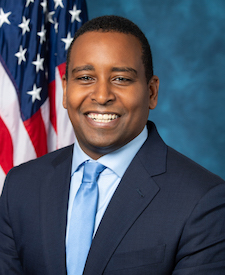
Rep. Joe Neguse
Sponsored bills
Maddy summaryThe Western Wildfire Support Act of 2023 establishes new funding mechanisms and programs to enhance wildfire prevention, detection, suppression, and recovery efforts across federal lands in the western United States. The bill creates dedicated firefighting accounts for the Departments of Agriculture and Interior with specific annual funding limits, authorizing $3 billion for ground-based firefighting operations by the Agriculture Department and $1 billion for the Interior Department. It also establishes community planning accounts to support wildfire protection programs, requires strategic fire management planning for federal lands, and creates a Long-Term Burned Area Recovery account with $100 million annual funding for ecosystem rehabilitation. The bill includes provisions for research on drone impacts on firefighting, unmanned aircraft systems for fire applications, and a prize competition to address invasive species after wildfires.
Maddy summaryHR 210, the "Stamp Out Invasive Species Act," creates a special semipostal stamp sold at post offices. When purchased, the stamp includes an extra 25% charge on the standard postage rate, with all proceeds going to combat invasive species. The funds will be split equally between the Department of the Interior and the Department of Agriculture for their existing programs, distributed twice yearly over a two-year period starting after the bill's enactment. This mechanism directly involves the public (via stamp purchases) and federal agencies managing invasive species efforts.
Maddy summaryHR 1088, the Shirley Chisholm Congressional Gold Medal Act, authorizes a posthumous Congressional Gold Medal to honor Congresswoman Shirley Chisholm, the first African-American woman elected to Congress (1968) and the first Black candidate for a major party's presidential nomination (1972). The bill directs the Treasury Secretary to design and strike a gold medal featuring Chisholm's image, which will be presented by Congress and then permanently displayed at the Smithsonian Institution. Duplicate bronze medals may be sold to the public to cover production costs, with proceeds deposited into the U.S. Mint fund. This bill commemorates Chisholm's legacy and achievements without creating new laws or affecting any current policies.
Maddy summaryThis bill authorizes a posthumous Congressional gold medal for Constance Baker Motley, a pioneering civil rights attorney and federal judge. It directs the Treasury to strike a gold medal featuring her image and name, to be presented to her son, Joel Motley III, and niece, Constance Royster. The medal is a commemorative tribute recognizing her historic contributions to civil rights and her service as the first African-American woman appointed to a federal judgeship. No new policies or programs are created; the bill solely honors her legacy through a commemorative medal.
Maddy summaryThe HELP Copays Act (HR 830) changes how health insurance plans calculate patient cost-sharing. It requires that payments made by third parties (like pharmacies, charities, or discount programs) toward medical costs count toward a patient's deductible, copay, or out-of-pocket limit. This directly affects insured individuals who receive financial assistance, discounts, or product vouchers for healthcare expenses. The law ensures these external payments reduce the patient's actual out-of-pocket costs more quickly, aligning with existing Affordable Care Act and Public Health Service Act requirements.
Aviation-Impacted Communities Act This bill addresses noise mitigation for aviation-impacted communities. ( Aviation-impacted community is defined as a community that is located not more than one mile from any point at which a commercial or cargo jet route is 3,000 feet or less above ground level.) Specifically, the bill expands Airport Improvement Program noise mitigation program funding for aviation-impacted communities that are not currently within the 65 day-night average sound level (DNL) standard; requires the Federal Aviation Administration (FAA) to enter into an agreement with the National Academy of Sciences to conduct a study that summarizes the relevant literature and studies done on aviation impacts worldwide and focuses on large hub commercial airports and surrounding communities, including communities currently outside of the 65 DNL contour; directs the FAA to conduct outreach to aviation-impacted communities to inform them of the opportunity to be a designated community; requires the FAA to devise an action plan that alleviates or addresses the concerns of a designated community; and provides grants for necessary noise mitigation in a designated community for residences, hospitals, nursing homes, adult or child day care centers, schools, and places of worship.
Bankruptcy Venue Reform Act This bill limits where a non-individual debtor (e.g., a corporate debtor) may file for bankruptcy to prevent forum shopping. Specifically, these debtors must file in the district court where their principal place of business or principal assets are located. Corporate debtors may also file in a district where there is a pending bankruptcy case concerning an affiliate that has a certain level of control over or ownership of the debtor (e.g., if the affiliate is a controlling shareholder of the debtor), if that pending case is in a proper venue under this bill. Under current law, these debtors may also file where they are domiciled (i.e., incorporated) or where there is a pending bankruptcy case concerning any affiliate, general partner, or partnership of the debtor. For corporate debtors that are issuers of securities, their principal place of business is defined in the bill as the address of the entity's principal executive office as provided in specified Securities and Exchange Commission filings.
Maddy summaryThis bill expands health care coverage under TRICARE for military dependents. It eliminates a separate premium for young adults aged 21-26 enrolled in the TRICARE Young Adult Program, meaning they will no longer pay an extra fee for coverage. The bill also removes an eligibility restriction that previously limited coverage for some dependents in this age group. These changes directly affect military service members' adult children and spouses who rely on TRICARE Young Adult coverage. The policy update simplifies enrollment and reduces out-of-pocket costs for these beneficiaries.
Maddy summaryThis bill authorizes a single Congressional Gold Medal to honor all U.S. Army Dustoff crews who served during the Vietnam War (1962-1973). It recognizes their critical role in evacuating nearly 900,000 wounded personnel, including U.S., South Vietnamese, and allied forces, under extreme combat conditions. The medal, designed with input from the Secretary of Defense, will be presented to the U.S. Army Medical Department Museum for permanent display. Duplicate bronze medals may be sold to cover costs, but the primary action is the commemorative recognition of these crews' service.