

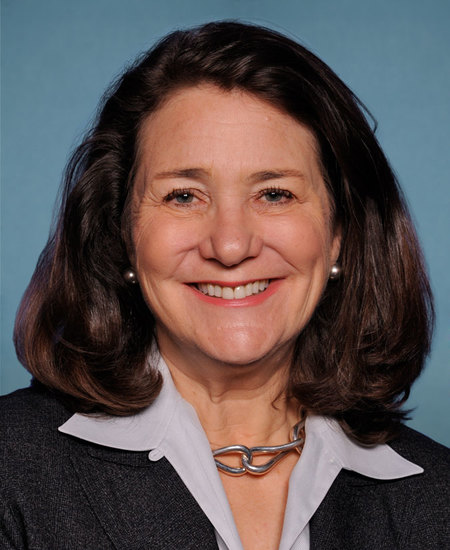
Photo of Diana DeGette
D United States House · District 1 · Colorado

Rep. Diana DeGette

Compare
Total votes
2,837
all sessions
Attendance
99%
28 missed
Near the chamber average
With party
98%
of cast votes
Near the chamber average
Bipartisan score
1%
crosses aisle rarely
Near the chamber average
Sponsored
1,153
bills & resolutions
Near the chamber average
Committees
4
assignments
1,153 bills and resolutions

Sponsored bills

Total
1,153
Primary
47
Co-sponsor
1,106
This page
1,153
matching current filters
Co-sponsor HR 40
In committee · United States House · Co-sponsor
Commission to Study and Develop Reparation Proposals for African Americans Act

Commission to Study and Develop Reparation Proposals for African Americans Act This bill establishes the Commission to Study and Develop Reparation Proposals for African Americans. The commission shall examine slavery and discrimination in the colonies and the United States from 1619 to the present and recommend appropriate remedies. The commission shall identify (1) the role of the federal and state governments in supporting the institution of slavery, (2) forms of discrimination in the public and private sectors against freed slaves and their descendants, and (3) lingering negative effects of slavery on living African Americans and society.

In committee Apr 14, 2021 1 co-sponsor
Co-sponsor HR 2465
In committee · United States House · Co-sponsor
Healthy Families Act

Healthy Families Act This bill provides for paid and unpaid sick leave for employees to meet their own medical needs and those of their families. It requires employers with 15 or more employees to provide their employees with at least one hour of earned paid sick leave for every 30 hours worked, up to a maximum of 56 hours of paid sick leave in a year. An employer with fewer than 15 employees may also provide the same amount of paid sick leave, but may opt out of such requirement, in which case such employer must provide its employees at least 56 hours of unpaid leave in a year. An employee may use sick leave for absences (1) resulting from a physical or mental illness, injury or medical condition; (2) resulting from obtaining professional medical diagnosis or care, or preventive medical care; (3) to care for a child, parent, spouse, a domestic partner, or other blood or close relative; and (4) resulting from domestic violence, sexual assault, or stalking. The bill makes it unlawful for any employer to interfere with, restrain, or deny the exercise of an employee's right to accrue sick leave as provided by this bill. An employee may take legal action to enforce the right to sick leave granted by this bill and the Department of Labor must investigate complaints of violations of the requirements of this bill. Labor is authorized to conduct a public awareness campaign to educate and inform the public of the requirements for paid sick leave provided by this bill.

In committee Apr 13, 2021 1 co-sponsor
Co-sponsor HR 2455
In committee · United States House · Co-sponsor
TRIA Act of 2021

Resetting the Impact Act of 2021 or the TRIA Act of 2021 This bill requires certain data collection and recommendations relating to a Medicare post-acute care prospective payment system to incorporate the effects of COVID-19 on providers and patients. Current law requires the Centers for Medicare & Medicaid Services (CMS) and the Medicare Payment Advisory Commission to develop a prototype for a unified Medicare payment system for post-acute care that is based primarily on patient characteristics (e.g., cognitive ability, functional status, or impairments) rather than the provider setting (e.g., skilled nursing facility, home health agency, inpatient rehabilitation facility, or long-term care hospital). The bill requires the prototype to account for the role of post-acute care providers during public health emergencies, particularly in light of the COVID-19 emergency and the related effects on such providers and their patients. The bill also delays the development of the prototype until two years after the later of January 1, 2022, and the date by which the CMS has collected eight calendar quarters of data after the emergency ends and other changes have been implemented.

In committee Apr 13, 2021 1 co-sponsor
Primary HR 2397
In committee · United States House · Lead sponsor
Protection from Cumulative Emissions and Underenforcement of Environmental Law Act of 2021

Protection from Cumulative Emissions and Underenforcement of Environmental Law Act of 2021 This bill directs the Environmental Protection Agency (EPA) to address the cumulative public health risks associated with multiple environmental stressors and recommend measures to reduce the number of violations of environmental law in certain environmental justice communities. Environmental justice communities are communities with significant representation of communities of color, low-income communities, or tribal and indigenous communities that experience, or are at risk of experiencing, higher or more adverse human health or environmental effects, as compared to other communities. In addition, the EPA must publish and implement a proposal for a protocol that assesses and addresses the cumulative public health risks associated with multiple environmental stressors, such as impacts associated with global climate change. Further, the EPA must identify at least 100 communities that (1) are environmental justice communities; and (2) have had more environmental law violations than the national average, as determined by the EPA. The EPA must then identify the causes of the violations, identify measures to reduce the number of violations, and implement such measures.

In committee Apr 13, 2021 0 co-sponsors
Co-sponsor HR 2396
In committee · United States House · Co-sponsor
Ensuring Safe Disposal of Coal Ash Act

Ensuring Safe Disposal of Coal Ash Act This bill updates the requirements related to state permit programs for the regulation of coal combustion residuals units, as administered by the Environmental Protection Agency (EPA). Specifically, the EPA must revise its regulations related to approved state programs for regulating coal combustion residuals units to include any criteria necessary to protect human health and the environment, including the health of vulnerable or disproportionately exposed subpopulations. The regulation revisions must include specified requirements, for example, requiring meaningful public participation in the issuance and renewal of all permits or other prior approvals. The EPA must promulgate regulations that (1) set forth minimum requirements for state and federal coal combustion residuals permit programs, and (2) require owners of closed coal combustion residuals disposal sites to identify the locations of such sites and record the information in the public record to ensure that the locations are known and can be located in the future. Under the bill, the EPA must also implement a requirement for a public hearing in the approval process for establishing a state permit program; review state permit programs at least once every 5 years (the current requirement is once every 12 years); review such programs not later than one year after it revises applicable criteria for federal regulations related to coal combustion residuals units; and include a reasonable period of time, not to exceed 180 days, for a state to correct deficiencies with respect to its permit program.

In committee Apr 13, 2021 1 co-sponsor
Co-sponsor HR 2431
In committee · United States House · Co-sponsor
Voices for Environmental Justice Act

Voices for Environmental Justice Act This bill authorizes the Environmental Protection Agency (EPA) to award grants to eligible entities to participate in decisions impacting the health and safety of their communities in connection with an actual or potential release of a covered hazardous air pollutant. Additionally, the bill authorizes the EPA to award grants to eligible entities to participate in decisions impacting the health and safety of their communities relating to the permitting or permit renewal of a solid waste disposal facility or hazardous waste facility. An eligible entity must be a group of individuals who reside in a community that (1) is a population or community of color, an indigenous community, or a low-income community; and (2) is in close proximity to the site of an actual or potential release of a covered hazardous air pollutant. Covered hazardous air pollutants include those listed on the Toxics Release Inventory or those identified as carcinogenic by an assessment under the Integrated Risk Information System of the EPA.

In committee Apr 13, 2021 1 co-sponsor
Co-sponsor HR 1391
In committee · United States House · Co-sponsor
Taxpayer Research and Coronavirus Knowledge Act of 2021

Taxpayer Research and Coronavirus Knowledge Act of 2021 This bill requires the Department of Health and Human Services (HHS) to coordinate with specified federal entities to compile a public database of federal contracts, tax benefits, and other support for COVID-19 (i.e., coronavirus disease 2019) biomedical research and development. HHS must develop the database within one month and update it every two weeks.

In committee Apr 12, 2021 1 co-sponsor
Co-sponsor HR 1309
In committee · United States House · Co-sponsor
SERVE Act

Supporting Eating Disorders Recovery Through Vital Expansion Act or the SERVE Act This bill provides for inpatient and outpatient treatment of eating disorders under TRICARE for dependents of members of the uniformed services. Dependents are eligible for such care regardless of (1) their age, except with respect to residential service; and (2) whether the eating disorder is their primary or secondary diagnosis. The bill also requires the Department of Defense (DOD) and the Department of Homeland Security (with respect to the Coast Guard) to identify, treat, and rehabilitate members of the armed forces who have an eating disorder. Finally, DOD and the Department of Veterans Affairs must jointly develop, publish, and disseminate clinical practice criteria and guidelines on the identification and treatment of eating disorders.

In committee Apr 12, 2021 1 co-sponsor
Co-sponsor HR 1442
In committee · United States House · Co-sponsor
PREPARED Act

Providing Responsible Emergency Plans for Animals at Risk of E merging Disasters Act or the PREPARED Act This bill establishes requirements governing the care of animals by entities, such as zoos, in emergencies or disasters. Specifically, the bill requires each research facility, dealer, exhibitor, intermediate handler, and carrier to develop and follow a contingency plan to provide for the humane handling, treatment, transportation, housing, and care of their animals in the event of an emergency or disaster.

In committee Apr 8, 2021 1 co-sponsor
Co-sponsor HR 2302
In committee · United States House · Co-sponsor
CLOSE Act

Closing Loopholes for Oil and other Sources of Emissions Act or the CLOSE Act This bill repeals exemptions from the Clean Air Act under which (1) emissions from oil and gas wells and pipeline facilities are excluded from aggregation with emissions from other similar units for purposes of determining major sources, and (2) the Environmental Protection Agency (EPA) excludes oil and gas production wells from being listed as area sources. Additionally, the bill requires the EPA to issue a final rule adding hydrogen sulfide to the list of hazardous air pollutants under the Clean Air Act and revising such list to include categories and subcategories of major sources and area sources of hydrogen sulfide, including oil and gas wells.

In committee Apr 2, 2021 1 co-sponsor
Showing 1,031 to 1,040 of 1,153 bills