

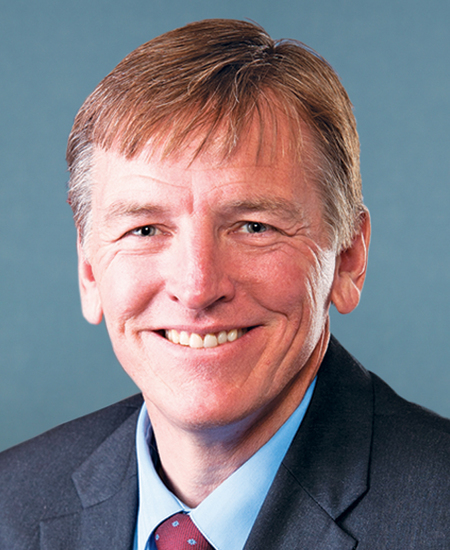
Photo of Paul A. Gosar
R United States House · District 9 · Arizona On the 2026 ballot

Rep. Paul A. Gosar

Compare
Total votes
2,837
all sessions
Attendance
95%
142 missed
Lower than 87% of chamber peers
With party
82%
of cast votes
Lower than 94% of chamber peers
Bipartisan score
9%
crosses aisle rarely
Higher than 93% of chamber peers
Sponsored
1,156
bills & resolutions
Near the chamber average
Committees
6
assignments
1,156 bills and resolutions

Sponsored bills

Total
1,156
Primary
96
Co-sponsor
1,060
This page
1,156
matching current filters
Co-sponsor HR 374
In committee · United States House · Co-sponsor
Abolish the ATF Act

Maddy summaryHR 374, titled the "Abolish the ATF Act," would eliminate the Bureau of Alcohol, Tobacco, Firearms and Explosives (ATF) as a federal agency. This bill directly affects the ATF itself, ending its existence and all its current operations. The key provision is a single, straightforward legislative action to abolish the bureau, without specifying alternative agencies or processes for handling the functions it currently performs. The bill does not detail how firearm regulations, tobacco enforcement, or other ATF responsibilities would be managed after abolition.

In committee Dec 5, 2024 1 co-sponsor
Co-sponsor HR 807
Signed into law · United States House · Co-sponsor
Working Dog Commemorative Coin Act

Maddy summaryThe Working Dog Commemorative Coin Act (HR 807) directs the U.S. Treasury to mint three types of commemorative coins honoring working dogs' service: $5 gold coins, $1 silver coins, and half-dollar coins with specific weight and composition requirements. Each coin will carry a surcharge ($35 for $5 coins, $10 for $1 coins, $5 for half-dollars) that will be paid directly to America's VetDogs to support their programs providing service dogs for veterans, the disabled, and others. The coins will be issued in 2027 with designs reflecting working dogs' roles in military, detection, therapy, and assistance work. The legislation specifies that all surcharge revenue must fund America's VetDogs' operations without creating new government programs. This is a commemorative measure focused on honoring working dogs' contributions through coin sales, with all surcharge funds going to a specific nonprofit organization.

Signed into law Nov 25, 2024 1 co-sponsor
Co-sponsor HR 10217
In committee · United States House · Co-sponsor
Visa Integrity Preservation Act of 2024

Maddy summaryThis bill requires in-person interviews with consular officers for certain non-citizens seeking visas who are currently unlawfully present in the United States. It amends immigration law to explicitly include these individuals under the category requiring such interviews. The key mechanism adds a new provision (subparagraph G) to the existing interview requirement, specifying that applicants who are inadmissible due to prior violations (under sections 212(a)(6) or (9)) must attend an in-person interview. This directly affects non-citizens who entered or remained in the U.S. without authorization and are applying for visas. The bill does not create new inadmissibility grounds but modifies the interview process for this specific group.

In committee Nov 21, 2024 1 co-sponsor
Co-sponsor HR 10062
In committee · United States House · Co-sponsor
Freedom to Petition the Government Act

Maddy summaryThis bill amends the District of Columbia Code to clarify that nonprofit organizations holding meetings with federal officials (including Members of Congress or government employees) do not count as "doing business" in the District. It specifically adds this activity to the list of non-business activities under D.C. law (Section 29-105.05(a)(11)). The change directly affects nonprofit organizations that regularly engage with federal government representatives. The policy shift removes potential regulatory barriers for these groups when meeting with federal officials in D.C.

In committee Nov 20, 2024 1 co-sponsor
Co-sponsor HR 8706
In committee · United States House · Co-sponsor
Dismantle DEI Act of 2024

Maddy summaryHR 8706, the "Dismantle DEI Act of 2024," would prohibit federal agencies from maintaining diversity, equity, and inclusion (DEI) offices, programs, or training by requiring the closure of existing DEI offices within 90 days and banning federal funding for DEI-related activities. The bill defines "prohibited diversity, equity, and inclusion practices" as those that discriminate based on race, color, ethnicity, religion, biological sex, or national origin, or require training that asserts a particular group is inherently superior or inferior. It would rescind several executive orders related to racial equity and gender inclusion, and prohibit the use of federal funds for DEI-related activities across all federal agencies, contractors, and grant recipients. The bill contains limited exceptions for Equal Employment Opportunity offices and disability rights enforcement offices as historically organized and operated.

In committee Nov 20, 2024 1 co-sponsor
Co-sponsor HR 10005
In committee · United States House · Co-sponsor
EARA

Maddy summaryThe Expedited Appeals Review Act (EARA) requires the Board of Land Appeals to issue a final decision on appeals of specific Department of the Interior decisions within 6 months of a party’s request for expedited review, but not before 18 months have passed since the appeal was initially filed. If the Board misses this deadline, the Department’s decision is treated as final for judicial review, and courts must review it without giving special weight to the agency’s original decision. This law applies to appeals pending when the Act takes effect or filed afterward.

In committee Nov 19, 2024 1 co-sponsor
Primary HR 8517
In committee · United States House · Lead sponsor
La Paz County Solar Energy and Job Creation Act

Maddy summaryThis bill would transfer approximately 3,400 acres of federal land managed by the Bureau of Land Management (BLM) in La Paz County, Arizona, to the county government. The land must be conveyed at fair market value (based on appraisal), with the county covering all related costs, and the land is withdrawn from mineral leasing. Key provisions require the county to protect tribal cultural artifacts by coordinating with the Colorado River Indian Tribes and minimizing impacts if artifacts are disturbed. The bill directly affects La Paz County (enabling potential development like solar projects) and tribal nations, while ensuring the land transfer follows specific environmental and cultural safeguards. It does not mandate solar development but facilitates land access for future projects.

In committee Nov 19, 2024 0 co-sponsors
Co-sponsor HR 8790
Passed · United States House · Co-sponsor
Fix Our Forests Act

Maddy summaryThe Fix Our Forests Act creates a new system for managing wildfire risk on federal lands by designating "firesheds" (landscape-scale areas with high wildfire risk) and establishing a central coordination center called the Fireshed Center. It streamlines environmental reviews for vegetation management projects in these areas, requires public tracking of wildfire risk and management activities through a Fireshed Registry, and limits legal challenges to these projects. The bill affects federal land management agencies (like the Forest Service and Bureau of Land Management), communities in wildfire-prone areas, and utility companies managing vegetation near power lines. It also includes provisions for community wildfire risk reduction programs and research on new wildfire management technologies, aiming to accelerate risk reduction while maintaining transparency about where and how these projects are implemented.

Passed Nov 12, 2024 1 co-sponsor
Co-sponsor HR 5342
Failed · United States House · Co-sponsor
Equal Treatment of Public Servants Act of 2023

Maddy summaryThis bill would change how Social Security benefits are calculated for public servants who worked in jobs not covered by Social Security (such as many state and local government positions). It replaces the current Windfall Elimination Provision with a new formula that accounts for both covered and noncovered earnings when calculating benefits, rather than reducing benefits based on noncovered employment. The bill would provide additional monthly payments of $100 for some affected individuals and $50 for others, starting 270 days after enactment. It also requires Social Security account statements to show noncovered earnings and directs the Social Security Administration to study ways to improve information sharing with state pension systems about noncovered pensions. The changes would apply to benefits payable starting January 1, 2025.

Failed Nov 12, 2024 1 co-sponsor
Co-sponsor HR 10020
In committee · United States House · Co-sponsor
Stop Woke Investing Act

Maddy summaryThis bill limits the number of shareholder proposals that public companies must include in their proxy materials based on the company's filing status: non-accelerated filers must include no more than 2 proposals, accelerated filers no more than 4, and large accelerated filers no more than 7. Proposals must have a "material" financial effect on the company - defined as a substantial financial risk or return relevant to investor decisions - to be included, excluding those focused on non-financial goals like environmental or social issues. The Securities and Exchange Commission must update proxy rules within 180 days to implement these limits and require companies to disclose their selection method for proposals. It directly affects large public companies and their shareholders seeking to influence corporate policies on social or environmental matters through voting.

In committee Oct 22, 2024 1 co-sponsor
Showing 341 to 350 of 1,156 bills
Previous 1 … 34 35 36 … 116 Next