

Energy Storage Tax Incentive and Deployment Act of 2021 This bill allows tax credits for (1) energy storage technologies, and (2) battery storage technology. The bill expands the tax credit for investments in energy property to include equipment that (1) receives, stores, and delivers energy using batteries, compressed air, pumped hydropower, hydrogen storage (including electrolysis), thermal energy storage, regenerative fuel cells, flywheels, capacitors, superconducting magnets, or other technologies identified by the Internal Revenue Service; and (2) has a capacity of at least five kilowatt hours. The bill also expands the tax credit for residential energy efficient property to include expenditures for battery storage technology that (1) is installed on or in connection with a dwelling unit located in the United States and used as a residence by the taxpayer, and (2) has a capacity of at least three kilowatt hours.
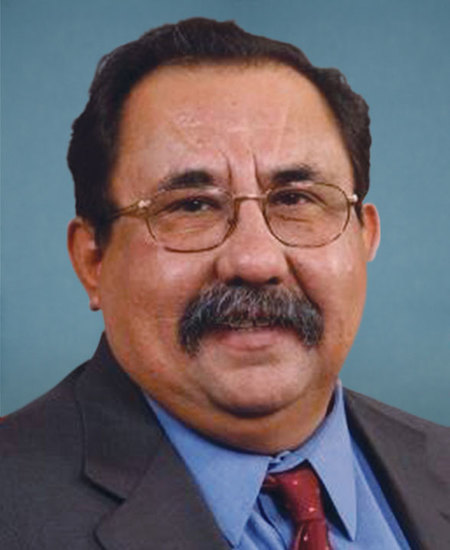
Rep. Raúl M. Grijalva
Sponsored bills
Prevent Interruptions in Physical Therapy Act of 2021 This bill allows a physical therapist to receive payment under Medicare for services provided to the physical therapist's patients by another physical therapist through a qualifying temporary arrangement, regardless of the geographic area or population served. Currently, physical therapists may only receive payment with respect to such arrangements for services provided in medically underserved, rural, or health professional shortage areas.
Donald Payne Sr. Colorectal Cancer Detection Act of 2021 This bill provides for Medicare coverage and payment, subject to specified frequency limits, of certain colorectal cancer screening blood-based tests.
George Floyd Justice in Policing Act of 2021 This bill addresses a wide range of policies and issues regarding policing practices and law enforcement accountability. It increases accountability for law enforcement misconduct, restricts the use of certain policing practices, enhances transparency and data collection, and establishes best practices and training requirements. The bill enhances existing enforcement mechanisms to remedy violations by law enforcement. Among other things, it does the following: lowers the criminal intent standard—from willful to knowing or reckless—to convict a law enforcement officer for misconduct in a federal prosecution, limits qualified immunity as a defense to liability in a private civil action against a law enforcement officer, and grants administrative subpoena power to the Department of Justice (DOJ) in pattern-or-practice investigations. It establishes a framework to prevent and remedy racial profiling by law enforcement at the federal, state, and local levels. It also limits the unnecessary use of force and restricts the use of no-knock warrants, chokeholds, and carotid holds. The bill creates a national registry—the National Police Misconduct Registry—to compile data on complaints and records of police misconduct. It also establishes new reporting requirements, including on the use of force, officer misconduct, and routine policing practices (e.g., stops and searches). Finally, it directs DOJ to create uniform accreditation standards for law enforcement agencies and requires law enforcement officers to complete training on racial profiling, implicit bias, and the duty to intervene when another officer uses excessive force.
War Powers Amendments of 2021 This joint resolution revises the War Powers Resolution, a law that limits the President's power to introduce Armed Forces into hostilities. Changes include shortening the time that Armed Forces may be involved in hostilities without congressional action and providing for judicial enforcement. The President shall remove any Armed Forces introduced into hostilities without congressional approval within 30 days unless Congress (1) declares war, (2) enacts a joint resolution specifically authorizing such use of the Armed Forces, or (3) is unable to meet because of an attack on the United States. This 30-day period may be extended by up to 15 days under specified circumstances. Current law allows such use of the Armed Forces for 60 days from when the President first reports to Congress about the engagement and allows for a 60-day extension. If Congress takes no such actions, funds may not be used to continue Armed Forces involvement in the hostilities, except to withdraw. The bill removes a provision requiring the removal of such engaged Armed Forces if Congress passes a concurrent resolution requiring such removal. A member of Congress may sue in district court for an order directing the President to comply with this bill. A judgment in such an action shall be directly appealable to the Supreme Court. The bill also revises various provisions relating to (1) the President reporting to and consulting with Congress regarding the use of the Armed Forces without congressional authorization, and (2) procedures for the expedited handling of joint resolutions related to such use of force.
This resolution supports the goals of a feminist foreign policy (i.e., a foreign policy that requires analysis of and challenges to power structures and inequalities that are based on systems of discrimination), and it supports the adoption of policies that promote gender equity and women's participation in public life.
National Women's Hall of Fame Commemorative Coin Act of 2021 This bill directs the Department of the Treasury to mint and issue $5 gold coins, $1 silver coins, half-dollar clad coins, and proof silver $1 coins in recognition and celebration of the National Women's Hall of Fame in Seneca Falls, New York. All minted coins shall include a specified surcharge, which shall be paid to the National Women's Hall of Fame Foundation to establish an endowment fund to provide for the long-term financing of the hall's operations.
LGBTQ Business Equal Credit Enforcement and Investment Act This bill requires financial institutions to report certain credit application data to the Consumer Financial Protection Bureau for the purposes of enforcing fair lending laws. Specifically, financial institutions must report this data regarding lesbian-, gay-, bisexual-, transgender-, or queer-owned businesses. Currently, this data is reported regarding women-owned, minority-owned, and small businesses.
Tar Sands Tax Loophole Elimination Act This bill expands the definition of crude oil for purposes of the excise tax on petroleum and petroleum products to include any bitumen or bituminous mixture, any oil derived from a bitumen or bituminous mixture (tar sands), and any oil derived from kerogen-bearing sources (oil shale). The bill also authorizes the Department of the Treasury to classify as crude oil or as a petroleum product subject to such tax any fuel feedstock or finished fuel product transported by pipeline, vessel, railcar, or tanker truck if (1) such classification is consistent with the definition of oil under the Oil Pollution Act of 1990, and (2) such fuel feedstock or finished fuel product is produced in sufficient commercial quantities as to pose a significant risk of hazard in the event of a discharge.
Northern Mariana Islands Legal Residents Relief Act of 2021 This bill expands eligibility for obtaining Commonwealth of the Northern Mariana Islands (CNMI) Resident status, provides a path for holders of such status to obtain U.S. permanent resident status, and makes CNMI-only transitional workers eligible to receive government relief or assistance in connection with a declared emergency. CNMI Resident status was available to qualifying individuals who applied for such status between February 19, 2020, and August 17, 2020. Among other requirements, a qualifying individual must have (1) been lawfully present in the CNMI on certain dates, and (2) continually and lawfully resided in the CNMI from November 28, 2009, through June 25, 2019. The bill reopens the period for applying for such status for 180 days and authorizes the Department of Homeland Security to waive this deadline in certain instances. The bill allows additional classes of individuals to qualify for CNMI Resident status, including an individual who (1) was admitted as a transitional worker during FY2015 and each subsequent fiscal year through FY2018, (2) is a qualified investor, or (3) resided in the CNMI as a guest worker for certain periods and is currently a transitional worker. The bill also waives the continual residence requirement for certain individuals and allows an individual lawfully present on December 31, 2020, to qualify. A qualifying alien with CNMI Resident status may obtain U.S. permanent resident status after holding CNMI Resident status for five years or after this bill has been enacted for five years, whichever is later.