Climate-Resilient International Development Optimization Act This bill directs agencies with direct international development programs and investments to incorporate climate resilience considerations into agency decision making. Agencies that participate in a multilateral entity must encourage the entity to incorporate climate-related risks into the decisions of the entity. The bill also establishes the Working Group on Climate-Resilient International Development in the Department of the Treasury to support such efforts.
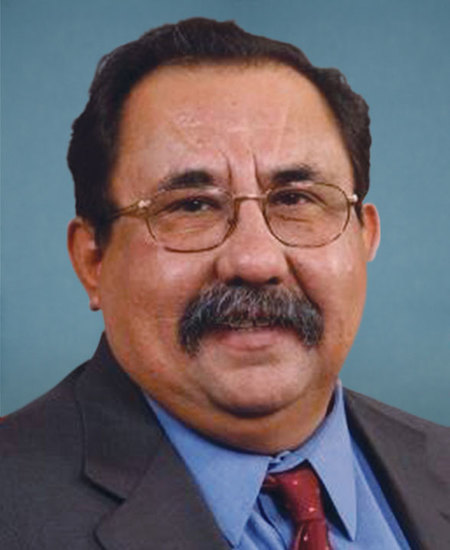
Rep. Raúl M. Grijalva
Sponsored bills
Clean Commute for Kids Act of 2021 This bill reauthorizes through FY2031 and revises the Clean School Bus Program. Under the revised program, the Environmental Protection Agency must provide financial assistance to replace existing school buses with clean school buses that do not emit specified pollutants, including greenhouse gases.
Access to Counsel Act of 2021 This bill provides various protections for covered individuals subject to secondary or deferred inspections when seeking admission into the United States. Covered individuals include U.S. nationals, lawful permanent residents, aliens in possession of a visa, returning asylees, and refugees. The Department of Homeland Security shall ensure that a covered individual subject to secondary or deferred inspection has a meaningful opportunity to consult with counsel and certain related parties, such as a relative, within an hour of the start of the secondary inspection and as necessary during the inspection process. The counsel and related party shall be allowed to advocate on behalf of the covered individual, including by providing evidence and information to the examining immigration officer. A lawful permanent resident subject to secondary or deferred inspection may not abandon lawful permanent resident status until the individual has had a meaningful opportunity to seek advice from counsel, unless the individual voluntarily and knowingly waives in writing this opportunity to seek counsel's advice.
Protection of Saudi Dissidents Act of 2021 This bill imposes temporary limits on arms sales to Saudi Arabia and requires various reports and actions related to the death of Saudi Arabian journalist Jamal Khashoggi. The President may not transfer or authorize for export certain defense articles or services to Saudi Arabia for 120 days after this bill's enactment. The prohibition shall remain in effect for up to three years unless the President periodically certifies to Congress that Saudi Arabia has not conducted (1) forced repatriation, intimidation, or killing of dissidents in other countries; (2) unjust imprisonment in Saudi Arabia of U.S. citizens or lawful aliens; or (3) torture of detainees in custody of the government of Saudi Arabia. The President shall certify to Congress that individuals with Saudi diplomatic credentials are not using such credentials to track or harass Saudi nationals in the United States. If the President does not make such a certification, the President shall close at least one Saudi diplomatic or consular facility in the United States until the certification is made. The bill requires reports to Congress on (1) whether any Saudi officials have engaged in a consistent pattern of harassment against any individual in the United States, and (2) whether the intelligence community fulfilled its duty to warn Khashoggi of the threats to his life.
National Origin-Based Antidiscrimination for Nonimmigrants Act or the NO BAN Act This bill imposes limitations on the President's authority to suspend or restrict aliens from entering the United States. It also prohibits religious discrimination in various immigration-related decisions, such as whether to issue an immigrant or nonimmigrant visa, unless there is a statutory basis for such discrimination. The President may temporarily restrict the entry of any aliens or class of aliens after the Department of State determines that the restriction would address specific and credible facts that threaten U.S. interests such as security or public safety. The bill also imposes limitations on such restrictions, such as requiring the President, State Department, and the Department of Homeland Security (DHS) to (1) only issue a restriction when required to address a compelling government interest, and (2) narrowly tailor the suspension to use the least restrictive means to achieve such an interest. Before imposing a restriction, the State Department and DHS shall consult with Congress. The State Department and DHS shall report to Congress about the restriction within 48 hours of the restriction's imposition. If such a report is not made, the restriction shall immediately terminate. Individuals or entities present in the United States and unlawfully harmed by such a restriction may sue in federal court. DHS may suspend the entry of aliens traveling to the United States on a commercial airline that failed to comply with regulations related to detecting fraudulent travel documents.
Washington, D.C. Admission Act This bill provides for admission into the United States of the state of Washington, Douglass Commonwealth, composed of most of the territory of the District of Columbia. The commonwealth shall be admitted to the Union on an equal footing with the other states. The Mayor of the District of Columbia shall issue a proclamation for the first elections to Congress of two Senators and one Representative of the commonwealth. The bill applies current District laws to the commonwealth and continues pending judicial proceedings. The commonwealth (1) shall consist of all District territory, with specified exclusions for federal buildings and monuments, including the principal federal monuments, the White House, the Capitol Building, the U.S. Supreme Court Building, and the federal executive, legislative, and judicial office buildings located adjacent to the Mall and the Capitol Building; and (2) may not impose taxes on federal property except as Congress permits. District territory excluded from the commonwealth shall be known as the Capital and shall be the seat of the federal government. The bill maintains the federal government's authority over military lands and specified other property. The bill provides for expedited consideration of a joint resolution repealing the Twenty-third Amendment to the Constitution, which provides for the appointment of electors of the President and Vice President. The bill continues certain federal authorities and responsibilities, including regarding employee benefits, agencies, courts, and college tuition assistance, until the commonwealth certifies that it is prepared to take over the authorities and responsibilities. The bill establishes the Statehood Transition Commission to advise the President, Congress, and District and commonwealth leaders on the transition.

This resolution recognizes the need for education, research, and medical interventions to address infertility and disparities associated with that disease.
Tax on Wall Street Speculation Act This bill imposes an excise tax on the transfer of ownership in certain securities (covered transaction), including any share of stock in a corporation; any partnership or beneficial interest in a partnership or trust; any note, bond, debenture, or other evidence of indebtedness (excluding tax-exempt municipal bonds); and derivative financial instruments. The bill includes exceptions for initial issues, certain traded short-term indebtedness, and securities lending arrangements. The bill also (1) imposes a penalty on taxpayers who fail to include a covered transaction on their tax return or information statement, and (2) allows an individual taxpayer whose modified adjusted gross income does not exceed $50,000 ($75,000 for married taxpayers filing joint returns) a tax credit for the amount of tax paid on covered transactions.
College for All Act of 2021 This bill establishes measures to expand access to higher education, including by eliminating tuition and required fees for eligible students, revising the Federal Pell Grant program, and reauthorizing certain programs to assist students from disadvantaged backgrounds. Specifically, the bill provides funding to eliminate tuition and required fees for (1) all students at community colleges and two-year tribal colleges and universities; (2) working- and middle-class students at four-year public institutions of higher education (IHEs) and tribal colleges and universities; and (3) eligible students at private, nonprofit historically Black colleges and universities (HBCUs) and minority-serving institutions. The bill permanently reauthorizes and otherwise revises the Federal Pell Grant program by providing funding to increase the maximum award for each eligible student, increasing the duration limit for the use of Pell Grants, and allowing students to use their awards to cover living and non-tuition expenses. Next, the bill makes Dreamer students (i.e., students who have been granted Deferred Action for Childhood Arrivals status) who entered the United States before the age of 16 and who meet certain educational criteria eligible for federal financial aid. Further, the bill requires the Department of Education to award grants to underfunded IHEs, HBCUs, and minority-serving institutions for investing in support programs to improve student outcomes (e.g., graduation rates). The bill also reauthorizes through FY2031 the Federal TRIO Programs and reauthorizes through FY2025 the Gaining Early Awareness and Readiness for Undergraduate Programs.
CERCLA Liability Expansion and Accountability for Negligent and Unjust Pollution Act or the CLEANUP Act This bill includes petroleum products under the definition of hazardous substances for purposes of Superfund, the program that directs and funds the cleanup of sites contaminated with hazardous substances. Additionally, the release of a petroleum product shall be considered as a release under Superfund if liability for such release is established by any other federal law. Per the bill, a petroleum product is petroleum or oil of any kind, in any form, or any fraction thereof, and includes fuel oil, sludge, oil refuse, and oil mixed with wastes other than dredged spoil.