

Furthering Underutilized Technologies and Unleashing Responsible Expenditures for Western Water Infrastructure and Drought Resiliency Act or the FUTURE Western Water Infrastructure and Drought Resiliency Act This bill addresses water-related resources and infrastructure. Among other provisions, the bill reauthorizes through FY2026 the California Bay-Delta program, the Water Availability and Use Science Program, and a water desalination program; reauthorizes through FY2028 the Fisheries Restoration and Irrigation Mitigation program; creates various grants for water projects and expands the allowable uses of grants for water recycling and reuse projects; establishes a funding source for certain water resources development projects in western states; expands the tax exclusion for energy conservation subsidies provided by public utilities to include certain subsidies for water conservation or efficiency measures and stormwater management measures; establishes prizes for water technology applications; requires the U.S. Army Corps of Engineers to use specified funds for water control manual updates for forecast-informed water operations projects; and allows certain funding to be used for the remediation of land formerly used to cultivate marijuana. The Department of the Interior must, within 10 years, make certain streamgages operational. (Streamgages are fixed structures at streams, rivers, lakes, and reservoirs that measure water level and related streamflow.) The bill establishes programs related to ecosystem protection and restoration, including programs to (1) incentivize farmers to keep fields flooded during appropriate periods for waterbird habitat creation and maintenance, and (2) prepare drought plans to sustain critically important fisheries.
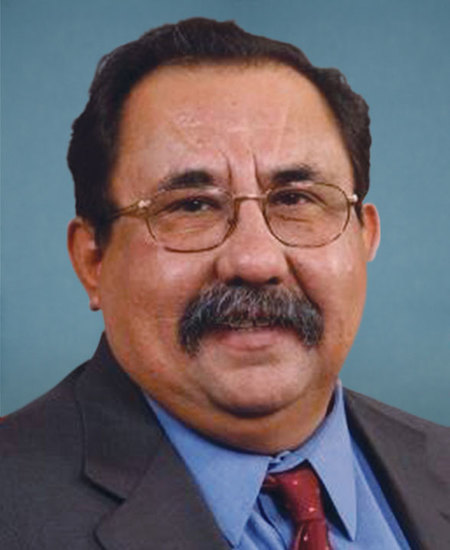
Rep. Raúl M. Grijalva
Sponsored bills
Medicare Dental, Vision, and Hearing Benefit Act of 2021 This bill provides for Medicare coverage of dental, vision, and hearing care. Coverage includes (1) routine dental cleanings and exams, basic and major dental services, emergency dental care, and dentures; (2) routine eye exams, eyeglasses, and contact lenses; and (3) routine hearing exams, hearing aids, and exams for hearing aids. With respect to such care, the bill establishes special payment rules, limitations, and coinsurance requirements.
United States Postal Service 50th Anniversary Resolution or the USPS 50th Anniversary Resolution This bill recognizes the 50th anniversary of the establishment of the U.S. Postal Service and applauds its employees' dedication and service.
Animal Welfare Enforcement Improvement Act This bill revises the licensing process of the Department of Agriculture (USDA) for animal dealers and exhibitors to expand USDA's oversight and enforcement of animal welfare requirements. The bill also authorizes citizen suits to enforce the Animal Welfare Act. Dealers and exhibitors must apply to USDA for licenses or renewal licenses each year. In order to obtain the licenses or renewals, dealers and exhibitors must meet certain standards for the humane treatment of animals and pass inspections as specified by this bill. USDA may not issue or renew such licenses if the dealers or exhibitors have violated laws relating to animals or if the issuance of the licenses would facilitate the circumvention of state or local laws that prohibit the private ownership of certain animals. Further, USDA must suspend the licenses of dealers or exhibitors whose violations present a risk to animal welfare. USDA must revoke the licenses if the violations persist or if the licensees commit multiple violations. Dealers and exhibitors with suspended or revoked licenses may not be (1) granted another license, (2) granted another license through another person or entity, or (3) employed by another licensee to work with animals during the period of the suspension or revocation.
Connecting Youth to Jobs Act This bill establishes and provides funding through FY2031 for grant programs to address barriers to youth employment. The bill also excludes certain youth employment income from Supplemental Nutrition Assistance Program (SNAP) eligibility determinations. Specifically, the bill requires the Department of Labor to provide formula grants to states and local areas, and competitive grants to community-based organizations and other eligible entities, to assist in carrying out subsidized public employment programs for youth with barriers to employment. Funding to states and local areas must be used for programs that lead eligible youth to unsubsidized full-time employment or to attainment of at least one recognized postsecondary credential. Grants to eligible entities must be used to match youth with employment barriers to subsidized employment programs funded by the bill and to provide hands-on work experience. The Government Accountability Office must evaluate and report on the activities funded by the bill. The bill also excludes from SNAP income eligibility determinations any income earned by a household member who is younger than 22 years old, is an elementary or secondary school student, and lives with a parent.
Pet Safety and Protection Act of 2021 This bill revises requirements concerning the sources of dogs and cats used by research facilities. Specifically, the bill revises the list of permissible sources of dogs and cats used by research facilities to include dogs and cats obtained (1) from a licensed dealer, (2) from a publicly owned and operated pound or shelter that meets specified requirements, (3) by donation from a person who bred and raised the dog or cat or owned it for not less than one year, or (4) from a research facility licensed by the Department of Agriculture. The requirements pertaining to sources apply to dogs and cats obtained through sales, donations, or offers. Monetary penalties are established for violations.
Student Food Security Act of 2021 This bill expands the Supplemental Nutrition Assistance Program (SNAP) and establishes programs to address food insecurity among college students. Specifically, the bill permanently modifies the eligibility requirements to allow additional college students to receive SNAP benefits, and it establishes a demonstration program to allow college students to use SNAP benefits on college campuses instead of meal plans. The bill also advances implementation of certain data-sharing agreements and notifications to help students who apply for federal financial aid to also apply for and receive other federal means-tested benefits (e.g., Section 8 tenant-based housing assistance, Medicaid, and Supplemental Security Income). In addition, the bill (1) requires questions about food and housing insecurity to be incorporated into the National Postsecondary Student Aid Study, and (2) establishes a grant program to support research and address incidences of food and housing insecurity among college students.
Making Essentials Available and Lawful (MEAL) Act of 2021 This bill repeals a lifetime ban that prohibits individuals convicted of certain offenses related to the possession, use, or distribution of a controlled substance from receiving Supplemental Nutrition Assistance Program (SNAP) benefits or assistance under programs funded by Temporary Assistance for Needy Families (TANF) block grants. Any state law that imposes conditions on eligibility for SNAP benefits or TANF assistance based on an individual's conviction of such an offense shall have no force or effect. In addition, individuals who are incarcerated and scheduled to be released within 30 days shall qualify as individual households for purposes of SNAP eligibility. Under current law, unless specifically excepted, individuals residing in institutions do not constitute a household.
This resolution supports the designation of a National Warrior Call Day to encourage Americans to talk with members of the Armed Forces and veterans to connect them with support.
Screening With Dignity Act This bill directs the Transportation Security Administration (TSA) to develop procedures to appropriately and respectfully screen self-identified transgender air passengers and passengers traveling with religious headwear or other articles of faith and begin training of all TSA Officers on such procedures. The TSA must implement protections for such passengers, including (1) prohibiting human viewing of passenger images and conducting pat downs by an officer of the gender requested by the passenger; and (2) ensuring secondary screening measures are no more intrusive than necessary to resolve an alarm or other concern raised by primary screening, including consideration of the sensitivity of the groin, chest, and other body areas and the sensitivity of religious articles of faith such as religious headwear. The TSA shall separately study and report on (1) the cost and feasibility of retrofitting advanced image technology screening equipment to distinguish between foreign objects and human body parts (including hair) in a manner that is gender neutral; and (2) the impact of imaging technology on transgender passengers, passengers whose religious faith requires them to travel with articles of faith, and passengers traveling with assistive devices. Additionally, the TSA must identify any policy, procedure, or training changes and complete any testing, certification, and assessment for qualifying additional technology to ensure that any advanced imaging utilized for passenger screening meets certain requirements, including not generating alarms based only on passengers' body parts (including hair), undergarments, or religious headwear.