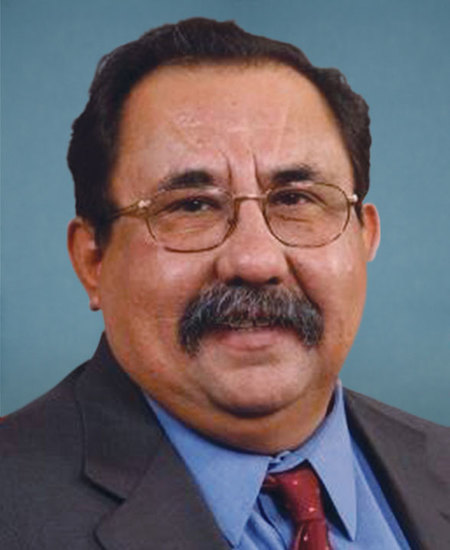
Photo of Raúl M. Grijalva
D United States House · District 7 · Former member · Arizona

Rep. Raúl M. Grijalva

Compare
Total votes
2,237
all sessions
Attendance
74%
579 missed
Among the lowest in the chamber
With party
97%
of cast votes
Bipartisan score
1%
crosses aisle rarely
Sponsored
2,161
bills & resolutions
Lower than 92% of chamber peers
Committees
0
assignments
2,161 bills and resolutions

Sponsored bills

Total
2,161
Primary
79
Co-sponsor
2,082
This page
2,161
matching current filters
Co-sponsor HR 4017
In committee · United States House · Co-sponsor
Central American Women and Children Protection Act of 2021

Central American Women and Children Protection Act of 2021 This bill temporarily authorizes the Department of State to enter into bilateral compacts with the governments of El Salvador, Guatemala, and Honduras to strengthen criminal justice systems, social supports, and other means to protect women and children from domestic and gender-based violence. At least 15 days before entering a compact, the State Department must submit to Congress a copy of the proposed agreement and related materials. Authority to enter a compact terminates on September 30, 2023, and a compact may last no more than six years. To support the objectives outlined in a compact, the State Department may provide assistance to international organizations, civil society, or other private entities for programs and activities to prevent and respond to domestic and gender-based violence in a compact country. The bill bars the provision of assistance to the government of a compact country as direct budgetary support. The State Department may suspend or terminate the assistance if a compact country or entity receiving the assistance engaged in conduct contrary to U.S. national security interests or inconsistent with the objectives of the compact. The State Department must notify Congress at least 15 days before suspending or terminating assistance. The bill also requires the State Department to annually report on progress made under each compact, including its effect on reported violence against women and children and other domestic and gender-based violence indicators.


In committee Aug 4, 2021 1 co-sponsor
Co-sponsor HCONRES 46
In committee · United States House · Co-sponsor
Recognizing the significance of equal pay and the disparity in wages paid to men and to Black women.

This concurrent resolution recognizes the disparity in wages paid to Black women and its impact on women, families, and the nation, and reaffirms Congress' support for ensuring equal pay and closing the gender wage gap.

In committee Aug 3, 2021 1 co-sponsor
Co-sponsor HR 4934
In committee · United States House · Co-sponsor
Equal Pay for Equal Work Act

Equal Pay for Equal Work Act This bill establishes the National Equal Pay Enforcement Task Force to improve enforcement of equal pay laws.

In committee Aug 3, 2021 1 co-sponsor
Co-sponsor HR 4922
In committee Aug 3, 2021 1 co-sponsor
Co-sponsor HR 4870
In committee · United States House · Co-sponsor
Promoting Access to Diabetic Shoes Act

Promoting Access to Diabetic Shoes Act This bill allows a nurse practitioner or physician assistant to fulfill documentation requirements for coverage, under Medicare, of special shoes for diabetic individuals. Under current law, such requirements may be satisfied only by a physician.

In committee Aug 2, 2021 1 co-sponsor
Co-sponsor HR 4892
In committee · United States House · Co-sponsor
Quiet Communities Act of 2021

Quiet Communities Act of 2021 This bill requires the Environmental Protection Agency to reestablish an Office of Noise Abatement and Control to promote the development of local noise control programs, carry out research, and develop and disseminate educational materials, among other duties.

In committee Aug 2, 2021 1 co-sponsor
Co-sponsor HR 3368
In committee · United States House · Co-sponsor
Lonnie Kilpatrick Central Pacific Relief Act

Lonnie Kilpatrick Central Pacific Relief Act This bill provides a presumption of service-connection for diseases associated with exposure to certain herbicide agents to veterans who served on (1) Guam or American Samoa, or in the territorial waters thereof, between January 9, 1962, and July 31, 1980; or (2) Johnston Atoll or a ship that went to Johnston Atoll between January 1, 1972, and September 30, 1977. Under a presumption of service-connection, specific diseases diagnosed in certain veterans are presumed to have been caused by the circumstances of their military service. Health care benefits and disability compensation may then be awarded. Additionally, the bill expands eligibility for hospital care, medical services, and nursing home care to veterans with a disability associated with exposure to certain herbicides during specified times of military service on Guam, American Samoa, or Johnston Atoll.

In committee Aug 2, 2021 1 co-sponsor
Co-sponsor HR 4801
In committee · United States House · Co-sponsor
Protecting the Information of our Vulnerable Children and Youth Act

Protecting the Information of our Vulnerable Children and Youth Act or the Kids PRIVCY Act This bill expands the requirements for digital services when handling the personal information of children. Specifically, the bill (1) requires digital services to obtain express, affirmative consent that is specific, informed, and unambiguous before processing the personal information of a child or teenager under the age of 18; (2) prohibits certain targeted advertising; and (3) allows individuals to access, correct, or delete their personal information. The bill increases the civil penalty for violations of the children's online privacy protections and provides for enforcement by the Federal Trade Commission and a private right of action.

In committee Jul 30, 2021 1 co-sponsor
Co-sponsor HR 4853
In committee · United States House · Co-sponsor
Medical Device Nonvisual Accessibility Act of 2021

Medical Device Nonvisual Accessibility Act of 2021 This bill requires certain medical devices with a digital interface to meet nonvisual accessibility standards established by the Food and Drug Administration (FDA). Specifically, the FDA must establish regulations to require a Class II or Class III medical device with a digital interface to provide a blind or low-vision user access to the same services and information, and generally the same ease of use, as provided to a user who is not low-vision or blind. (The FDA classifies medical devices in three classes. Class I devices are low-risk, Class II devices are moderate-risk, and Class III devices are high-risk.) A Class II or Class III medical device that does not meet the nonvisual accessibility standards established under this bill may not be sold.

In committee Jul 30, 2021 1 co-sponsor
Showing 1,651 to 1,660 of 2,161 bills