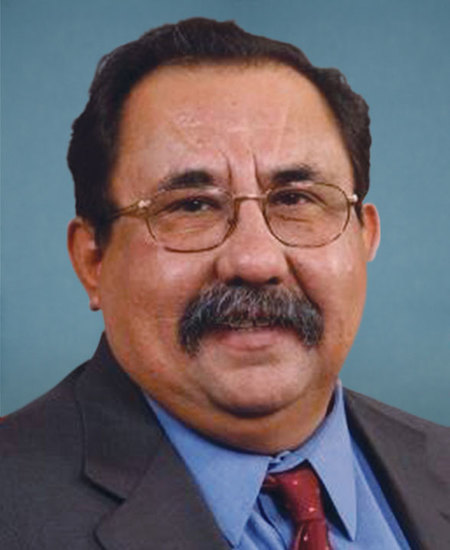
Photo of Raúl M. Grijalva
D United States House · District 7 · Former member · Arizona

Rep. Raúl M. Grijalva

Compare
Total votes
2,237
all sessions
Attendance
74%
579 missed
Among the lowest in the chamber
With party
97%
of cast votes
Bipartisan score
1%
crosses aisle rarely
Sponsored
2,161
bills & resolutions
Lower than 92% of chamber peers
Committees
0
assignments
2,161 bills and resolutions

Sponsored bills

Total
2,161
Primary
79
Co-sponsor
2,082
This page
2,161
matching current filters
Co-sponsor HR 4257
In committee · United States House · Co-sponsor
Cameras in the Courtroom Act

Cameras in the Courtroom Act This bill requires the Supreme Court to permit television coverage of all open sessions of the Court unless it decides by majority vote that allowing such coverage in a particular case would violate the due process rights of any of the parties involved.

In committee Nov 1, 2022 1 co-sponsor
Co-sponsor HR 4194
In committee · United States House · Co-sponsor
The People’s Response Act

The People's Response Act This bill establishes multiple grant programs and requirements to promote qualified approaches to community safety. These are programs or services that are disconnected from carceral institutions (e.g., law enforcement, child welfare services, and immigration enforcement). Specifically, the bill establishes the Division of Community Safety within the Department of Health and Human Services (HHS) to administer the grants and carry out related activities. These include grants for community-based organizations to support qualified approaches to community safety, such as unarmed first responder agencies and 9-1-1 diversion programs; neighborhood-level interventions, including safe passage to school and violence interruption programs; behavioral health treatment, nutrition support, and other public health programs; housing security programs; and programs for youth and families, survivors of violence, and individuals exiting incarceration or criminal supervision. Additionally, the division must administer grants pertaining to qualified approaches for community safety for state and local governments and hiring and training first responders. The bill also establishes an advisory board to oversee the division's activities. Membership on the board must reflect the racial, ethnic, and other demographic diversities of the United States. The board must also include members who have personal experience with the criminal justice system. Furthermore, HHS must set up (1) a federal health response unit to respond to any public health emergency, assist with qualified approaches to community safety, and provide resources for safe and inclusive schools; and (2) an interagency task force to promote qualified approaches to community safety across federal programs.

In committee Nov 1, 2022 1 co-sponsor
Primary HR 4137
In committee · United States House · Lead sponsor
Veterans Visa and Protection Act of 2021

Veterans Visa and Protection Act of 2021 This bill provides permanent resident status and citizenship eligibility to certain noncitizen veterans and addresses related issues. The Department of Homeland Security (DHS) must establish a program that allows (1) eligible noncitizen veterans outside of the United States to be admitted as permanent residents, and (2) eligible noncitizen veterans in the United States to obtain permanent resident status.  Generally, an eligible noncitizen veteran under this bill is one who was not removed from the United States for certain crimes related to violence or national security. DHS may waive these eligibility requirements for humanitarian, family unity, public interest, or exceptional military service reasons. A noncitizen veteran who obtains permanent resident status under this bill shall be eligible for (1) naturalization through service in the Armed Forces, and (2) military and veterans benefits as if they had not been removed (or ordered removed) from the United States. For a noncitizen veteran in removal proceedings or subject to a final removal order, the Department of Justice (DOJ) must determine whether the veteran is eligible for permanent resident status under this bill. If the veteran is eligible, DOJ must adjust the veteran's status. The bill also protects noncitizen veterans or service members from being removed from the United States unless the veteran has been convicted of a crime of violence.

In committee Nov 1, 2022 0 co-sponsors
Co-sponsor HR 3993
In committee · United States House · Co-sponsor
Stop Shackling and Detaining Pregnant Women Act

Stop Shackling and Detaining Pregnant Women Act This bill prohibits the Department of Homeland Security (DHS) from detaining an individual during pregnancy or postpartum recovery and addresses related issues. DHS must immediately release any detainee found to be pregnant, unless the detainee presents an immediate and serious threat of hurting themselves or others. A DHS detention facility may not use a restraint on a detainee who is known to be pregnant, including during labor, transport to a medical facility or birthing center, and delivery, or during postpartum recovery, except for medical or safety purposes. The bill requires DHS to use the least restrictive restraint necessary and prohibits certain specified restraint types, including four-point restraints and binding hands behind the detainee's back. The bill prohibits DHS detention officers from being present during a detainee's pelvic exam, labor, delivery, or treatment relating to a pregnancy, unless specifically requested by medical personnel. If a detention officer is requested by medical personnel, such officer shall be female, if practicable, and remain at a reasonable distance from the detainee. A pregnant detainee must have access to health care services, including comprehensive services relating to reproductive health care and pregnancy. DHS must provide annual training about this bill's requirements to each employee who has a role in the detention or care of a pregnant detainee or a postpartum parent of a newborn. DHS must also provide each detainee notice of their rights under this bill in the detainee's native language.

In committee Nov 1, 2022 1 co-sponsor
Co-sponsor HR 3950
In committee · United States House · Co-sponsor
Veterans Medical Legal Partnerships Act of 2021

Veterans Medical Legal Partnerships Act of 2021 This bill establishes a grant program to support the establishment of medical-legal partnerships (MLPs) that provide legal expertise and services to veterans, with a particular focus on veterans whose medical needs put them at risk of recidivism, reoffending, or becoming victim to a crime. The bill also permits (1) the Department of Justice to give preference, when awarding grants for veteran treatment courts, to applicants that plan to work with MLPs; and (2) the Department of Veterans Affairs to establish MLPs in its facilities.

In committee Nov 1, 2022 1 co-sponsor
Co-sponsor HR 3929
In committee · United States House · Co-sponsor
Disarm Hate Act

Disarm Hate Act The bill expands the categories of persons who are prohibited from receiving or possessing a firearm. Specifically, it prohibits firearm sale or transfer to and receipt, possession, shipment, or transport by a person (1) who has been convicted of a misdemeanor hate crime, or (2) who has received an enhanced hate crime misdemeanor sentence.

In committee Nov 1, 2022 1 co-sponsor
Co-sponsor HR 3862
In committee · United States House · Co-sponsor
Community-Based Response Act of 2021

Community-Based Response Act of 2021 This bill establishes a program to assist communities with implementing alternative emergency response models in vulnerable populations to resolve crisis situations that may not require a law enforcement response or situations in which a law enforcement response may increase the risk of harm. Specifically, Administration for Community Living, in consultation with the Department of Housing and Urban Development and the Department of Justice, must award grants to eligible partnerships to establish or expand these models. The partnerships must consist of a unit of local or tribal government that is independent of law enforcement agencies and a nonprofit, community-based organization or consortium of such organizations. The partnerships may also include other entities, such as nonprofit or public institutions of higher education and behavioral health organizations. A partnership may use grant funds for a variety of purposes, such as triaging 9-1-1 calls to refer certain emergencies to entities other than law enforcement. In awarding these grants, the administration must prioritize partnerships that include community-based organizations that have a record of effectively serving, and are led by members of, vulnerable populations.

In committee Nov 1, 2022 1 co-sponsor
Co-sponsor HR 3800
In committee · United States House · Co-sponsor
GLOBE Act of 2021

Greater Leadership Overseas for the Benefit of Equality Act of 2021 or the GLOBE Act of 2021 This bill contains provisions related to (1) the protection of LGBTQI individuals globally; and (2) immigration protections for vulnerable individuals. The bill establishes (1) an interagency group to respond to urgent threats to LGBTQI people in foreign countries, and (2) a permanent Special Envoy for the Human Rights of LGBTQI Peoples in the Department of State. The President shall impose visa-blocking sanctions on foreign persons responsible for violating the human rights of individuals based on sexual orientation, gender identity, or sex characteristics. The State Department shall establish the Global Equality Fund to provide assistance to nongovernmental organizations working to advance and protect human rights. The U.S. Agency for International Development shall establish the LGBTQI Global Development Partnership to work with the private sector and nongovernmental organizations to support LGBTQI rights. The bill removes prohibitions against providing foreign assistance to nongovernmental organizations that offer certain medical services (e.g., abortion-related services) using non-U.S. government funds. The bill contains several immigration-related provisions, such as those  establishing that persecution based on sexual orientation or gender identity may form the basis of an asylum request, allowing certain applicants to file asylum claims more than a year after their arrival in the United States, including a permanent partnership between two partners as a marriage for immigration law purposes, providing for free counsel in certain immigration proceedings, and granting U.S. citizenship to a child born abroad through assistive reproductive technology from a U.S. citizen who is the child's nonbiological parent.


In committee Nov 1, 2022 1 co-sponsor
Co-sponsor HR 3772
In committee · United States House · Co-sponsor
Housing Is a Human Right Act of 2021

Housing is a Human Right Act of 2021 This bill establishes and expands programs to assist homeless and housing-unstable individuals and establishes new real property-related taxes to fund specified Department of Housing and Urban Development (HUD) programs. HUD must establish the Community Development Block Grant Plus Program for state and local governments to assist homeless and housing-unstable individuals as well as cost-burdened households. These funds may be used only for certain activities that assist these populations, including the construction of new affordable housing. The bill also establishes other grant programs to assist these individuals, such as by facilitating access to voting and libraries. Governmental entities may not receive assistance under the bill unless they have, or are working to implement, policies that (1) do not criminally punish homeless individuals for sleeping outside or on public property, and (2) comply with constitutional protections for these individuals' property. In addition, the bill establishes taxes on (1) the sale or exchange of real property of at least $10 million, (2) the sale or exchange of real property involving an anonymous entity, and (3) rent received by landlords that own large amounts of dwelling units. The revenue from these taxes must be credited to various HUD programs in specified percentages. The Government Accountability Office must study (1) the allocation formula for Emergency Food and Shelter grants, (2) recipient compliance with various grant program guidelines, and (3) barriers related to access to essential documents that homeless and housing-unstable individuals face.

In committee Nov 1, 2022 1 co-sponsor
Showing 1,261 to 1,270 of 2,161 bills