

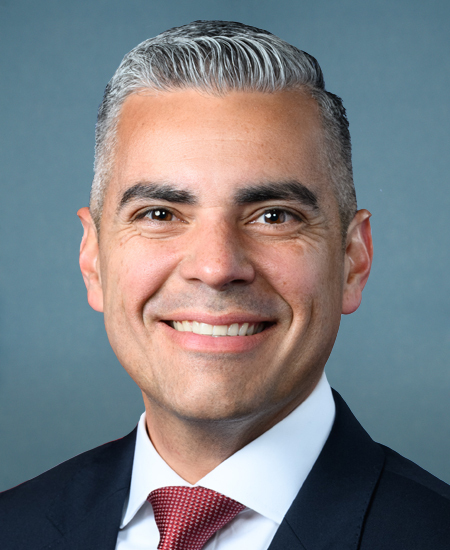
Photo of Juan Ciscomani
R United States House · District 6 · Arizona On the 2026 ballot

Rep. Juan Ciscomani

Compare
Total votes
1,879
all sessions
Attendance
96%
70 missed
Lower than 83% of chamber peers
With party
89%
of cast votes
Near the chamber average
Bipartisan score
6%
crosses aisle rarely
Near the chamber average
Sponsored
746
bills & resolutions
Near the chamber average
Committees
7
assignments
746 bills and resolutions

Sponsored bills

Total
746
Primary
63
Co-sponsor
683
This page
746
matching current filters
Co-sponsor HCONRES 98
In committee · United States House · Co-sponsor
Affirming the vital importance to the United States and its allies and partners of actions necessary to preserve peace, security, and freedom of navigation in the Red Sea and Gulf of Aden.

Maddy summaryThis concurrent resolution expresses Congress's support for U.S. military actions to protect maritime security in the Red Sea and Gulf of Aden. It urges the President to take necessary steps to restore deterrence against Houthi attacks, consult Congress before authorizing military responses, and provide timely reports on incidents involving U.S. forces. The resolution also supports designating the Iran-backed Houthi group as a terrorist organization and emphasizes protecting freedom of navigation through international cooperation. It directly affects U.S. military operations and diplomatic coordination in the region, aiming to safeguard global trade routes that handle nearly 15% of the world's maritime traffic.

In committee Mar 13, 2024 1 co-sponsor
Co-sponsor HRES 1037
In committee · United States House · Co-sponsor
Providing the sense of the House of Representatives that in vitro fertilization (IVF) is necessary for women who cannot conceive naturally, and for other purposes.

Maddy summaryThis non-binding resolution expresses the House's support for in vitro fertilization (IVF) access, noting that 19% of women in the U.S. face infertility challenges. It states IVF is necessary for those unable to conceive naturally, emphasizes policies enabling family growth, and recognizes "life is precious." The resolution does not create new laws or change regulations but symbolically affirms the House's position on IVF as a vital medical option for individuals struggling with infertility. It was introduced by Rep. Chavez-DeRemer and others on February 29, 2024.

In committee Mar 8, 2024 1 co-sponsor
Co-sponsor HRES 1041
In committee · United States House · Co-sponsor
Condemning the order issued by the International Court of Justice on January 26, 2024, imposing provisional measures against Israel.

Maddy summaryHRES 1041 is a non-binding resolution introduced in the U.S. House of Representatives on February 29, 2024, that condemns the International Court of Justice's (ICJ) January 26, 2024, order requiring Israel to report on measures taken to comply with provisional measures related to South Africa's genocide case against Israel. The resolution specifically condemns the ICJ's order and South Africa's case, asserts Israel's right to self-defense against Hamas, and calls on the U.S. President to direct the Secretary of State to intervene in support of Israel. It does not impose legal requirements or alter policy, as resolutions like this express congressional opinion only.

In committee Feb 29, 2024 1 co-sponsor
Co-sponsor HR 7478
In committee · United States House · Co-sponsor
PROTECT Jewish Student and Faculty Act

Maddy summaryHR 7478, the PROTECT Jewish Student and Faculty Act, amends the Higher Education Act to require colleges and universities receiving federal funds to take specific steps against antisemitism. The bill mandates that these institutions include the International Holocaust Remembrance Alliance's definition of antisemitism in all campus conduct documents and explicitly state that antisemitic conduct by students may lead to expulsion, while antisemitic conduct by employees may result in termination. This directly affects all institutions covered under the Higher Education Act by imposing new requirements for policy documentation and disciplinary consequences. The key mechanism is the mandatory inclusion of the IHRA definition and clear statements of penalties, aiming to standardize how institutions address antisemitism on campus.

In committee Feb 29, 2024 1 co-sponsor
Co-sponsor HR 7361
In committee · United States House · Co-sponsor
Flowers for Fallen Heroes Act of 2024

Maddy summaryHR 7361, the Flowers for Fallen Heroes Act of 2024, requires the American Battle Monuments Commission to establish a low-cost program allowing the public to order flowers for military gravesites at Commission-managed cemeteries. The bill mandates the Commission to partner with third-party florists (without excess fees) and create a user-friendly website and phone system for ordering by one year after enactment. It also authorizes credit card and electronic payment processing for these orders, with customers responsible for any third-party processing fees, and requires annual reports to Congress detailing program implementation, including order data and florist engagement. This bill directly affects the public seeking to honor fallen service members and the Commission’s operations at 25 overseas military cemeteries.

In committee Feb 29, 2024 1 co-sponsor
Primary HR 7467
In committee · United States House · Lead sponsor
HEADWAY Act

Maddy summaryThis bill amends the Head Start Act to improve teacher qualifications in Early Head Start programs. It requires each Early Head Start center to have at least one teacher per classroom who holds or is working toward a child development associate credential, with mentorship support during that process. The law eliminates outdated deadlines and updates requirements so teachers providing direct services must be actively pursuing this credential and relevant training. These changes directly affect Early Head Start programs nationwide by setting new standards for staff qualifications and professional development.

In committee Feb 28, 2024 0 co-sponsors
Co-sponsor HR 7455
In committee · United States House · Co-sponsor
Sunset Act of 2024

Maddy summaryHR 7455, the Sunset Act of 2024, requires federal agencies to automatically expire significant rules after 10 years unless Congress passes a new law extending them. Agencies must submit reports 180 days before expiration, and Congress can extend rules via joint resolution within 3 legislative days of receiving the report. The bill also mandates annual reviews of 10% of active agency rules for 9 years, with rules not extended by Congress after the 10-year period expiring. It applies to all major agency rules (e.g., environmental or safety regulations) and includes limited presidential exemptions for emergencies, but does not affect existing rules already in effect.

In committee Feb 26, 2024 1 co-sponsor
Co-sponsor HR 7411
In committee · United States House · Co-sponsor
Recover Pride in Service Act

Maddy summaryHR 7411, the Recover Pride in Service Act, requires the Department of Defense to automatically upgrade all military discharges based solely on sexual orientation to honorable status without veterans needing to apply. It directly affects veterans discharged under such policies, including those separated before September 20, 2011. Key provisions include amending review procedures to eliminate documentation requirements for veterans seeking review, establishing a Defense Outreach Unit to notify affected veterans within 60 days, and mandating a 5-year timeline for full implementation. The bill also requires annual progress reports to Congress on discharge upgrades and final reports detailing outcomes like the number of upgrades completed.

In committee Feb 20, 2024 1 co-sponsor
Primary HR 7369
In committee · United States House · Lead sponsor
CBP HiRe Act of 2024

Maddy summaryThe CBP HiRe Act of 2024 creates special hiring and retention tools for U.S. Customs and Border Protection (CBP) employees working in rural or remote border areas. It allows direct hiring without standard civil service rules for critical positions, plus recruitment/relocation bonuses (up to 100% of salary) and retention bonuses (up to 50% of salary) for employees in these areas. CBP hiring officials must prove staffing challenges are directly tied to an area’s remote location before using these authorities, and must report annually on their effectiveness to Congress. The law expires after five years and requires annual reviews to ensure these flexibilities address actual hiring and retention needs.

In committee Feb 15, 2024 0 co-sponsors
Co-sponsor HR 7382
In committee · United States House · Co-sponsor
Empowering Law Enforcement To Fight Sex Trafficking Demand Act of 2024

Maddy summaryHR 7382 amends existing law to allow law enforcement agencies using Byrne JAG funds (a federal grant program) to specifically fund programs aimed at reducing demand for commercial sex trafficking. This change directly affects state and local law enforcement agencies that receive Byrne JAG grants, enabling them to allocate these funds toward demand reduction initiatives like public awareness campaigns or victim services. The key mechanism is adding "programs to reduce the demand for trafficked persons" as an explicitly authorized use of Byrne JAG funds under the 1968 Crime Control Act. This policy change expands the scope of existing federal funding to target the demand side of sex trafficking, without creating new programs or altering other funding categories.

In committee Feb 15, 2024 1 co-sponsor
Showing 541 to 550 of 746 bills
Previous 1 … 54 55 56 … 75 Next