

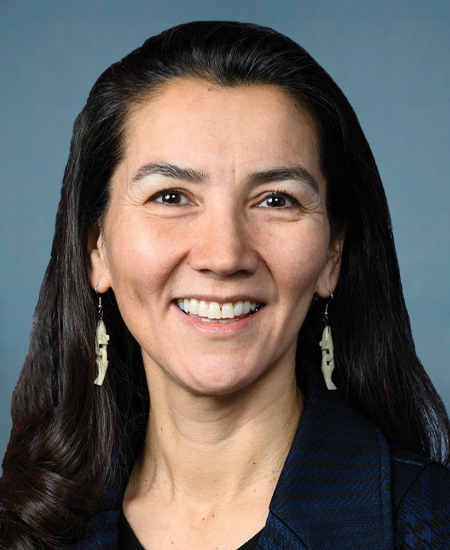
Photo of Mary Sattler Peltola
D United States House · District At-Large · Alaska

Rep. Mary Sattler Peltola

Compare
Total votes
1,329
all sessions
Attendance
82%
234 missed
Lower than 97% of chamber peers
With party
86%
of cast votes
Lower than 93% of chamber peers
Bipartisan score
7%
crosses aisle rarely
Higher than 90% of chamber peers
Sponsored
384
bills & resolutions
Near the chamber average
Committees
0
assignments
384 bills and resolutions

Sponsored bills

Total
384
Primary
36
Co-sponsor
348
This page
384
matching current filters
Co-sponsor HR 7003
In committee · United States House · Co-sponsor
National Landslide Preparedness Act Reauthorization Act of 2024

Maddy summaryThis bill extends funding for the National Landslide Preparedness Act through 2028, replacing the previous 2021-2024 authorization period. It directly affects existing federal landslide preparedness programs by continuing their current funding structure without new requirements. The key change is simply updating the program's authorization period in two specific sections of the law (sections 3(h) and 5(e)). The bill does not create new policies or alter how landslide preparedness activities are conducted.

In committee Dec 18, 2024 1 co-sponsor
Co-sponsor HR 3230
In committee · United States House · Co-sponsor
Unfunded Mandates Accountability and Transparency Act of 2023

Maddy summaryThis bill amends the Unfunded Mandates Reform Act of 1995 to strengthen requirements for federal agencies when creating regulations that impose costs on state, local, tribal governments or the private sector. It requires agencies to conduct detailed regulatory impact analyses for "major rules" (defined as rules with significant economic effects, such as annual costs of $100 million or more) before finalizing them, including analyzing costs and benefits of alternatives. The bill enhances consultation requirements with state, local, tribal governments and private sector entities, including small businesses, throughout the rulemaking process. Agencies must select the regulatory alternative that maximizes net benefits, and the Office of Information and Regulatory Affairs gains new oversight responsibilities to ensure compliance with these requirements.

In committee Dec 18, 2024 1 co-sponsor
Co-sponsor HR 2989
In committee · United States House · Co-sponsor
Save Our Sequoias Act

Maddy summaryThe Save Our Sequoias Act establishes a coordinated approach to protect giant sequoia groves in California from wildfires, insects, and drought. It creates a Giant Sequoia Lands Coalition including federal agencies, state governments, and the Tule River Indian Tribe to assess grove health, develop protection projects, and recommend forest management activities. The bill streamlines implementation of certain projects through categorical exclusion from environmental reviews, authorizes $10-40 million annually for conservation efforts, and establishes a fund for philanthropic support of sequoia protection.

In committee Dec 18, 2024 1 co-sponsor
Co-sponsor HR 9275
In committee · United States House · Co-sponsor
End Kidney Deaths Act

Maddy summaryThis bill creates a $10,000 annual tax credit for individuals who make non-directed living kidney donations (where donors don’t know the recipient’s identity) for five years (the donation year plus four subsequent years). It directly affects living kidney donors who qualify under these specific conditions, covering costs related to the donation process. The credit applies to kidneys removed after December 31, 2024, and expires December 31, 2034. The bill does not alter organ transplant recipient eligibility or medical procedures, focusing solely on financial incentives for donors.

In committee Dec 17, 2024 1 co-sponsor
Co-sponsor HR 8796
In committee · United States House · Co-sponsor
Stop Comstock Act.

Maddy summaryHR 8796, the "Stop Comstock Act," removes outdated restrictions from federal law that previously banned the distribution of materials related to contraception and abortion as "obscene" or "indecent." The bill amends Title 18 and the Tariff Act by deleting references to "indecent," "immoral," "unlawful abortion," and "procuring abortion" from provisions governing obscene materials. It clarifies that the law only prohibits "obscene materials" in commerce, eliminating broad restrictions on reproductive health information. This directly affects internet platforms, healthcare providers, and individuals sharing reproductive health resources by removing legal barriers to their distribution.

In committee Dec 17, 2024 1 co-sponsor
Primary HR 8788
In committee · United States House · Lead sponsor
Fisheries Improvement and Seafood Health Act of 2024

Maddy summaryThis bill establishes the Fisheries and Ecological Resilience Program within NOAA's National Marine Fisheries Service to help fisheries adapt to climate change and shifting ocean conditions. It requires the program to conduct research on changing ecosystems, develop science-based tools for fishery managers, coordinate across agencies, and engage with fishing communities - funded with $30 million annually from 2025-2030. The bill also directs a report analyzing U.S. seafood competitiveness in global markets, including trade barriers and recommendations for improving domestic producer support. It affects federal fishery managers, coastal communities, and seafood producers by mandating climate-informed management practices under the Magnuson-Stevens Act.

In committee Dec 17, 2024 0 co-sponsors
Co-sponsor HR 8458
In committee · United States House · Co-sponsor
Increasing Mental Health Options Act of 2024

Maddy summaryThe Increasing Mental Health Options Act of 2024 would expand access to mental health care in rural and underserved areas by providing a 10% financial incentive to clinical psychologists who serve Medicare patients in designated health professional shortage areas starting in 2025. It also removes requirements for clinical psychologists to have physician supervision in specific Medicare-covered settings - such as outpatient rehabilitation centers, skilled nursing facilities, and home health services - when state law permits. These changes aim to encourage more clinical psychologists to work in areas with mental health provider shortages. The bill directly affects clinical psychologists and Medicare beneficiaries in underserved communities by streamlining access to mental health services.

In committee Dec 17, 2024 1 co-sponsor
Co-sponsor HR 8331
In committee · United States House · Co-sponsor
Essential Caregivers Act of 2024

Maddy summaryThe Essential Caregivers Act of 2024 requires nursing homes and similar facilities to allow residents to designate essential caregivers who provide emotional support or assistance with daily activities. During emergencies when regular visitation is restricted, facilities must permit at least one essential caregiver access to residents daily and cannot deny access without following specific procedures. Facilities may deny access for a maximum of 7 days during emergencies (or 14 days with state approval), and must provide a written explanation and appeal process if access is denied. The bill establishes a 48-hour appeal process for residents and caregivers to challenge denials, with facilities required to prove violations during appeals. This law applies to Medicare skilled nursing facilities, Medicaid nursing facilities, intermediate care facilities, and certain inpatient rehabilitation facilities.

In committee Dec 17, 2024 1 co-sponsor
Co-sponsor HR 8018
In committee · United States House · Co-sponsor
ABC Act

Maddy summaryHR 8018, the ABC Act, requires Medicare, Medicaid, CHIP, and Social Security Administration to review their eligibility processes, forms, and communications to simplify interactions for family caregivers. It targets reducing duplicate paperwork, improving website accessibility (including ADA compliance), and enhancing staff communication - such as shorter call waits and multilingual support - to better serve caregivers supporting individuals enrolled in these programs. The review must include input from caregivers and organizations, with results reported to Congress within one year. This procedural bill does not change program benefits but mandates systemic improvements to reduce administrative burdens.

In committee Dec 17, 2024 1 co-sponsor
Co-sponsor HR 7379
In committee · United States House · Co-sponsor
MATCH IT Act of 2024

Maddy summaryThe MATCH IT Act of 2024 establishes national standards to improve patient matching accuracy in electronic health records. It requires the Secretary to create a uniform definition for measuring patient match rates (accounting for duplicate/overlaid records) and develop a minimum data set to support 99.9% matching accuracy by healthcare systems. The bill mandates incorporating this data set into health IT certification requirements and Medicare interoperability programs within 18-24 months. It also creates a voluntary Medicare bonus for providers meeting 90% patient match rates, with anonymous reporting of accuracy data. This directly affects healthcare providers, health IT vendors, and Medicare participants by requiring standardized matching protocols to reduce medical errors and costs linked to misidentification.

In committee Dec 17, 2024 1 co-sponsor
Showing 11 to 20 of 384 bills