

Securing Urgent Resources Vital to Indian Victim Empowerment Act or the SURVIVE Act This bill establishes a grant program through which the Department of Justice's Office for Victims of Crime must make grants for Indian tribes to provide programs and services to crime victims. These programs and services include domestic violence shelters, rape crisis centers, child abuse programs, child advocacy centers, elder abuse programs, medical care, legal services, relocation assistance, and transitional housing. In addition, the bill makes 5% of the Crime Victims Fund available for these grants.
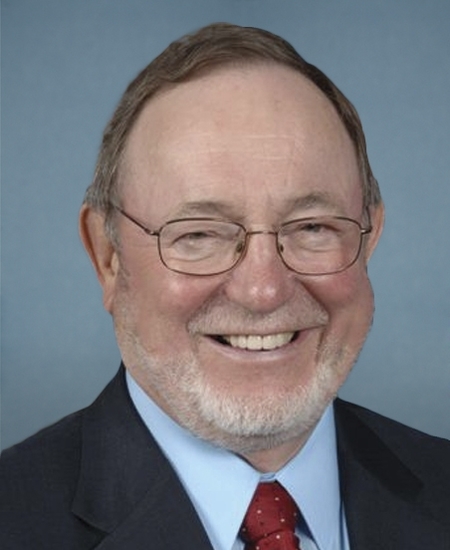
Rep. Don Young
Sponsored bills
Veterans Medical Marijuana Safe Harbor Act This bill provides guidance related to veterans and medical marijuana that shall be effective for five years. Specifically, the bill authorizes (1) a veteran to use, possess, or transport medical marijuana in accordance with applicable state or Native American tribal law; (2) a Department of Veterans Affairs (VA) physician to discuss with a veteran the use of medical marijuana as a treatment if the physician is in a state or on tribal land that authorizes such treatment; or (3) a VA physician to recommend, complete forms for, or register veterans for participation in a medical marijuana treatment program in accordance with applicable state or tribal law. The bill requires the VA to report on (1) the effects of medical marijuana on veterans in pain; and (2) the relationship between state-approved medical marijuana treatment programs, program access, and opioid use and abuse reduction.
Prohibiting IRS Financial Surveillance Act This bill prohibits the Department of the Treasury from requiring a financial institution to report the transfers into and out of a financial account. This prohibition does not apply to laws or regulations in effect on October 1, 2021.
Indian Programs Advance Appropriations Act of 2021 This bill authorizes advance appropriations for several covered appropriations accounts of (1) the Bureau of Indian Affairs and the Bureau of Indian Education within the Department of the Interior, and (2) the Indian Health Service within the Department of Health and Human Services. The advance appropriations provide new budget authority that first becomes available for the first fiscal year after the budget year. The covered accounts within the Bureau of Indian Affairs are (1) Operation of Indian Programs, (2) Contract Support Costs, (3) the Indian Guaranteed Loan Program, (4) Construction, and (5) Payments for Tribal Leases. The covered accounts within the Bureau of Indian Education are (1) Operation of Indian Education Programs, and (2) Education Construction. The covered accounts within the Indian Health Service are (1) Indian Health Services, (2) Contract Support Costs, (3) Payments for Tribal Leases, and (4) Indian Health Facilities. The bill also requires the President's budget and the supporting documents submitted to Congress to include detailed estimates related to the advance appropriations.
Prince Jonah Kūhiō Kalaniana'ole Protecting Family Legacies Act This joint resolution consents to the Hawaii legislature's amendments to the Hawaiian Homes Commission Act. In 2017, the Hawaii legislature reduced the minimum Native Hawaiian blood quantum required for an individual to inherit a homestead lease under the act.
This concurrent resolution supports the designation of a national day of remembrance for the Native American children who died while attending an Indian boarding school in the United States.
Furthering Opioid Services, Training, and Education Resources Act or the FOSTER Act This bill reauthorizes through FY2026 and expands the scope of grants available for states and Indian tribes to address the opioid crisis. Specifically, the bill allows the use of grant funds for workforce recruitment and training, health care services, and foster and adoptive parent recruitment and training to support opioid abuse prevention and treatment services for children and caregivers, kinship care families, and kinship caregivers.
Israel Relations Normalization Act of 2021 This bill requires the Department of State to take certain actions promoting the normalization of relations between Israel, Arab states, and other relevant countries and regions. Specifically, the State Department must develop a strategy on expanding and strengthening the Abraham Accords (the term used to refer collectively to agreements between Israel and the United Arab Emirates and between Israel and Bahrain marking the public normalization of relations between the two Arab countries and Israel). The strategy must include a description of how the U.S. government will encourage further normalization of relations with Israel. In addition, the State Department must report on options for U.S. international efforts to promote the strengthening of ties between Israel, Arab states, and other relevant countries and regions. The State Department must also report on the status of the normalization of relations with Israel, including information on (1) laws that punish individuals for people-to-people relations with Israelis (i.e., anti-normalization laws), and (2) evidence of steps taken by Arab governments toward permitting or encouraging normalized relations between their citizens or residents and Israeli citizens.
Save our Stages Extension Act This bill extends to March 11, 2023, the time frame during which Shuttered Venue Operators Grant recipients may use grant funds to cover their expenses. These grants provide funds to certain types of entities in the arts and entertainment industry affected by the COVID-19 pandemic. Currently, a recipient may use such funds to cover expenses incurred between March 1, 2020, and December 31, 2021.
Eliminating a Quantifiably Unjust Application of the Law Act of 2021 or the EQUAL Act of 2021 This bill eliminates the federal sentencing disparity between drug offenses involving crack cocaine and powder cocaine. Currently, different threshold quantities of crack cocaine and powder cocaine (e.g., 28 grams of crack cocaine and 500 grams of powder cocaine) trigger the same statutory criminal penalties. This bill eliminates the lower quantity thresholds for crack cocaine offenses. Under the bill, the same threshold quantities of crack cocaine and powder cocaine trigger the same statutory criminal penalties. The change applies to future cases and cases pending on the date of enactment. With respect to past cases, the bill authorizes a sentencing court to impose a reduced sentence on a defendant who was convicted or sentenced for a specified crack cocaine offense before this bill's enactment. A defendant does not have to be present at the sentence reduction hearing. Finally, the bill prohibits the reduction of a sentence that was previously reduced.