

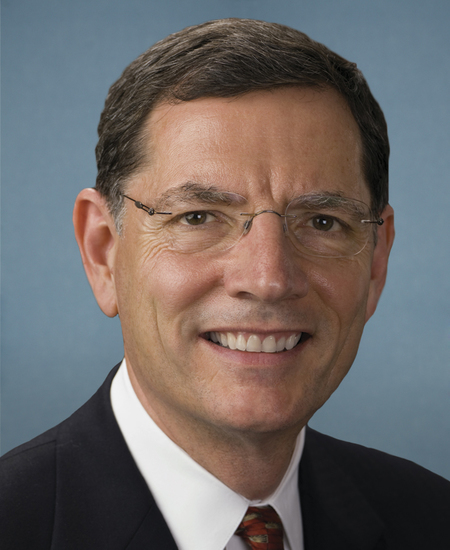
Photo of John Barrasso
R United States Senate · Wyoming

Sen. John Barrasso

Compare
Total votes
1,037
all sessions
Attendance
94%
61 missed
Higher than 94% of chamber peers
With party
96%
of cast votes
Higher than 75% of chamber peers
Bipartisan score
2%
crosses aisle rarely
Lower than 79% of chamber peers
Sponsored
1,031
bills & resolutions
Near the chamber average
Committees
13
assignments
1,031 bills and resolutions

Sponsored bills

Total
1,031
Primary
171
Co-sponsor
860
This page
1,031
matching current filters
Co-sponsor S 1983
In committee · Texas Senate · Co-sponsor
No WHO Pandemic Preparedness Treaty Without Senate Approval Act

Maddy summaryThis bill requires the U.S. Senate to approve any World Health Organization (WHO) pandemic preparedness agreement as a treaty, rather than allowing it to take effect through executive action. It directly affects the U.S. government’s ability to enter into international agreements on pandemic prevention, preparedness, and response with the WHO. The bill explicitly deems any such agreement "a treaty" requiring Senate advice and consent under the U.S. Constitution (two-thirds approval). It responds to the WHO’s recent adoption of a pandemic agreement draft at the 78th World Health Assembly in May 2025, aiming to ensure Senate oversight for all future pandemic-related international commitments.

In committee Jun 5, 2025 1 co-sponsor
Co-sponsor S 1960
In committee · Texas Senate · Co-sponsor
PEAKS Act

Maddy summaryS 1960 (PEAKS Act) modifies distance requirements for critical access hospitals (CAHs) in rural areas with mountainous terrain or limited road access. It allows hospitals already designated as CAHs that met the 15-mile distance rule at their last certification to be deemed compliant after January 1, 2026, provided they have a new facility within 10-15 miles. This change specifically affects CAHs in remote regions where road conditions make meeting standard distance thresholds difficult. The bill requires the Health Secretary to issue regulations within one year of enactment to implement these provisions. It does not alter current CAH requirements but extends flexibility for qualifying hospitals facing geographic challenges.

In committee Jun 5, 2025 1 co-sponsor
Co-sponsor S 1935
In committee · Texas Senate · Co-sponsor
Expanding Access to Palliative Care Act

Maddy summaryThe Expanding Access to Palliative Care Act (S 1935) creates a new 5-year Medicare model to provide community-based palliative care for beneficiaries with serious illnesses like cancer, heart disease, dementia, or kidney disease. It directly affects Medicare beneficiaries who need symptom management and care coordination, including those who previously used hospice care (who cannot be excluded). The bill requires 24/7 access via telehealth or in-person care, a team-based approach with certified palliative specialists, and aims to reduce unnecessary emergency visits and hospitalizations. Key provisions include eliminating hospice history barriers, requiring care coordination across settings (including homes and hospitals), and measuring outcomes like emergency department use and patient experience.

In committee Jun 3, 2025 1 co-sponsor
Co-sponsor S 1936
In committee · Texas Senate · Co-sponsor
Improving Access to Transfusion Care for Hospice Patients Act of 2025

Maddy summaryS 1936 would test a new payment model for Medicare hospice care, allowing blood transfusions to be paid separately from the standard hospice all-inclusive payment. This change would directly affect hospice patients requiring transfusions and Medicare hospice providers, altering how these services are reimbursed. The bill requires the Center for Medicare and Medicaid Innovation (CMI) to establish this model within one year, setting transfusion payments at the standard Medicare rate (not the bundled hospice rate). CMI must then evaluate the model by comparing key metrics like hospital visits, transfusion frequency, and hospice care duration between patients in the new model and similar patients not in the model. The goal is to assess whether separate payment improves access to necessary transfusions without increasing overall costs.

In committee Jun 3, 2025 1 co-sponsor
Co-sponsor SRES 255
Passed · Texas Senate · Co-sponsor
A resolution honoring the life, achievements, and legacy of former United States Senator Christopher "Kit" Bond of Missouri.

Maddy summaryThis resolution (SRES 255) is a ceremonial Senate measure honoring former U.S. Senator Christopher "Kit" Bond of Missouri, who died on May 13, 2025. It recognizes his 40+ years of public service, including his roles as Missouri Governor (1973-1977, 1981-1985) and U.S. Senator (1987-2011). The resolution directs the Senate to adjourn briefly as a mark of respect and transmit a copy to his family. It has no policy impact or direct effect on constituents, as it is purely commemorative.

Passed May 22, 2025 1 co-sponsor
Co-sponsor SRES 250
Passed · Texas Senate · Co-sponsor
A resolution recognizing National Foster Care Month as an opportunity to raise awareness about the challenges of children in the foster care system, and encouraging Congress to implement policies to improve the lives of children in the foster care system.

Maddy summarySRES 250 is a symbolic Senate resolution designating May 2025 as National Foster Care Month. It recognizes the challenges faced by the approximately 368,530 children in foster care in the U.S. and encourages Congress to develop policies improving their lives. The resolution does not create new laws or funding; it solely raises awareness and acknowledges foster parents, workers, and youth. It highlights issues like prolonged care (average 22.6 months), educational instability, and the need for better support for youth aging out (18,538 in 2022). As a procedural resolution, it has no binding effect on policy changes.

Passed May 22, 2025 1 co-sponsor
Primary S 1862
In committee · Texas Senate · Lead sponsor
ORPHAN Cures Act

Maddy summaryThis bill amends a federal drug pricing program to better support manufacturers of drugs for rare diseases. It clarifies that time periods when a drug was designated as an "orphan drug" (for rare diseases) will not count toward the timeline for price negotiations under the program. This change directly affects pharmaceutical companies developing treatments for rare conditions by potentially delaying when their drug prices become subject to federal negotiation. The policy adjustment aims to provide more time for these specialized treatments to reach the market without immediate price constraints.

In committee May 22, 2025 0 co-sponsors
Co-sponsor S 1894
In committee · Texas Senate · Co-sponsor
SPEED Act

Maddy summaryThe SPEED Act (S 1894) amends federal transportation law by doubling the funding thresholds for projects eligible for categorical exclusion from environmental reviews. It increases the federal assistance limit from $6 million to $12 million and the project cost limit from $35 million to $70 million. This change directly affects state and local transportation projects that qualify under these thresholds, allowing them to bypass certain federal environmental assessments. The bill makes a technical adjustment to existing law without creating new requirements or altering approval processes.

In committee May 22, 2025 1 co-sponsor
Co-sponsor S 1823
In committee · Texas Senate · Co-sponsor
Black Vulture Relief Act of 2025

Maddy summaryThe Black Vulture Relief Act of 2025 allows livestock producers and their employees to remove or kill black vultures that are harming or likely to harm livestock, but prohibits using poison for this purpose. It requires these individuals to submit an annual report to the U.S. Fish and Wildlife Service about vultures taken, using a simple form developed by the agency within 180 days of the bill’s enactment. The reporting form must be no more complicated than similar forms under the Migratory Bird Treaty Act. This bill directly affects livestock operations facing vulture-related losses while maintaining federal bird protections outside these specific circumstances.

In committee May 20, 2025 1 co-sponsor
Co-sponsor S 237
In committee · Texas Senate · Co-sponsor
Honoring Our Fallen Heroes Act of 2025

Maddy summaryThis bill expands benefits for public safety officers (like police and firefighters) who develop certain cancers linked to their work. It creates a presumption that specific cancers - such as lung, bladder, or mesothelioma - were caused by job-related exposure to carcinogens, if the officer served at least 5 years, was diagnosed within 15 years of leaving active duty, and the cancer caused death or permanent disability. The list of covered cancers will be updated every 3 years based on medical evidence from agencies like the National Institute for Occupational Safety and Health. Claims must be filed within 3 years of the bill’s enactment, applying to cases involving deaths or disabilities occurring after January 1, 2020.

In committee May 20, 2025 1 co-sponsor
Showing 151 to 160 of 1,031 bills
Previous 1 15 16 17 104 Next