Background Check Completion Act of 2021 This bill prohibits a licensed gun dealer from transferring a firearm to an unlicensed person prior to the completion of a background check. Current law permits a licensed gun dealer to transfer a firearm to an unlicensed person if a submitted background check remains incomplete after three business days.
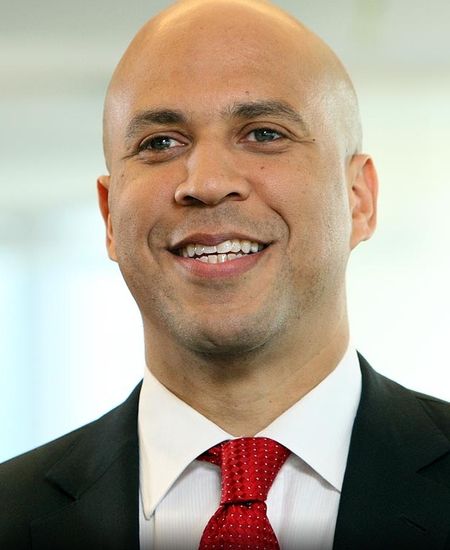
Sen. Cory A. Booker
Sponsored bills
Stop Underrides Act This bill requires the installation of rear, side, and front underride guards on certain trucks and trailers. Specifically, the Department of Transportation (DOT) must require the installation of rear, side, and front underride guards on the following a trailer or semi-trailer that is more than 10,000 pounds, and a single unit truck for which the bottom of the carriage is greater than 22 inches above the ground and that is more than 10,000 pounds. For rear and side underride guards, DOT must require adherence to a performance standard that requires the guards to be able to prevent intrusion from the body or frame of a trailer, semi-trailer, or truck into the passenger compartment of the motor vehicle that contacts the guard while traveling at 35 miles per hour. In addition, DOT must require drivers to (1) conduct a pre-trip inspection of the underride protection system on their vehicles; (2) identify rusted metal compromising structural integrity, cracked welds, or missing or loose fasteners; and (3) complete any necessary repairs. DOT must establish a Committee on Underride Protection to oversee the ongoing underride guard rulemaking process. DOT must publish data on victims of truck underride crashes.
Department of State Student Internship Program Act This bill requires the Department of State to establish the Department of State Student Internship Program to offer paid internship opportunities at the State Department to raise awareness of the role of diplomacy in the conduct of U.S. foreign policy. Participants must be enrolled at an institution of higher education (IHE) and able to receive and hold an appropriate security clearance. The State Department must pay participating interns a specified amount, as well as provide housing and travel assistance. The State Department may also enter agreements with IHEs to ensure these internships satisfy criteria for the academic programs in which participants are enrolled. Additionally, the State Department must transition all of its unpaid internship programs to internship programs that offer compensation.
VOCA Fix to Sustain the Crime Victims Fund Act of 2021 This bill adds a new source of revenue for the Crime Victims Fund and makes changes to formula grants supported by the fund. Specifically, the bill directs revenues collected from deferred prosecution and non-prosecution agreements to be deposited into the Crime Victims Fund. Currently, such revenues are deposited into the general fund of the Treasury. Additionally, the bill increases the percentage—from 60% to 75%—of state compensation payments to crime victims in the prior fiscal year used to calculate formula grants for state victim compensation programs. Finally, the bill directs states to waive the matching requirement for recipients of state victim assistance formula grants during and for one year after a pandemic-related national emergency. It also allows states to waive the matching requirement pursuant to a policy established by the state.
This joint resolution eliminates the deadline for the ratification of the Equal Rights Amendment, which prohibits discrimination based on sex. The amendment was proposed to the states in House Joint Resolution 208 of the 92nd Congress, as agreed to in the Senate on March 22, 1972. The amendment shall be part of the Constitution whenever ratified by the legislatures of three-fourths of the states.
Oral Health for Moms Act This bill expands access to oral health care during pregnancy and the postpartum period. Specifically, Medicaid, the Children's Health Insurance Program (CHIP), and health insurance plans in the individual and small-group markets must provide coverage for oral health services for pregnant and postpartum individuals. The federal government must cover, subject to certain exceptions, the costs of oral health services provided through Medicaid and CHIP, and the Department of Health and Human Services (HHS) must publish measures to assess the quality of oral health services provided through those public insurance programs. In addition, HHS must consult with tribal nations and organizations to improve the oral health of pregnant individuals, postpartum individuals, and infants in tribal populations. The bill also establishes grants and programs for purposes related to maternal oral health, including to promote good oral health practices among, and share information about oral health benefits with, pregnant and postpartum individuals in public insurance programs; to expand access to oral health services through federally qualified health centers; and to train maternal health providers about oral health during the pregnancy and postpartum period. Furthermore, the Medicaid and CHIP Payment and Access Commission must report on issues related to maternal oral health.
Resources for Victims of Gun Violence Act of 2021 This bill establishes the Advisory Council to Support Victims of Gun Violence. Among other things, the advisory council must assess the needs of victims of gun violence and disseminate information about helpful resources.
Federal Death Penalty Prohibition Act This bill prohibits the imposition of a death penalty sentence for a violation of federal law. A person sentenced to death before enactment of this bill must be resentenced.
Protecting Domestic Violence and Stalking Victims Act of 2021 This bill establishes new federal firearms restrictions for individuals who are convicted of misdemeanor stalking offenses. The bill expands the categories of persons who are prohibited from receiving, possessing, shipping, or transporting a firearm or ammunition. Specifically, it adds a new category of prohibited persons: persons convicted of a misdemeanor crime of stalking. The term misdemeanor crime of stalking means a misdemeanor stalking offense under federal, state, tribal, or municipal law and a course of harassment, intimidation, or surveillance of another person that (1) places such person in reasonable fear of harm to themselves, an immediate family member, a household member, or a spouse or intimate partner (including a current or former dating partner); or (2) causes emotional distress to such person. The bill also specifically prohibits dating partners who are convicted of a misdemeanor crime of domestic violence or who are subject to certain restraining orders from receiving, possessing, shipping, or transporting a firearm or ammunition. Currently, such restrictions generally only apply to spouses, co-parents, and cohabitants.

Shareholder Protection Act of 2021 This bill requires shareholder authorization of certain political expenditures by a publicly traded company. A violation of this requirement is considered a breach of fiduciary duty, and the officers and directors who authorized the expenditure are subject to joint and several liability. A publicly traded company must require a board vote with respect to political expenditures in excess of $50,000 and, within 48 hours, make publicly available the individual votes of each board member.