This resolution recognizes September 28, 2021, as National Voter Registration Day and encourages those eligible to vote to register, verify their personal information on record with local election officials, and vote.
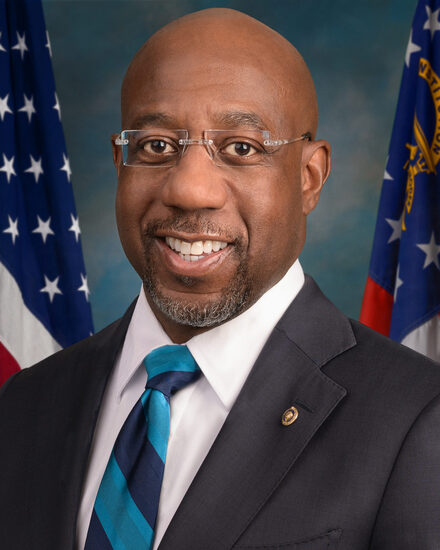
Sen. Raphael G. Warnock
Sponsored bills
Save our Stages Extension Act This bill extends to March 11, 2023, the time frame during which Shuttered Venue Operators Grant recipients may use grant funds to cover their expenses. These grants provide funds to certain types of entities in the arts and entertainment industry affected by the COVID-19 pandemic. Currently, a recipient may use such funds to cover expenses incurred between March 1, 2020, and December 31, 2021.
This resolution expresses support for the goals and ideals of National Forensic Science Week.
Unclaimed Savings Bond Act of 2021 This bill establishes requirements and procedures for the Department of the Treasury to transfer ownership of certain matured, unredeemed savings bonds and related records to states.
State and Local General Sales Tax Protection Act This bill restricts the source of revenue for airport spending to local fuel excise taxes. Under current Federal Aviation Administration policy, state and local governments must also use general sales taxes collected on aviation fuel for airport spending.
This resolution honors the life of Robert Dove, Parliamentarian Emeritus of the Senate, and offers the condolences of the Senate regarding his death.
This resolution designates September 20-September 24, 2021, as National Clean Energy Week.
This resolution honors the contributions of small businesses in the United States and supports the designation of National Small Business Week.
Low-Income First-Time Homebuyers Act of 2021 or the LIFT Homebuyers Act of 2021 This bill establishes a program to provide fixed-rate 20-year mortgages for first-time, first-generation homebuyers whose incomes do not exceed a certain amount. These mortgages must be offered by the Federal Housing Administration (FHA) or the Rural Housing Service (RHS). Pricing terms must be established (1) such that monthly mortgage payments under this program are similar to a 30-year FHA- or RHS-backed mortgage, or (2) as are determined to be necessary to develop liquidity for securities backed by covered mortgage loans and expand program participation by eligible homebuyers. Additionally, program funds must be transferred to the Department of the Treasury for the purchase of securities backed by such mortgages.
Radiation Exposure Compensation Act Amendments of 2021 This bill expands two programs that compensate individuals who were exposed to radiation during certain nuclear testing or uranium mining and subsequently developed medical conditions, including cancers. First, the bill expands and extends a program that compensates individuals who were exposed to radiation from atmospheric nuclear testing or other sources and subsequently developed specified cancers. Under current law, this program compensates individuals who were present in a designated geographic area during a period of nuclear testing and certain individuals employed in uranium mining. The bill expands the designated areas to include Colorado, Idaho, Montana, New Mexico, and Guam and additional areas in Arizona, Nevada, and Utah; makes more individuals who worked in uranium mining eligible for the program; increases the amount of compensation awarded to and provides medical benefits for eligible claimants; and extends for 19 years following the bill's enactment the fund that supports this program and the statute of limitations for filing claims (currently, the program terminates on July 10, 2022). Second, the bill makes certain individuals employed in uranium mines or mills eligible for a program that compensates workers, including Department of Energy employees and contractors, for illnesses caused by occupational exposure to radiation and hazardous substances during development and testing of the nation's nuclear weapons stockpile. The bill also establishes a grant program in the National Institute of Environmental Health Sciences for institutions of higher education to study the epidemiological impacts of uranium mining and milling among individuals without occupational exposure.