

John R. Lewis Voting Rights Advancement Act of 2021 This bill establishes new criteria for determining which states and political subdivisions must obtain preclearance before changes to voting practices may take effect. Preclearance is the process of receiving preapproval from the Department of Justice (DOJ) or the U.S. District Court for the District of Columbia before making legal changes that would affect voting rights. The bill also includes provisions related to federally protected activities at polling places and voting access on tribal lands. A state and all of its political subdivisions shall be subject to preclearance of voting practice changes for a 10-year period if 15 or more voting rights violations occurred in the state during the previous 25 years; or 10 or more violations occurred during the previous 25 years, at least 1 of which was committed by the state itself. A political subdivision as a separate unit shall also be subject to preclearance for a 10-year period if three or more voting rights violations occurred there during the previous 25 years. States and political subdivisions that meet certain thresholds regarding minority groups must preclear covered practices before implementation, such as changes to methods of election and redistricting. Further, states and political subdivisions must notify the public of changes to voting practices. Next, the bill authorizes DOJ to require states or political subdivisions to provide certain documents or answers to questions for enforcing voting rights. The bill also outlines factors courts must consider when hearing challenges to voting practices, such as the history of official voting discrimination in the state or political subdivision. In addition, the bill (1) includes certain protections for election workers, polling places, and election infrastructure; and (2) expands voting access on tribal lands.
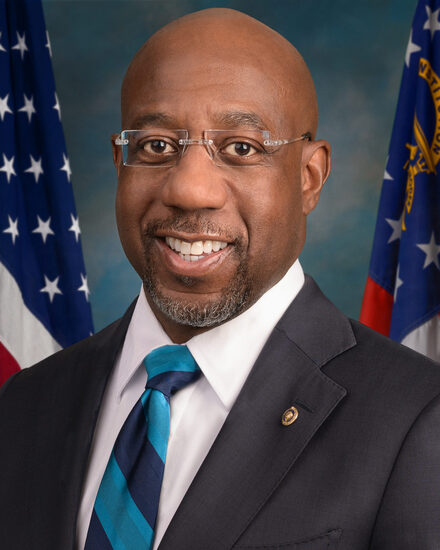
Sen. Raphael G. Warnock
Sponsored bills
Protecting Sensitive Personal Data Act of 2021 This bill expands the covered transactions that are subject to the review of the Committee on Foreign Investment in the United States (CFIUS), which analyzes the national security implications of foreign investment in the United States. Specifically, CFIUS may require declarations for foreign investments in U.S. businesses that maintain or collect sensitive personal data of U.S. citizens that may be exploited to threaten national security.
Aviation Emissions Reduction Opportunity Act or the AERO Act This bill requires the Department of Transportation to award competitive grants for projects in the United States that support the production and deployment of sustainable aviation fuel or the development of low-emission aviation technologies. Eligible grantees include, among others, state or local governments, air carriers, and research institutions.
This resolution designates October 2021 as National Dyslexia Awareness Month and calls on Congress, schools, and educational agencies to recognize that dyslexia has significant educational implications that must be addressed.
Maddy summarySRES 429 designates October 26, 2021, as the "Day of the Deployed" to honor currently deployed members of the U.S. Armed Forces and their families. The resolution calls on the public to reflect on their service and encourages observance through appropriate ceremonies and activities. This is a commemorative resolution, not a law creating new obligations, and it aligns with an annual designation first established in 2011.
Solar Energy Manufacturing for America Act This bill allows a new tax credit for the production and sale of certain solar equipment produced and sold in a taxpayer's trade or business.
Ban Conflicted Trading at the Fed Act This bill imposes investment restrictions on certain Federal Reserve employees. Specifically, members of the Board of Governors of the Federal Reserve System and presidents or vice presidents of a Federal Reserve bank are prohibited from (1) purchasing or selling a specified investment, including an investment in a security, a commodity, virtual currency, or a future; or (2) entering into a transaction that creates a net short position in a security. (A short position is an investment strategy employed when an investor anticipates a short term decrease in the investment's price.) Investments held prior to taking office may not be bought or sold, except for approved placement in a blind trust or divestiture during a specified time period. Further, Federal Reserve bank presidents, vice presidents, and directors must make annual and periodic financial and transaction disclosures. Finally, the Board of Governors of the Federal Reserve System must issue rules within 90 days of enactment requiring Federal Reserve board members, presidents, vice presidents, and senior staff (1) to provide 45 days advance notice of investment transactions, and (2) to hold investments for at least 1 year from the date of transaction.
Designates the facility of the United States Postal Service located at 3900 Crown Road Southwest in Atlanta, Georgia, as the "John R. Lewis Post Office Building."
Freedom to Vote Act This bill addresses voter registration and voting access, election integrity and security, redistricting, and campaign finance. Specifically, the bill expands voter registration (e.g., automatic and same-day registration) and voting access (e.g., vote-by-mail and early voting). It also limits removing voters from voter rolls. Next, the bill establishes Election Day as a federal holiday. The bill declares that the right of a U.S. citizen to vote in any election for federal office shall not be denied or abridged because that individual has been convicted of a criminal offense unless, at the time of the election, such individual is serving a felony sentence. The bill establishes certain federal criminal offenses related to voting. In particular, the bill establishes a new criminal offense for conduct (or attempted conduct) to corruptly hinder, interfere with, or prevent another person from registering to vote or helping someone register to vote. Additionally, the bill sets forth provisions related to election security, including by requiring states to conduct post-election audits for federal elections. The bill outlines criteria for congressional redistricting and generally prohibits mid-decade redistricting. The bill addresses campaign finance, including by expanding the prohibition on campaign spending by foreign nationals, requiring additional disclosure of campaign-related fundraising and spending, requiring additional disclaimers regarding certain political advertising, and establishing an alternative campaign funding system for certain federal offices.
This resolution supports the designation of October 3-October 9, 2021, as National 4-H Week. It also (1) recognizes the important role of 4-H in youth development and education, and (2) encourages all citizens to recognize 4-H for the significant impact the organization and members have made and continue to make by empowering young people with the skills needed to lead for a lifetime.