Maintaining Our Resolve to Defend, Encourage, and Conserve our Alliance with Israel Resolution or the MORDECAI Resolution This resolution expresses the sense of the House of Representatives that Israel is a crucial ally of the United States and that anti-Semitism and hostility against Israel should be rejected in all forms.
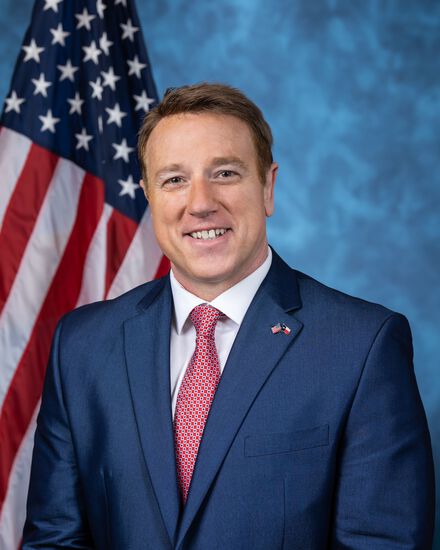
Rep. Pat Fallon
Sponsored bills
Purple Heart Freedom to Work Act This bill increases the monthly income limit that is used to determine whether certain Purple Heart recipients are eligible for Social Security Disability Insurance (SSDI) benefits. Specifically, when making such determinations with respect to Purple Heart recipients who are entitled to SSDI benefits based on combat-related injuries, the Social Security Administration must use the limit that applies to individuals who are blind rather than the lower limit that applies to other SSDI recipients. In addition, the bill phases out SSDI benefits for these Purple Heart recipients, with benefits reduced by $1 for every $4 of earnings in excess of the limit.
Protecting Children From Experimentation Act of 2021 This bill establishes a new criminal offense for performing gender reassignment medical interventions on minors. It also provides that a minor who receives such an intervention may bring a civil action against each person who performed that intervention. The bill defines these interventions as certain surgeries or the use of hormones to change the body of an individual to correspond to a sex that is discordant with the individual's biological sex. It excludes, however, interventions in cases where an individual has ambiguous external biological sex characteristics or where a physician has determined that an individual does not have normal sex chromosome structure, sex steroid hormone production, or sex steroid hormone action. An individual who performs these interventions on a minor is subject to criminal penalties—a fine, a prison term of up to five years, or both. A minor who receives these medical interventions may not be arrested or prosecuted for an offense under this bill.
Stopping Border Surges Act This bill modifies immigration law provisions relating to unaccompanied alien minors and to asylum seekers. For certain unaccompanied inadmissible alien children, generally those not at risk of being trafficking victims nor having a fear of persecution, the Department of Homeland Security (DHS) shall repatriate the child. Currently, only inadmissible unaccompanied aliens from neighboring countries are subject to repatriation, and DHS has discretion whether to repatriate. When HHS releases an unaccompanied child to an individual, it shall provide DHS with certain information about that individual, including Social Security number and immigration status. The bill amends the definition of credible fear of persecution to require that such fear can be established by statements that are more probable than not. The bill also imposes certain rules relating to credible fear interviews, including requirements for recordings and interpreters. If an alien is granted asylum because of fear of persecution in a country, the alien shall be deemed to have renounced asylum status by returning to that country, if there has been no change in the country's conditions. The bill also (1) expands the definition of what constitutes a frivolous asylum application, (2) imposes additional limitations on eligibility for asylum, (3) shortens the deadline for applying for asylum, and (4) extends the time period an alien seeking asylum must wait before receiving employment authorization. Any individual who knowingly and willfully makes materially false statements or uses fraudulent documents in asylum-related proceedings shall be fined or imprisoned up to 10 years, or both.

Regulations from the Executive in Need of Scrutiny Act of 20 21 This bill revises provisions relating to congressional review of agency rulemaking. Specifically, the bill establishes a congressional approval process for a major rule. A major rule may only take effect if Congress approves of the rule. A major rule is a rule that results in (1) an annual effect on the economy of $100 million or more; (2) a major increase in costs or prices for consumers, individual industries, government agencies, or geographic regions; or (3) significant adverse effects on competition, employment, investment, productivity, innovation, or the ability of U.S.-based enterprises to compete with foreign-based enterprises. In addition, the bill establishes a congressional disapproval process for a nonmajor rule. A nonmajor rule may only take effect if Congress does not disapprove of the rule.
Homeland and Cyber Threat Act or the HACT Act This bill allows claims in federal or state court against foreign states that conduct or participate in cyberattacks against U.S. nationals.
State Border Security Reimbursement Act of 2021 This bill requires the federal government to reimburse eligible states for their border security expenses. To be eligible, a state must have expended more than $2.5 billion on border security and enforcement in the 10 years before this bill's enactment. If such a state provides an accounting of all of its nonfederally funded border security expenses any time up to 180 days after this bill's enactment, the federal government shall reimburse the full amount.
This resolution calls on the Office for Civil Rights within the Department of Education and state attorneys general to assist elementary and secondary schools in complying with existing civil rights laws and investigate and enforce such laws. In addition, the resolution condemns the practice of requiring teachers to receive education in critical race theory as a condition of certification.
Contents of Our Character Act of 2021 This bill prohibits agencies from using federal funds to conduct or promote specified workplace training related to race or sex.
This bill prohibits any executive agency from contravening Executive Order 13950 (Combating Race and Sex Stereotyping), except as such order relates to contractors and grant recipients.