

Maddy summaryHR 1206, the WEST Act of 2025, cancels a specific Bureau of Land Management (BLM) rule titled "Conservation and Landscape Health" (published in the Federal Register on April 3, 2023). The bill directly affects the BLM and anyone subject to the rule, which governed land management practices on public lands. Its key mechanism is a straightforward provision declaring the rule "shall have no force or effect," effectively removing it from federal regulations without creating new policies. This is a procedural action targeting a specific existing regulation, not a broader policy change.
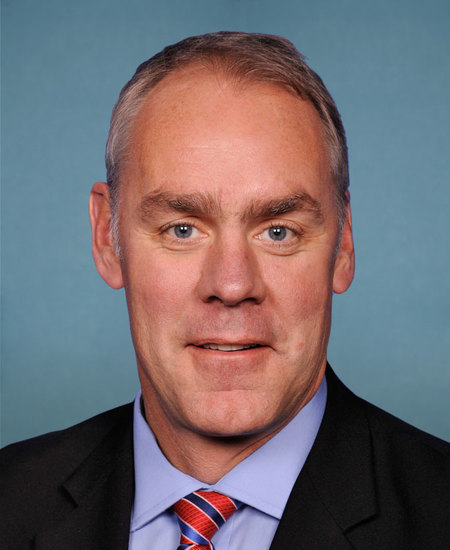
Rep. Ryan K. Zinke
Sponsored bills
Maddy summaryHR 1131 exempts certain family farms and small businesses from being counted as assets when calculating financial need for federal student aid under the Higher Education Act. Specifically, it amends the law to exclude the net value of a family farm where the family resides and small businesses (with ≤100 employees) owned by the family from need analysis calculations. This change directly affects students from qualifying family farm or small business households when applying for federal financial aid. The exemption applies to need analysis conducted for award years beginning after the bill's enactment date. The bill modifies Section 480(f)(2) of the Higher Education Act of 1965 to implement this policy change.
Maddy summaryHR 1125, the LOCAL Act, mandates that the Bureau of Land Management (BLM) headquarters relocate to Grand Junction, Colorado, and requires all existing BLM employees stationed there to remain in place. The bill also requires the Secretary of the Interior to study relocating additional BLM positions to Grand Junction or other western states within one year, assessing impacts on Federal land management, community coordination, and activities like tourism and conservation. The study must be reported to Congress within 365 days of the bill's enactment. This legislation directly affects BLM operations and employee locations in western states, with no changes to substantive land management policies.
Maddy summaryThe CONSTRUCTS Act of 2025 creates a federal grant program to fund training programs at community colleges and career schools focused on residential construction careers. It targets rural areas and underserved populations - including veterans, low-income individuals, and groups with historically low representation in construction - to develop skills in trades like carpentry, plumbing, electrical work, and HVAC. Grants, totaling $20 million annually from 2026-2030, require flexible scheduling, partnerships with construction employers, and plans to increase affordable housing supply through workforce development. The bill directly affects community colleges in rural or underserved regions and their students seeking residential construction careers.
Maddy summaryHR 925, the "Dismantle DEI Act of 2025," would eliminate diversity, equity, and inclusion (DEI) programs across federal government operations. The bill requires federal agencies to close DEI offices, rescind related executive orders, and prohibit the use of federal funds for DEI training, offices, or initiatives. It defines "prohibited diversity, equity, or inclusion practice" as any activity that discriminates based on race, ethnicity, religion, biological sex, or national origin, or requires employees to complete training asserting that certain groups are inherently superior or inferior. The legislation also prohibits requiring employees to sign statements about race, ethnicity, or gender, and establishes private lawsuits for violations with potential damages of $1,000 per violation per day. This bill would directly affect federal agencies, contractors, grantees, and advisory committees receiving federal funding.
Maddy summaryHR 921, the Master Sergeant Roddie Edmonds Congressional Gold Medal Act, authorizes the posthumous award of a Congressional Gold Medal to Master Sergeant Roddie Edmonds for his heroic actions during World War II. The bill recognizes Edmonds' defiance of Nazi orders to separate Jewish-American soldiers at Stalag IX-A prisoner camp, where he declared "We are all Jews here" to protect approximately 200 Jewish soldiers, saving their lives. The medal, to be struck by the U.S. Treasury and presented to his son or next of kin, commemorates his actions and his posthumous recognition as "Righteous Among the Nations" by Yad Vashem. This commemorative act does not create new policy or affect any group beyond honoring Edmonds' legacy.
Maddy summaryThe Northern Montana Water Security Act of 2025 (HR 907) establishes a final settlement of water rights for the Fort Belknap Indian Community (Gros Ventre and Assiniboine Tribes) in Montana, confirming their rights to 20,000 acre-feet of water annually from Lake Elwell. The bill ratifies a water rights compact between the tribe and Montana, creates a process for exchanging Federal and State lands, and establishes two trust funds to support water infrastructure projects and management. It includes provisions for the tribe to manage water allocations, lease water rights, and develop infrastructure while protecting allottees' water rights through a Tribal water code. The bill provides specific funding for rehabilitation of the Fort Belknap Indian Irrigation Project and mitigation for the Milk River Project, with implementation requirements and timelines.
Medicare Patient Access and Practice Stabilization Act of 2025 This bill increases certain payment adjustments under the Medicare physician fee schedule for services furnished between April 1, 2025, and January 1, 2026.
Drug Cartel Terrorist Designation Act This bill directs the Department of State to designate four specified drug cartels as foreign terrorist organizations. (Among other things, such a designation allows the Department of the Treasury to require U.S. financial institutions to block transactions involving the organization.) The four specified cartels in the bill are the Gulf Cartel, the Cartel Del Noreste, the Cartel de Sinaloa, and the Cartel de Jalisco Nueva Generacion. The bill also requires the State Department to submit a detailed report on those four cartels and any other cartels it may identify. Based on this report, the State Department must designate as a foreign terrorist organization any such identified cartel (or faction thereof) that meets certain criteria for designation as a foreign terrorist organization. The bill specifies that it may not be construed to expand eligibility for asylum.
Maddy summaryThis bill increases criminal penalties for individuals who re-enter the U.S. after being deported, removed, or excluded. It sets a maximum 5-year prison sentence for most cases, but adds up to 10 years for those with prior drug/crime convictions or multiple prior removals. For serious cases - such as aggravated felonies or two prior reentry convictions - it mandates a 5-20 year prison term. The law directly affects people who return without authorization after formal immigration removal proceedings.