

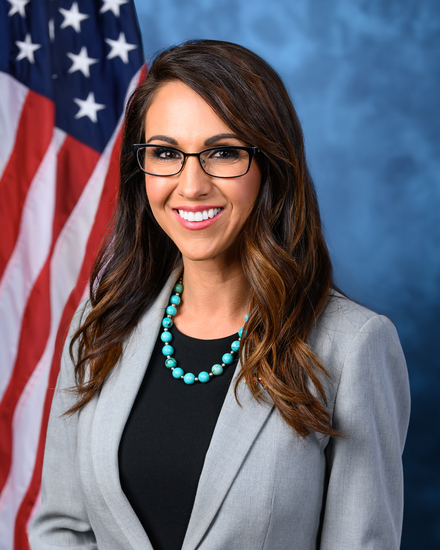
Photo of Lauren Boebert
R United States House · District 4 · Colorado On the 2026 ballot

Rep. Lauren Boebert

Compare
Total votes
2,818
all sessions
Attendance
96%
118 missed
Near the chamber average
With party
82%
of cast votes
Lower than 95% of chamber peers
Bipartisan score
9%
crosses aisle rarely
Higher than 94% of chamber peers
Sponsored
1,019
bills & resolutions
Near the chamber average
Committees
7
assignments
1,019 bills and resolutions

Sponsored bills

Total
1,019
Primary
88
Co-sponsor
931
This page
1,019
matching current filters
Co-sponsor HR 9005
In committee · Texas House · Co-sponsor
Rural Hospital Revitalization Act of 2026

Maddy summaryThe Rural Hospital Revitalization Act of 2026 provides zero-interest loans to specific rural hospitals for building new facilities or renovating existing ones. To qualify, a hospital must be located in a county with fewer than 20,000 people, be at least 35 miles from the nearest hospital, have operated for at least 30 years, and demonstrate financial stability. The loans are initially interest-free for five years and can be refinanced later at standard rates if the hospital's financial situation improves, or renewed once under strict conditions if the hospital struggles financially. Additionally, receiving hospitals become eligible for technical assistance grants designed to help improve their operations and financial health.

In committee May 21, 2026 1 co-sponsor
Co-sponsor HR 8990
In committee · Texas House · Co-sponsor
Protect Domestic Oil and Gas Small Business Act of 2026

Maddy summaryThis bill, titled the Protect Domestic Oil and Gas Small Business Act of 2026, exempts small oil and gas wells from specific environmental regulations under the Clean Air Act. It directly affects owners and operators of marginal wells, defined as sites producing 15 barrels of oil or less per day, or 90,000 cubic feet of natural gas or less per day. The legislation removes requirements for monitoring, reporting, and leak detection for these smaller operations, while also mandating that the EPA approve any state plan revisions granting this exemption within 180 days. Additionally, the bill requires the EPA to update its regulations to reflect these changes and to terminate any ongoing enforcement actions against marginal wells that were initiated before the law takes effect.

In committee May 21, 2026 1 co-sponsor
Primary HR 8921
In committee · Texas House · Lead sponsor
Freedom from Taxes Act of 2026

Maddy summaryThe Freedom from Taxes Act of 2026 eliminates federal transfer and making taxes on firearms, which directly affects individuals buying or manufacturing guns. By setting these specific taxes to zero, the bill removes the $200 fee previously required when transferring or making certain firearms. The law also adds a time limit to a special tax, ensuring it no longer applies to years beginning after the bill takes effect. These changes would become active on the first day of the first calendar quarter starting more than 90 days after the legislation is signed into law.

In committee May 20, 2026 0 co-sponsors
Co-sponsor HR 7024
In committee · Texas House · Co-sponsor
Hemp Planting Predictability Act

Hemp Planting Predictability Act This bill extends by two years the implementation of changes to the regulation of hemp products, which reimpose certain federal controls over some hemp products. Specifically, Congress enacted the FY2026 agriculture appropriations act (P.L. 119-37) on November 12, 2025. Effective November 12, 2026, the act modifies the statutory definition of hemp products that are considered to be lawful. This bill extends the effective date to November 12, 2028. As background, the 2018 farm bill excluded hemp from the Controlled Substances Act definition of marijuana and defined hemp . As a result, hemp and hemp-derived products at or below the 0.3% delta-9 tetrahydrocannabinol (THC, the psychoactive component of marijuana) concentration threshold were no longer regulated as Schedule I controlled substances and registration with the Drug Enforcement Administration was no longer required to cultivate or handle hemp and hemp-derived products. However, hemp remained subject to Department of Agriculture and Food and Drug Administration regulation. The 2025 changes to the definition of hemp, include changing the limit to a total THC concentration of not more than 0.3% on a dry weight basis rather than only delta-9 THC, explicitly including industrial hemp, excluding seeds from a cannabis plant that exceed a certain THC concentration, and excluding various types of hemp-derived cannabinoid products. Cannabinoids refer to unique chemical compounds that are found in hemp and marijuana (e.g., THC) and are known to exhibit a range of psychological and physiological effects.

In committee May 20, 2026 1 co-sponsor
Co-sponsor HR 8827
In committee · Texas House · Co-sponsor
ASSIMILATION Act

Maddy summaryThis bill, known as the ASSIMILATION Act, fundamentally restructures the U.S. immigration system by replacing family-based and lottery-based admissions with a merit-based approach that prioritizes economic self-sufficiency and national interest. It directly affects prospective immigrants, current visa holders, and employers by establishing new requirements for entry, employment, and naturalization. Key provisions eliminate the diversity visa lottery, restrict family-sponsored immigration to spouses and minor children, and mandate that all immigrants demonstrate the ability to support themselves without relying on government benefits. The legislation also introduces stricter enforcement measures, such as making visa overstays a criminal offense, expanding E-Verify to all employers, and requiring higher English proficiency and tax compliance for citizenship. Additionally, it tightens asylum rules by adding a transit bar for those passing through other countries and limits parole to specific humanitarian cases rather than broad programs.

In committee May 14, 2026 1 co-sponsor
Co-sponsor HR 8821
In committee · Texas House · Co-sponsor
No Bailouts for Cashless Bail Jurisdictions Act

Maddy summaryThis bill prohibits the federal government from providing funds to any local jurisdiction that has largely eliminated cash bail for serious crimes. Under the law, the Attorney General must review and publicly announce which areas have stopped using cash bail for offenses such as violent crimes, sex offenses, burglary, and looting. If a jurisdiction is found to be in violation of this rule, it loses access to federal funding until it either re-establishes cash bail or waits 180 days after the initial determination. The measure directly impacts state and local governments by linking their receipt of federal money to their pretrial release policies.

In committee May 14, 2026 1 co-sponsor
Primary HCONRES 97
In committee · Texas House · Lead sponsor
Expressing support for the Federal Protective Service and its law enforcement officers.

Maddy summaryThis concurrent resolution expresses Congress's appreciation for the Federal Protective Service and its law enforcement officers. It formally recognizes the dedication of these officers who protect over 8,500 federal facilities and honors those who have died in the line of duty. The resolution encourages continued collaboration between the service and the communities it serves to strengthen public safety and trust.

In committee May 12, 2026 0 co-sponsors
Co-sponsor HR 8730
In committee · Texas House · Co-sponsor
Connected Vehicle Security Act of 2026

Maddy summaryThe Connected Vehicle Security Act of 2026 restricts the importation, sale, and manufacture of vehicles and related technology from specific countries, including China, Russia, Iran, and North Korea, to address national security concerns. The law defines prohibited items as connected vehicles, their software, and hardware components and sets different effective dates, with vehicle bans starting in 2027 and hardware restrictions beginning in 2030. A government official can grant exceptions for specific items after reviewing security risks and notifying Congress, while the agency must publish annual reports on enforcement actions and compliance.

In committee May 11, 2026 1 co-sponsor
Co-sponsor HR 8680
In committee · Texas House · Co-sponsor
Armed Forces Carry Rights Protection Act of 2026

Maddy summaryThe Armed Forces Carry Rights Protection Act of 2026 modifies federal law to make it easier for military personnel to carry personal firearms on military bases when they are not on duty. Under this bill, commanders would face a legal presumption in favor of approving such requests, shifting the default stance toward allowing carry rather than restricting it. If a commander does deny a request, the law requires them to provide a written explanation that is specific to the individual and based on objective criteria. This change directly affects active-duty service members and the commanders who evaluate their requests for firearm authorization on installation.

In committee May 7, 2026 1 co-sponsor
Co-sponsor HR 8596
In committee · Texas House · Co-sponsor
FAIR Labels Act of 2026

Maddy summaryThe FAIR Labels Act of 2026 establishes new labeling requirements for cell-cultivated protein products and plant-based alternatives designed to look like meat or poultry. It mandates that labels for these products prominently display the terms "cell-cultivated" or "plant-based alternative protein product" and include clear disclaimers stating the items are not derived from live animals or birds. Additionally, the bill updates regulatory oversight by requiring the USDA and FDA to revise their agreement, assigning the USDA primary responsibility for regulating cell-cultivated meat and poultry while the FDA oversees production safety and facility compliance. The legislation also directs these agencies to create common standards of identity for these products within 180 days of enactment.

In committee Apr 30, 2026 1 co-sponsor
Showing 41 to 50 of 1,019 bills
Previous 1 4 5 6 102 Next