

Maddy summaryHB 115 restricts Texas local governments (like cities and counties) from using public funds to hire lobbyists or pay organizations that hire lobbyists to influence state legislation. The bill specifically prohibits spending public money to contract with registered lobbyists or fund associations primarily representing local governments if those associations employ registered lobbyists, with exceptions for sheriffs' associations and certain staff activities. It allows local government employees to provide information to lawmakers, advocate for policies without registering as lobbyists, and cover direct travel expenses for such activities. Taxpayers or residents can sue to stop prohibited spending and recover legal fees if they win the case. The law aims to prevent public funds from being used to directly lobby the state legislature.
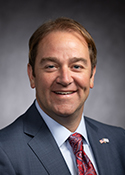
Rep. John McQueeney
Sponsored bills
Maddy summaryHB 95 establishes minimum training and certification standards for Emergency Management Coordinators in Texas counties with populations over 500,000. It requires these coordinators, appointed by Emergency Management Directors, to meet qualifications set by the Texas Division of Emergency Management. The bill directly affects county emergency management staff in larger jurisdictions who handle disaster response coordination. Key provisions mandate that coordinators' qualifications be defined through division rules, ensuring standardized emergency management capacity across qualifying counties.
Maddy summaryThis resolution urges Governor Greg Abbott to return federal reconciliation funds to Texas taxpayers by implementing property tax relief. The Texas House of Representatives passed this non-binding resolution to formally request the Governor use the funds for property tax cuts, directing the chief clerk to forward a copy to the Governor's office. It does not require legal action or change existing tax policy, as resolutions like this serve only as a formal expression of legislative opinion.
Maddy summaryHB 1 requires justices of the peace in counties without a medical examiner to complete state-developed training on managing mass fatality events within one year of election. The training covers autopsy referrals, body identification, missing persons data collection, and multi-agency coordination during disasters. The bill also authorizes the Texas Division of Emergency Management to access criminal history records for emergency manager license applicants and disaster volunteers, with strict limits on disclosure. These provisions directly affect local justices of the peace and individuals seeking emergency management roles.
Maddy summaryHB 2 creates the Texas Interoperability Council to develop a statewide strategic plan for emergency communication equipment and infrastructure. The council will administer a grant program to help local governments (municipalities, counties, and special districts) purchase interoperable equipment and build communication infrastructure. This ensures first responders can effectively communicate during emergencies by standardizing technology across jurisdictions. The bill establishes the council’s structure, including appointments by state leaders, and exempts it from certain public disclosure laws.
Maddy summaryHB 4 establishes new congressional district boundaries for Texas voters to be used in the 2026 U.S. House elections. It adopts the PLANC2308 redistricting plan based on 2020 Census data (TIGER/Line Shapefiles) to define district lines. The bill replaces all prior Texas congressional district maps, including those from 2021, and applies to elections starting with the 120th Congress (2026). This is a procedural redistricting bill directly affecting Texas residents' voting districts for federal elections beginning in 2026.
Maddy summaryHB 274 establishes a framework for Texas to join an interstate compact focused on animal health initiatives with other states. The bill authorizes the governor to develop and execute this compact, enabling states to share resources like research facilities, surveillance systems, and personnel to address animal health outbreaks affecting livestock, wildlife, and other animals. Key provisions include joint planning for disease response, mutual support for infrastructure/equipment, and allowing fund transfers between states for research and response activities. The compact does not require congressional approval or increase states' political power relative to the federal government. This legislation creates a mechanism for future cooperation but does not mandate specific actions or funding.
Maddy summaryThis concurrent resolution (HCR 11) urges the federal government to take immediate action to prevent the spread of the New World screwworm - a parasitic fly that infests livestock - into Texas. It directly affects Texas ranchers, the state’s $1.8 billion livestock industry, and the broader national food supply chain, as an outbreak could cause widespread animal deaths and economic damage. The resolution requests federal agencies to: collaborate with Mexico on control plans, fund a Texas-based screwworm control facility, approve treatments for infected animals, and approve pesticides for prevention. It does not create new laws but formally asks Congress and federal agencies to act, citing the parasite’s proximity to Texas (370 miles from the border as of July 2025).
Maddy summaryHB 273 creates the Institute for Animal Health Research and Response as a component of Texas A&M University, operating under Texas A&M Agrilife Extension. The institute will partner with Texas Parks and Wildlife and the Texas Animal Health Commission to study animal diseases and parasitic infestations, develop prevention strategies, and create treatments. It may accept grants, hire staff, build facilities, and prioritize specific health threats, but implementation depends on legislative funding appropriations. The bill takes effect September 1, 2025.
Maddy summaryHB 272 establishes a special fund called the Screwworm Abatement Trust (SWAT) Fund to support efforts preventing, controlling, and eradicating the New World Screwworm pest. The fund, managed by the state comptroller outside the main treasury, can receive gifts, donations, or appropriations (capped at $50 million) to cover related programs, research, surveillance, and emergency responses. It directly affects state agricultural agencies, universities, and other public entities that administer or utilize these pest control activities. The bill creates a dedicated funding mechanism for coordinated intergovernmental efforts without imposing new taxes or regulations.