

Maddy summaryHB 1674 would ban the production, sale, and use of certain agricultural products containing PFAS chemicals (like pesticides or crop protectants). It directly affects agricultural businesses, manufacturers, and sellers of these products. The bill creates criminal penalties for violations, treating unauthorized PFAS use as a punishable offense. The bill is currently pending in the Environmental Regulation committee after committee hearings. (Note: Full bill text is not yet available; this summary is based on the title and pending status.)
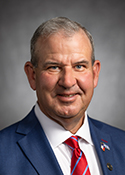
Rep. Pat Curry
Sponsored bills
Maddy summaryHB 2275 requires that surplus lines insurance contracts (specialized policies for high-risk or hard-to-place coverage) containing arbitration agreements must specify that any arbitration occurs in Texas and follows Texas law. It mandates that both the arbitration process and contract interpretation be governed by Texas statutes, applying only to contracts delivered, issued, or renewed on or after January 1, 2026. Existing contracts before that date remain subject to prior law. The bill takes effect September 1, 2025, and directly affects insurers writing surplus lines policies in Texas.
Maddy summaryHB 298 requires Texas driver's licenses and personal ID certificates to include a clear indication that the holder is a U.S. citizen. This applies to all licenses issued or renewed on or after January 1, 2026. The bill specifies that licenses must also display the holder's full name, date of birth, a full-face photograph, a distinguishing number, and either a residence address or, for certain federal judges or officials, the courthouse address. It does not change existing requirements for non-citizens. The law takes effect September 1, 2025.
Maddy summaryHJR 161 proposes amending the Texas Constitution to explicitly prohibit non-citizen residents from voting in Texas elections. The bill would add "persons who are not citizens of the United States" as a new category barred from voting, alongside existing restrictions for minors, those declared mentally incompetent, and convicted felons. If approved by voters in November 2025, this constitutional change would formally enshrine the current legal standard - non-citizens already cannot vote in Texas - into the state constitution. The amendment requires voter approval at the 2025 general election, with ballot language specifying the change. This is a procedural constitutional amendment, not a new voting law.
Maddy summaryHB 41 prohibits Texas state and local government entities from acquiring or using unmanned aircraft (drones) or related equipment/services produced by companies owned by or tied to the governments of China, Iran, North Korea, Russia, or Syria. The law defines "governmental entity" broadly to include state agencies, cities, counties, and school districts, with a grace period allowing existing systems (acquired before September 1, 2025) to remain in use until September 1, 2030. It also establishes a grant program to help law enforcement agencies obtain secure drone technology through the "Law Enforcement Secure Unmanned Aircraft Grant Program." The bill directly affects all Texas public entities purchasing or operating drone systems, aiming to restrict foreign technology access based on national security concerns.
Maddy summaryHB 129 prohibits Texas state and local government entities from entering contracts with companies designated as "foreign adversary companies" (those tied to countries like China, Russia, or Iran) or "federally banned companies" (listed on federal sanctions lists). The bill defines these companies based on U.S. federal designations, including entities restricted under federal defense laws or sanctions. Violating this prohibition could result in civil penalties imposed by the state. The law directly affects Texas government agencies and contractors working with them, aiming to align state procurement with federal security policies.
Maddy summaryHB 3344 requires roofing contractors in Texas to obtain an occupational license from the Texas Department of Licensing and Regulation (TDLR) and pay associated fees. It directly affects professionals who perform roofing services (installation, repair, or maintenance) for compensation on commercial or residential properties, excluding homeowners doing their own work, government employees, or those selling roofing materials without installation. Key provisions include creating administrative penalties for violations, authorizing TDLR to set licensing fees, and establishing criminal offenses for certain violations. The bill exempts contractors working on new construction and those performing services for property owners on their own residential or agricultural properties.
Maddy summaryHB 133 creates two new criminal offenses in Texas law. It criminalizes acting as an agent of a foreign government or terrorist organization to commit certain crimes (like assault or harassment) with the intent to force someone to leave the U.S., discourage protected speech, or retaliate for such speech. It also criminalizes unauthorized enforcement of foreign law within Texas, such as investigating or surveilling residents to prevent them from violating foreign laws without state approval. Penalties are increased (e.g., a Class A misdemeanor becomes a misdemeanor with 180 days minimum jail time). The bill also mandates a study and law enforcement training on transnational repression.
Maddy summaryHB 3832 creates a new "Animal Friendly" specialty license plate in Texas, requiring the Department of Motor Vehicles to issue these plates to benefit spay and neuter programs. Vehicle owners who purchase these plates will fund local animal welfare initiatives, with plate designs developed in consultation with the Texas Humane Legislation Network. The bill takes effect September 1, 2025, and directly affects Texas drivers who choose this specialty plate option.
Maddy summaryHB 3061 increases penalties for certain criminal offenses committed while wearing masks or disguises specifically to hide the offender's identity. It applies to offenses under Texas law covering assault, robbery, public disorder (Title 5, Chapters 28-30, or Sections 42.01/42.02). If proven, the punishment escalates to the next higher offense category, with a minimum 180-day jail term for Class A misdemeanors. Exceptions allow the penalty increase to be avoided if the disguise was for events like Halloween, proven by a preponderance of evidence.