

Maddy summaryHB 3830 creates a franchise tax credit for businesses operating concentrated animal feeding operations (CAFOs) located in major sole source impairment zones under Texas Water Code. It allows eligible entities to claim a credit equal to their actual costs for transporting agricultural waste outside these zones (covering fuel, labor, and equipment), capped at 50% of their franchise tax after other credits. Unused credits may be carried forward for up to 10 years. The bill directly affects CAFOs meeting specific water code location and waste transport requirements, aiming to incentivize waste management outside sensitive water zones.
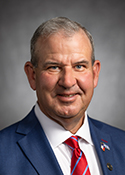
Rep. Pat Curry
Sponsored bills
Maddy summaryHB 1085 allows Texas public high schools to offer a lifetime recreation and outdoor pursuits course - featuring a hunter education component - to fulfill physical education credit requirements. The State Board of Education, working with the Parks and Wildlife Department, must develop this course's curriculum. It directly affects public high school students and school districts, providing an alternative to traditional PE courses. The policy change takes effect for the 2025-2026 school year.
Maddy summarySB 2230 requires Texas municipalities and county commissioners courts to mandate evacuations of unauthorized people from hazard zones calculated by the Federal Aviation Administration (FAA) during space flight activities. Violating these evacuation orders would be a Class B misdemeanor (Class A for repeat offenses). The bill’s effective date depends on another related bill (S.B. 2188) also passing into law. It creates a legal mechanism to enforce safety zones around space launch sites without specifying new safety protocols or altering FAA regulations.
Maddy summaryHB 4346 expands access to motor vehicle collision reports by allowing the Texas Department of Public Safety to release these records to more individuals and entities upon written request and payment of a fee. It specifically adds new categories of recipients, including drivers involved in collisions, their employers or guardians, property owners damaged in crashes, insurance companies (for both vehicles and people), and certain media outlets like weekly free newspapers meeting specific criteria. The bill modifies existing law to remove prior restrictions on who can receive reports, while still requiring formal requests and fees for non-law enforcement access. This change directly affects drivers, insurers, property owners, and some media organizations by providing clearer pathways to obtain collision report information.
Maddy summaryHB 1228 allows homeowners to immediately begin emergency repairs on damaged residential buildings if the repairs protect public safety, prevent further damage, or preserve structural integrity. Homeowners must apply for an emergency permit within three business days of starting repairs or when the municipality/county can accept the application. The bill requires cities and counties to permit these immediate repairs and prohibits them from blocking such work. If a local government violates this law, homeowners can sue for damages and recover attorney fees. This directly affects homeowners needing urgent repairs and local governments managing building permits.
Maddy summaryHB 4936 directs the Texas Economic Development and Tourism Office to conduct a study on creating a new Department of Marketing Services. The study must examine the department’s structure, funding, and potential operations, including how it would interact with existing state agencies. This bill does not create the department but authorizes a formal assessment to determine if such a department would be feasible. The study’s findings would inform future legislative decisions, but the bill itself only mandates the research process.
Maddy summaryHB 4663 specifies exact routes for permits allowing oversized and overweight vehicles to travel between border crossings and ports in Cameron County (which borders Mexico). It details paths using U.S. Highways 77 and 83, State Highway 4, and Farm-to-Market roads to reach Brownsville Port, Harlingen Port entrances, and Boca Chica Beach. The bill directly affects trucking companies moving large equipment and port authorities in border counties. It formalizes routing requirements for permit issuance under the Texas Transportation Code, effective September 1, 2025.
Maddy summaryHB 3134 establishes a regulatory framework for "advanced air mobility" in Texas, primarily affecting electric aircraft and vertiports (landing/takeoff sites for air taxis). The bill requires the Texas Department of Transportation to create an office for technical support, develop a statewide strategic plan, identify uniform planning standards for vertiports, estimate electric grid capacity needs, and provide guidebooks to local governments. It specifically applies to aircraft over 300 pounds capable of carrying passengers or cargo, focusing on electric vertical takeoff aircraft and urban air mobility infrastructure. The law aims to enable future air taxi services by standardizing planning and infrastructure requirements across the state.
Maddy summaryHCR 64 is a ceremonial resolution designating the first full week in April as "Gifted and Talented Students Week" in Texas for a 10-year period ending in 2035. It does not create new laws, funding, or requirements - it simply recognizes and celebrates gifted and talented students, their achievements, and the educators who support them. The resolution applies to all Texas students and schools identified under state gifted education programs, which currently serve over 450,000 students. It remains effective until April 2035 per Texas Government Code Section 391.004(d). This is a symbolic gesture with no direct policy or financial impact.
Maddy summaryHB 3675 prohibits most public employers in Texas from asking about or checking an applicant's criminal history before making a conditional job offer. It allows employers to inform applicants upfront about disqualifying convictions or ask limited questions about specific offenses that would disqualify someone under law. The bill applies to state agencies, local governments, and public universities (excluding independent school districts and licensed law enforcement roles). It takes effect September 1, 2025, and only affects applications submitted after that date.