

Maddy summaryHB 129 prohibits Texas state and local government entities from entering contracts with companies designated as "foreign adversary companies" (those tied to countries like China, Russia, or Iran) or "federally banned companies" (listed on federal sanctions lists). The bill defines these companies based on U.S. federal designations, including entities restricted under federal defense laws or sanctions. Violating this prohibition could result in civil penalties imposed by the state. The law directly affects Texas government agencies and contractors working with them, aiming to align state procurement with federal security policies.
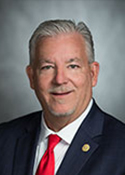
Rep. Keith Bell
Sponsored bills
Maddy summaryHB 3344 requires roofing contractors in Texas to obtain an occupational license from the Texas Department of Licensing and Regulation (TDLR) and pay associated fees. It directly affects professionals who perform roofing services (installation, repair, or maintenance) for compensation on commercial or residential properties, excluding homeowners doing their own work, government employees, or those selling roofing materials without installation. Key provisions include creating administrative penalties for violations, authorizing TDLR to set licensing fees, and establishing criminal offenses for certain violations. The bill exempts contractors working on new construction and those performing services for property owners on their own residential or agricultural properties.
Maddy summaryHB 3913 updates Texas licensing requirements for real estate professionals by defining mandatory educational courses for license holders. It requires qualifying courses to cover five specific areas: agency relationships, contract law, real estate principles (including 3+ hours on housing discrimination laws), property management, and appraisal fundamentals. The bill directly affects real estate brokers and agents seeking initial licensing or continuing education. Key provisions include mandating training on federal/state housing discrimination laws and specific topics like lease procedures and fiduciary duties, ensuring standardized education under the Texas Real Estate Commission.
Maddy summaryHB 3061 increases penalties for certain criminal offenses committed while wearing masks or disguises specifically to hide the offender's identity. It applies to offenses under Texas law covering assault, robbery, public disorder (Title 5, Chapters 28-30, or Sections 42.01/42.02). If proven, the punishment escalates to the next higher offense category, with a minimum 180-day jail term for Class A misdemeanors. Exceptions allow the penalty increase to be avoided if the disguise was for events like Halloween, proven by a preponderance of evidence.
Maddy summaryThis bill requires Texas licensing authorities to issue provisional occupational licenses for six months to applicants with criminal convictions who are otherwise qualified for the license, unless they have specific serious convictions listed in the Occupations Code. The provisional license begins upon the applicant's release from incarceration if they were imprisoned. It applies to most occupational licensing fields (like healthcare or trades) but excludes applicants convicted of offenses under Section 53.021(a). The bill provides a pathway for certain applicants to obtain licenses without full revocation of eligibility.
Maddy summaryHB 1499 creates a grant program administered by the Texas Commission on Environmental Quality (TCEQ) to reimburse ready-mixed concrete manufacturers for costs associated with obtaining environmental product declarations (EPDs). EPDs are independently verified, environmentally focused labels showing a product's life-cycle impact. The program requires manufacturers receiving grants to commit to using EPDs for their concrete products, with TCEQ setting eligibility rules, application processes, and monitoring procedures. This policy directly affects concrete manufacturers by reducing their costs for environmental labeling compliance, effective September 1, 2025.
Maddy summaryHB 5337 requires Texas voters to submit proof of U.S. citizenship when registering to vote. Applicants must provide documents like a U.S. passport, birth certificate, or citizenship papers to county registrars. If proof isn't submitted, voters would only qualify for a limited federal ballot under Chapter 115. The bill creates criminal penalties for failing to provide required documentation and amends election code sections to implement these requirements. This directly affects all new voter registrants in Texas seeking full voting rights.
Maddy summarySB 569 allows Texas school districts to adjust how student attendance is calculated during emergencies (like natural disasters or pandemics) to maintain funding under the Foundation School Program. It authorizes the commissioner of education to grant waivers or modifications to average daily attendance rules during crises, preventing funding cuts that would otherwise occur if attendance dropped due to virtual learning or school closures. The bill also permits the commissioner to charge a fee for processing these attendance adjustments. This directly affects school districts relying on state funding tied to attendance metrics during emergency periods.
Maddy summaryHB 5008 allows public community colleges, workforce boards, community-based organizations (with college partnerships), and Texas A&M Engineering entities to use the Skills Development Fund for tailored job training programs. It requires that training addresses actual or projected local labor shortages and that wages for trained workers match local averages. The bill specifies that A&M entities must prioritize statewide programs or those not offered by local colleges. This policy directly affects workforce training providers seeking state funding for business-specific training initiatives.
Maddy summaryHB 3287 exempts trust fund requirements for residential construction projects on single-family homes, duplexes, triplexes, and quadruplexes. It modifies Texas Property Code to clarify that funds reserved for these specific residential improvements are not considered "trust funds" under Chapter 162. The bill also adds a provision allowing beneficiaries (like contractors or material suppliers) to recover attorney fees if they successfully sue a trustee over trust fund issues. These changes apply only to construction contracts entered into on or after September 1, 2025, with the new attorney fee rule applying to lawsuits filed after that date.